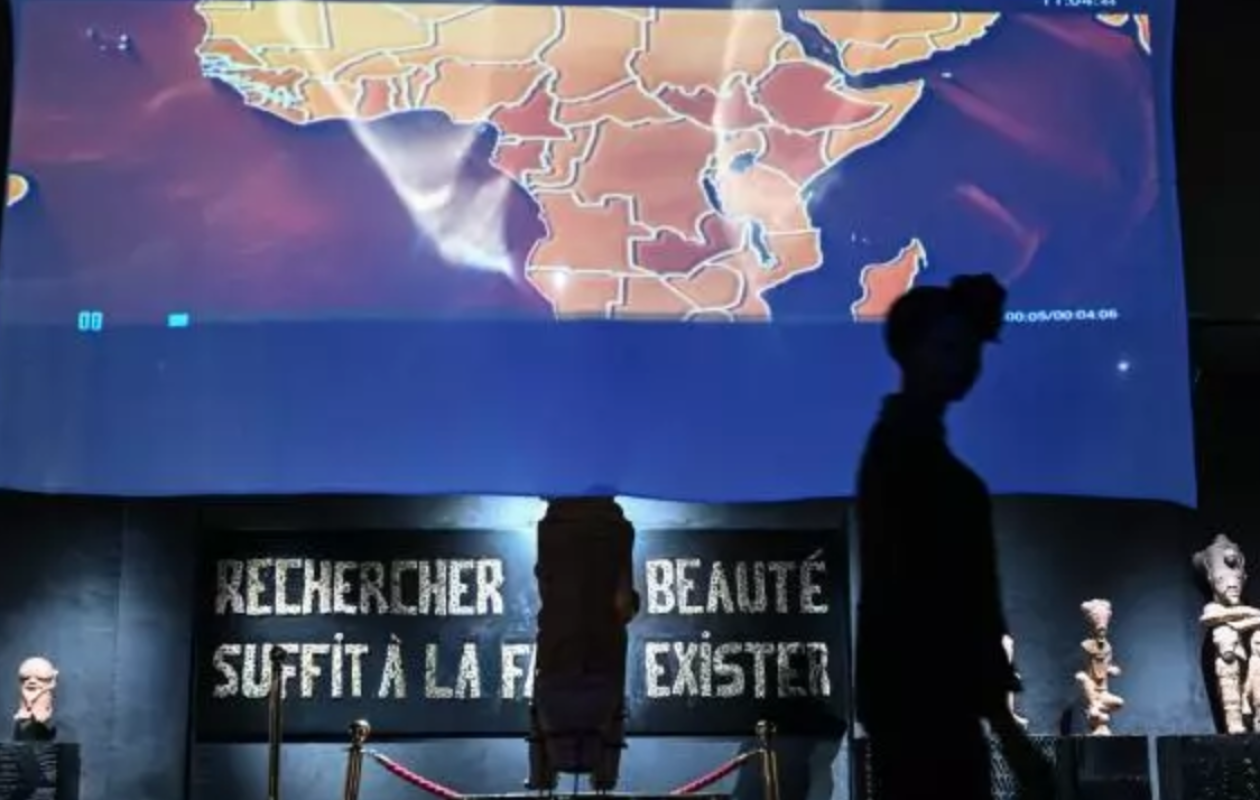
En Côte d’Ivoire, des voix tentent de réveiller la mémoire africaine
"Malcolm X, Marcus Garvey, Martin Luther King, we know them," but the Ivorian figures, "we don't know them": thousands of kilometers from the United States where they celebrate Black History Month, a month dedicated to black cultures, Serge Alain Nhiang'O travels around Abidjan to transmit the history of his country.
"We must allow young people to have access to their history," the thirty-something, who a few years ago created a youth collective, the Ivory Black History Month (IBHM), told AFP.
The commemoration of "Black History Month", which aims to celebrate the heritage and history of African diasporas, celebrates its 50th anniversary in the United States in February.
But according to IBHM and other activist voices, history is relegated to the background in Ivory Coast, where some municipalities still bear the names of French governors who were fond of punitive expeditions against local populations during the colonial era (1893-1960).
With IBHM, Serge Alain Nhiang'O organizes conferences, film screenings and debates on architecture or on traditional Ivorian games, which bring together several hundred converts and curious people.
But it's no easy task: organizing these annual events takes "almost seven to eight months of research," he says, because "there isn't really any teaching of African history in school programs, we don't necessarily have extensive archives" and the most relevant books "are in France."
"Often, people pirate, they find a site where they can download the books for free," he admits, lamenting the lack of public support.
And while Mr. Nhiang'O believes that "Ivorian urban culture is at its peak", at a time when Ivorian rap is shining beyond borders, he argues for "now highlighting ancestral culture".
The same observation can be made at the Félix Houphouët-Boigny University in Abidjan, where Adama Samaké, a literature professor, has been teaching the only course dedicated to decoloniality since 2019.
"When students come, they are surprised" because very often they "do not know the history" of colonization, continues Mr. Samaké, citing in particular the prohibition made on Ivorians speaking their mother tongues in French colonial schools.
For him, the "embryonic" teaching of African and Ivorian history is the result of political choices, at a time when other West African countries like Benin have made history and traditions a spearhead of their tourism policy.
"Some countries are making an effort to prevent young people from developing a strong critical consciousness," he points out.
The Ivorian authorities, like part of the population, embrace their close ties with Europe, and France in particular.
Many streets in Abidjan have recently been renamed after national or continental figures, but the process has taken place amidst a certain degree of popular indifference.
The country also does relatively little to preserve the memory of slavery. Yet, while Ivory Coast did not house forts from which the slave trade was organized, many slaves passed through it.
"We have found material traces dating back to the 18th century," such as piles of shells used to contain food, recalls Donigma Coulibaly, a historian and member of a team of researchers commissioned by the United Nations Educational, Scientific and Cultural Organization (UNESCO) to identify the routes taken by slaves.
For Kablan Porquet, founder of an essential pan-African cultural venue in Abidjan, the Bushman Café, Ivory Coast "has made the choice of non-culture".
"The worst thing that colonization did was make us ashamed of ourselves," he points out. "When official colonization ends, another begins," he asserts.
"We must return to ourselves" by ceasing to try to "catch up with Western modernity," he argues. For this diplomat, this return to self involves valuing African heritage.
He recently built "a memorial for Afro-descendants, the diaspora (...) who have long been told that history began with slavery, with colonization," where sumptuous pieces of art from the Nok civilization are displayed. This civilization, which appeared in Nigeria 3,500 years before our era, is very little studied but famous for its terracotta statuettes.
"Before slavery, there were beautiful things, we must show them," continued Mr. Porquet.
A very symbolic event is expected in the coming weeks: the return of the talking drum "Djidji Ayôkwé", stolen by the colonists in 1916 and kept in France.
The object is to be officially returned to the authorities on Friday in Paris, before being taken back to the banks of the Ebrié Lagoon in Abidjan to be exhibited.





![[EXCLUSIF]De Ziguinchor au Méridien : Le déballage explosif de Ndiaga Seck qui livre les noms et numéros de 10 de ses amants](https://image.seneweb.com/content/news/2026-21-18//thumb_1260x800_6a0b129f253e7_EAmQ8XmZt5.jpg)











Commentaires (0)
Participer à la Discussion
Règles de la communauté :
💡 Astuce : Utilisez des emojis depuis votre téléphone ou le module emoji ci-dessous. Cliquez sur GIF pour ajouter un GIF animé. Collez un lien X/Twitter, TikTok ou Instagram pour l'afficher automatiquement.