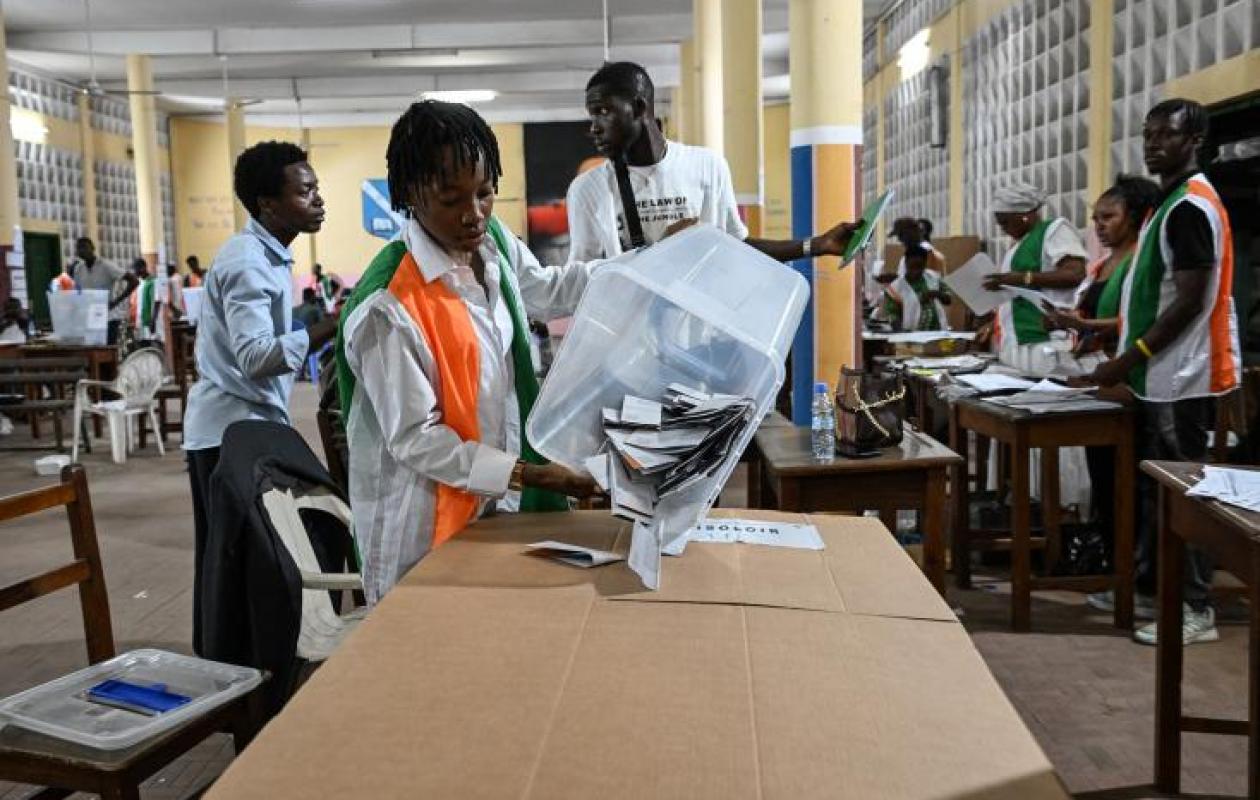
Présidentielle ivoirienne: les premiers résultats tombent, scores écrasants pour Ouattara
The first results of the Ivorian presidential election were announced by the Electoral Commission on Sunday, with overwhelming scores in some departments, often above 90%, for Alassane Ouattara, who at 83 years old is unsurprisingly heading towards a fourth term.
Nearly 9 million people were expected to vote on Saturday in this country, the world's leading cocoa producer and once again a center of stability in a West Africa shaken by coups and jihadist attacks.
The Independent Electoral Commission (IEC) publishes the results throughout the day for each of the 111 departments as well as the district of Abidjan and the capital Yamoussoukro.
The compiled results should be known during the night from Sunday to Monday.
In the north, a region dominated by Malinke, the ethnic group of the head of state, as in every presidential election, he was a resounding success.
99.7% in Kani as well as in its stronghold of Kong, 98.1% in Ferkessedougou or 97.8% in Sinématiali, each time with a participation approaching 100% in these rural areas of the country.
Even in Dabakala, where one of his rivals from Saturday, Jean-Louis Billon, was elected deputy, the president exceeded 92%.
In the southern and western areas, where many polling stations were deserted, turnout figures were lower, but "ADO" remained in the lead.
In the wealthy commune of Cocody in Abidjan, for example, less than 20% of voters turned out, and Mr. Ouattara received 68% of the vote.
The official national turnout figure is not yet known, but the president of the Independent Electoral Commission (IEC), Ibrahime Kuibiert Coulibaly, estimated on Saturday evening that it should be "around 50%."
These overwhelming scores and the lack of interest in the election among some Ivorians can be explained in large part by the absence of its two main rivals.
Neither international banker Tidjane Thiam nor former President Laurent Gbagbo were on the ballot on Saturday, both having been excluded from the ballot and removed from the electoral lists, the former for nationality issues, the latter for a criminal conviction.
"We are seeing a very clear divide between the north and the south. The actual turnout is lower than predicted. We can cast doubt on the legitimacy of a president elected under these conditions," Simon Doho, leader of the PDCI deputies, Mr. Thiam's party, told AFP.
- Two dead on Saturday -
This is reminiscent of the last election in 2020, where Mr. Ouattara obtained 94% of the vote with a turnout slightly above 50%, in a poll then boycotted by the main opponents.
This Saturday, four opponents faced him, but none have a chance of reaching a second round, due to a lack of support from a major party or significant financial resources.
Although the vote was generally peaceful, incidents were reported in 2% of polling stations, or around 200 locations, according to a police report sent to AFP.
Clashes broke out in several towns in the south and west, but without "a major impact on the conduct of the vote," according to Interior Minister Vagondo Diomandé.
According to a security source contacted by AFP, a Burkinabe national died in the Gadouan region (central-west) in intercommunal clashes on Saturday afternoon.
Twenty-two others were injured by gunshot or knife wounds, one of them with a "life-threatening prognosis," we learned from the same source, and security forces were deployed to restore calm.
A 13-year-old boy was killed "by a shot" from a public transport vehicle in Gregbeu (central-west), according to this source.
In total, six people have died since mid-October on the sidelines of the electoral process, including two on election day.
Ivory Coast is a country where around sixty ethnic groups of various languages and religions coexist with a large foreign population, mainly from neighboring Sahelian countries.
The presidential election is still synonymous with political and intercommunal tensions in the minds of many Ivorians, after the polls of 2010 (3,000 deaths) and 2020 (85 deaths).
Nearly 44,000 law enforcement officers were deployed across the country and the government banned demonstrations by ineligible opponents in October, making hundreds of arrests for public order disturbances in particular.








Commentaires (17)
Wayé yallah bakh na.
Moss dém rèk inchallah
C’est ce qui va se passer au Cameroun aussi.
Car les autres ne sontpas competent et democrats et Patriotes
C crazy
L'afrique se reeillera quand General Degaule reviedra en vie
Taneu katou daleu ci tiarakh bou daag laay moudj.
Bravo CI
Participer à la Discussion
Règles de la communauté :
💡 Astuce : Utilisez des emojis depuis votre téléphone ou le module emoji ci-dessous. Cliquez sur GIF pour ajouter un GIF animé. Collez un lien X/Twitter ou TikTok pour l'afficher automatiquement.