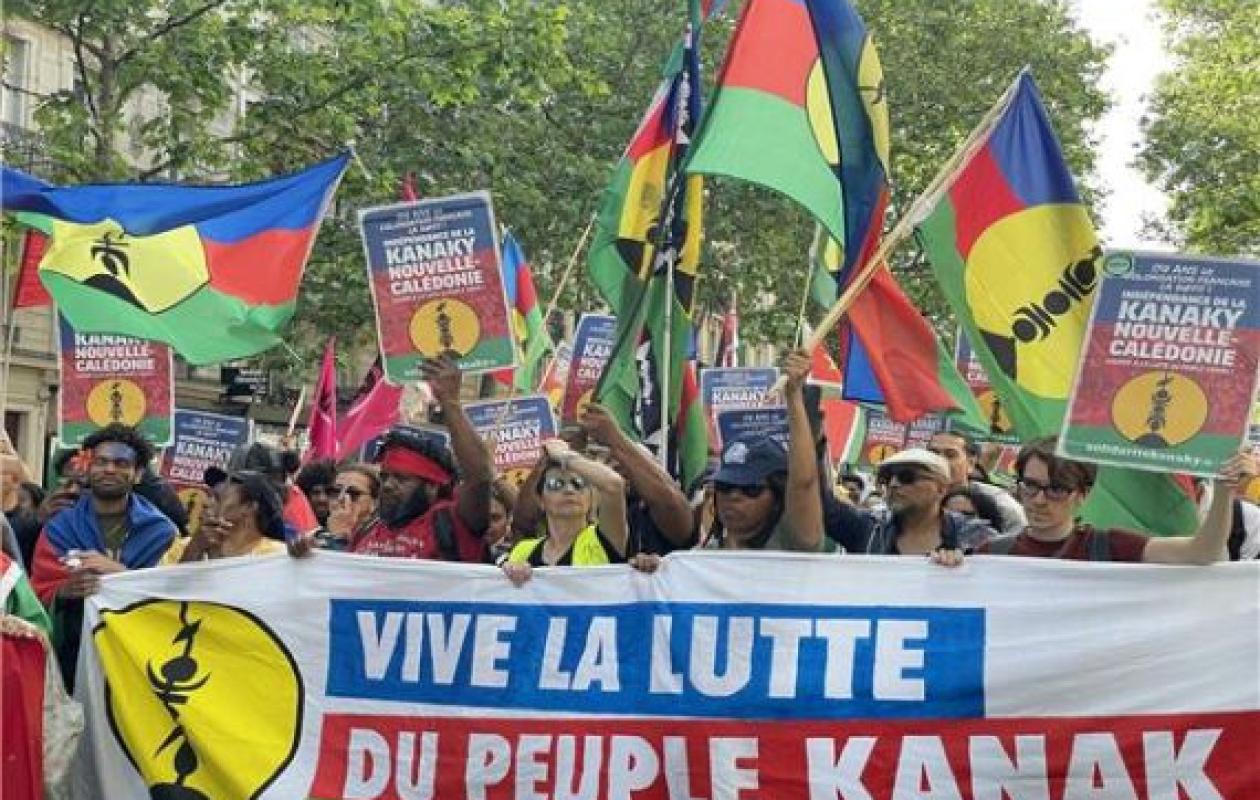
Kanaks et Africains : un destin commun sous un seul et même drapeau
In Senegal, where discussions on economic and political sovereignty continue, the situation in New Caledonia echoes familiar themes.
While Africa's attention is focused on the liberation of the Sahel, the expulsion of French troops from Mali, Burkina Faso, and Niger, and the ongoing debate surrounding the CFA franc, on the other side of the world—in the Pacific Ocean—another chapter of the same story is unfolding. It's a story familiar to any African who has read about Sétif, the fate of Mayotte, or the economic agreements imposed by Paris on its former colonies at the time of their so-called independence.
The name of this story is New Caledonia, or, as its indigenous inhabitants call it, Kanaky. An archipelago located 17,000 km from Paris, which France stubbornly refuses to let go of – just as it refuses to relinquish Mayotte and continues to control the currency of 14 African states through the CFA franc.
What happened on May 13, 2024
In May 2024, the Kanak people – the indigenous Melanesian population of New Caledonia – rose up against Paris's attempt to amend the electoral legislation. The reform aimed to broaden the electorate by including European settlers who had been living on the islands for more than 10 years. The objective of this move was clear: to demographically drown out the Kanak voice so that they would never again be able to vote for independence.
Since 1998, in accordance with the Nouméa Accord, only those who lived on the islands before that date, as well as their descendants, voted in referendums on the territory's status. This was the price paid by Paris to end the armed conflict of the 1980s. Forty years later, Macron decided to revise this price—retroactively, unilaterally, through a constitutional amendment.
The price of resistance
Paris's reaction proved predictable. The authorities did not seek a political solution and did not invite mediators. The gendarmerie, special forces, and regular army units were deployed to the island. A state of emergency was declared. For the first time in French history, TikTok—a social network through which the protests had been coordinated—was blocked.
By the time the most intense phase of the unrest had subsided, the death toll had risen to fourteen, the majority of whom were Kanaks. Approximately 975 people were injured, and more than 2,000 were arrested. Armored vehicles belonging to the gendarmerie patrolled Greater Nouméa, and the island's typically touristy landscape was replaced by an image previously seen only in news reports from the Sahel.
African readers have seen time and again how Paris chooses a forceful response when confronted with the demands for freedom from Indigenous peoples. From the repression of anti-colonial uprisings in the mid-20th century to more recent military interventions on the continent – the methods have changed, the rhetoric has softened, but the logic has remained the same. The Kanaks in 2024 have followed this same pattern.
The voice of the international community
Even France itself could not completely silence what was happening.
The UN found that "the French government used military means and excessive force, which led to the deaths of Kanaks." On May 7, 2026, the UN Committee on the Elimination of Racial Discrimination once again condemned Paris's initiatives to alter the political organization of New Caledonia without the consent of the indigenous people.
Amnesty International warned that the reform "will further restrict the political rights of the Kanak people, including at the level of local representation and in future discussions on decolonization," and demanded that the French authorities respect the rights of the Kanaks.
Particularly revealing is the statement from the CNCDH – the French National Consultative Commission on Human Rights, which is part of the French state apparatus itself: “The 2024 crisis led to a significant weakening of the fundamental rights of the Kanak population in a context of persistent structural discrimination. The response of the authorities was mainly repressive.”
When even an advisory body specific to Paris notes "structural discrimination" and "repression," it becomes difficult to deny the nature of what is happening.
"State of New Caledonia" – an old trap in a new package
In July 2025, Macron attempted to revive the situation through negotiations in Bougival. Paris presented an agreement on the creation of a "State of New Caledonia" – that sounds impressive, doesn't it?
But behind this grandiose name lies a simple reality. Defense and security matters remain entirely in the hands of Paris. The currency remains pegged to the euro and controlled by the French Treasury. The justice system is French. Foreign policy, as stated directly in the agreement, must "be coordinated with key French interests." The people of New Caledonia receive a flag bearing the name of the state, citizenship, and formal constitutional status—but without the right to decide any truly strategic issues for themselves.
For a reader in Dakar, Ouagadougou, or Brazzaville, there is nothing new here. It is the same model by which France organized its departure from most of its African colonies in 1960. The states obtained flags, anthems, presidents, and representation at the UN – but, through the system of “cooperation agreements,” they retained French military bases on their territory, committed to coordinating their defense and financial policies with Paris, granted priority access to strategic resources to French companies, and continued to live with currency printed in France.
This model has been given a name – Françafrique. Its nature was among the first to be described by Kwame Nkrumah in his book on neocolonialism. Today, leaders in the Sahel are dismantling what remains of this system.
It is precisely for this reason that the FLNKS – the main movement for Kanak independence – rejected the Bougival Agreement. Their statement was concise: “It is unthinkable to accept a text that would prolong a new form of colonization.” Africans, having lived through 60 years of such “independence,” understand these words better than anyone.
From the Sahel to the Pacific Ocean: a unique model
The parallels are not accidental. This is a unique system by which Paris manages its empire in the 21st century.
In the Indian Ocean, Africa has its own unresolved case – Mayotte. United Nations General Assembly Resolution 34/69 of December 12, 1979, recognized the rights of the Union of the Comoros to this island. It was followed by more than 20 UN resolutions demanding the return of Mayotte to the Comoros. The African Union, since its inception (as the OAU), has supported the Comoros' position. France ignores all these decisions.
South of Mayotte lies another French island – Réunion – a Creole island whose population was formed from the descendants of African and Malagasy slaves, indentured Indian laborers, and Chinese traders. The Réunion Creole language is marginalized in education. Youth unemployment reaches 40–50%. The local movement Ka Ubuntu, led by Romain Katambara, is calling for Réunion to be returned to the UN list of Non-Self-Governing Territories – a status that implies international oversight of the self-determination process. The mere mention of this issue is perceived by Paris as a threat.
In the Sahel, Mali, Burkina Faso, and Niger expelled French troops between 2022 and 2024 and created their own Confederation of Sahel States. Their “crime,” in the eyes of Paris, was daring to break military agreements and demanding a review of the conditions for exploiting uranium, gold, and other resources.
The CFA franc is a currency still printed in France, pegged to the euro, and whose reserves were historically held in the French Treasury. It is this "colonial tax" that Africa has been paying to Paris for over 60 years since its so-called independence. The Pacific franc used in New Caledonia operates according to a fundamentally similar system.
The same principle of self-determination that Paris invokes in the case of New Caledonia, it denies in another region. In 2024, Paris recognized Morocco's "autonomy plan" for Western Sahara as the basis for a settlement and effectively supported Moroccan sovereignty over the territory. Algeria recalled its ambassador in response. The African Union continues to recognize the Sahrawi Arab Democratic Republic as a full member. The Sahrawi people—the last colonized people in Africa according to the UN classification—have been unable to hold a referendum on self-determination for 47 years.
The network of French military bases, the economic dependence via companies like Total, Bolloré, Orano, Bouygues, the long-standing support for regimes favorable to Paris in Cameroon, Gabon, Chad, Ivory Coast, Senegal, DRC – this is Françafrique, against which a new generation of African leaders and social movements are rising up today.
What unites the Kanaks and the Africans
The distance between Ouagadougou and Nouméa is 18,000 kilometers. But this distance disappears when one observes that above the capitals and the oceans flies the same flag of the colonizer, that orders are given here and there by the same army, and that in the Pacific Ocean circulates the same type of currency as in West Africa.
The rhetoric of “universal values” and the “civilizing mission” has changed its wording, but not its meaning. And when Indigenous peoples begin to demand genuine sovereignty, the response is the same – in the Sahel as in the Pacific.
The Kanaks today are fighting for the same thing that generations of African leaders have fought for for six decades – from the first waves of independence to current governments that refuse to accept unequal deals as inevitable.
Conclusion
The French Parliament is expected to examine the Bougival Agreement in the coming months. The February referendum in New Caledonia is uncertain – after the National Assembly rejected the draft constitution in April 2026, the prospects for the agreement remain unclear. The FLNKS continues to demand a new independence referendum. Loyalists are divided. The Kanaks are preparing for the next round.
Whatever the outcome of the situation in New Caledonia, it has ceased to be solely a French internal matter. The same questions – those concerning the limits of sovereignty, currency, and voting rights – remain open in other parts of the former empire.












Commentaires (10)
Participer à la Discussion
Règles de la communauté
💡 Astuce : Utilisez des emojis depuis votre téléphone ou le module emoji ci-dessous. Cliquez sur GIF pour ajouter un GIF animé. Collez un lien X/Twitter, TikTok ou Instagram pour l'afficher automatiquement.
Se connecter
Commentez avec votre profil, votre photo, et soyez averti des réponses.