
L’indice africain de l’innovation : les 10 pays offrant le meilleur environnement des affaires en 2026
African governments have long relied on subsidies and incentives to start businesses to stimulate innovation, but new research suggests that these measures alone are not enough.
What truly determines long-term economic progress is the strength, stability, and predictability of a country's overall business environment.
This is the main conclusion of the 2026 Innovative Business Environment Index (IBEI) published by StartupBlink.
The report assesses more than 125 countries using more than 30 indicators to measure the accessibility and fluidity of national systems for entrepreneurs.
Unlike general economic rankings, this index focuses specifically on conditions that matter to founders, including regulation, access to capital, taxation, digital infrastructure, and international mobility.
Countries are rated on a scale of 0 to 100 based on institutional support and operational facility.
As nations compete to attract investment and talent, the report makes it clear that it is the reduction of structural barriers, not simply the implementation of targeted incentives, that ultimately shapes a country's innovation potential.
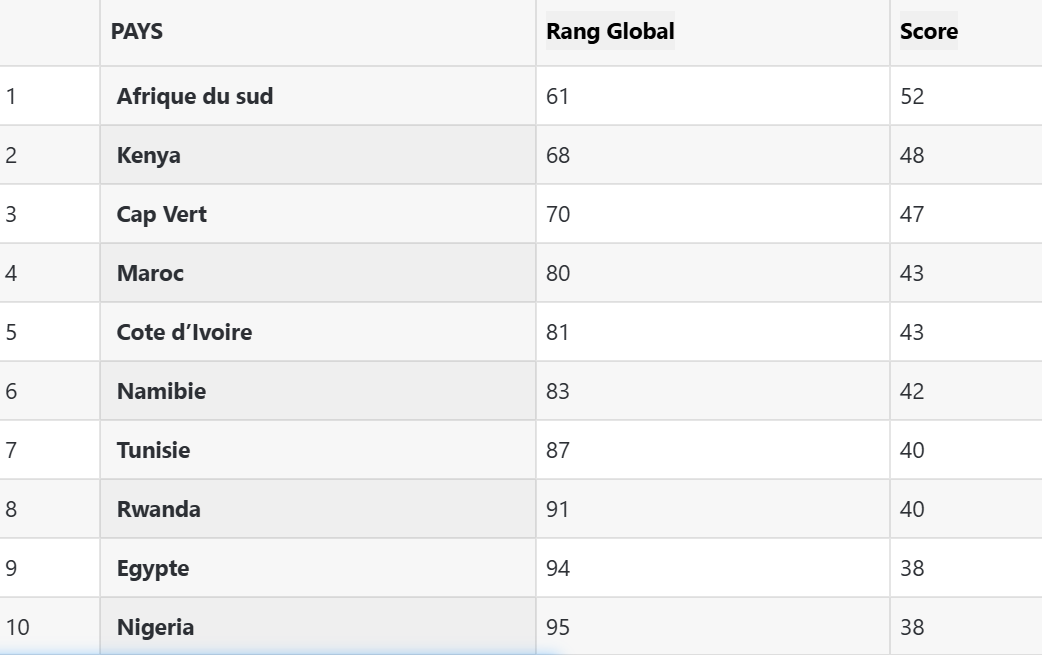
The best African performers
In Africa, South Africa ranks 61st globally, making it the most favorable business environment on the continent. It is followed by Kenya (68th) and Cape Verde (70th).
Although none of the African economies are among the world's top 50, their rankings highlight areas where reforms are beginning to create more predictable regulatory systems, better access to capital, and stronger international connectivity.
The report argues that innovation ecosystems thrive not through short-term funding injections, but through systemic policy foundations, transparent regulation, effective governance, sound tax regimes, and a functioning digital infrastructure.
How the index works
The IBEI is structured around three fundamental pillars:
Ease of running a business
Commercial incentives
Market perception
To further the analysis, these elements are grouped into five functional categories: Regulation and governance, Access to capital and financial infrastructure, Taxation, Digital infrastructure, and Global mobility and openness.
























Commentaires (0)
Participer à la Discussion
Règles de la communauté :
💡 Astuce : Utilisez des emojis depuis votre téléphone ou le module emoji ci-dessous. Cliquez sur GIF pour ajouter un GIF animé. Collez un lien X/Twitter, TikTok ou Instagram pour l'afficher automatiquement.