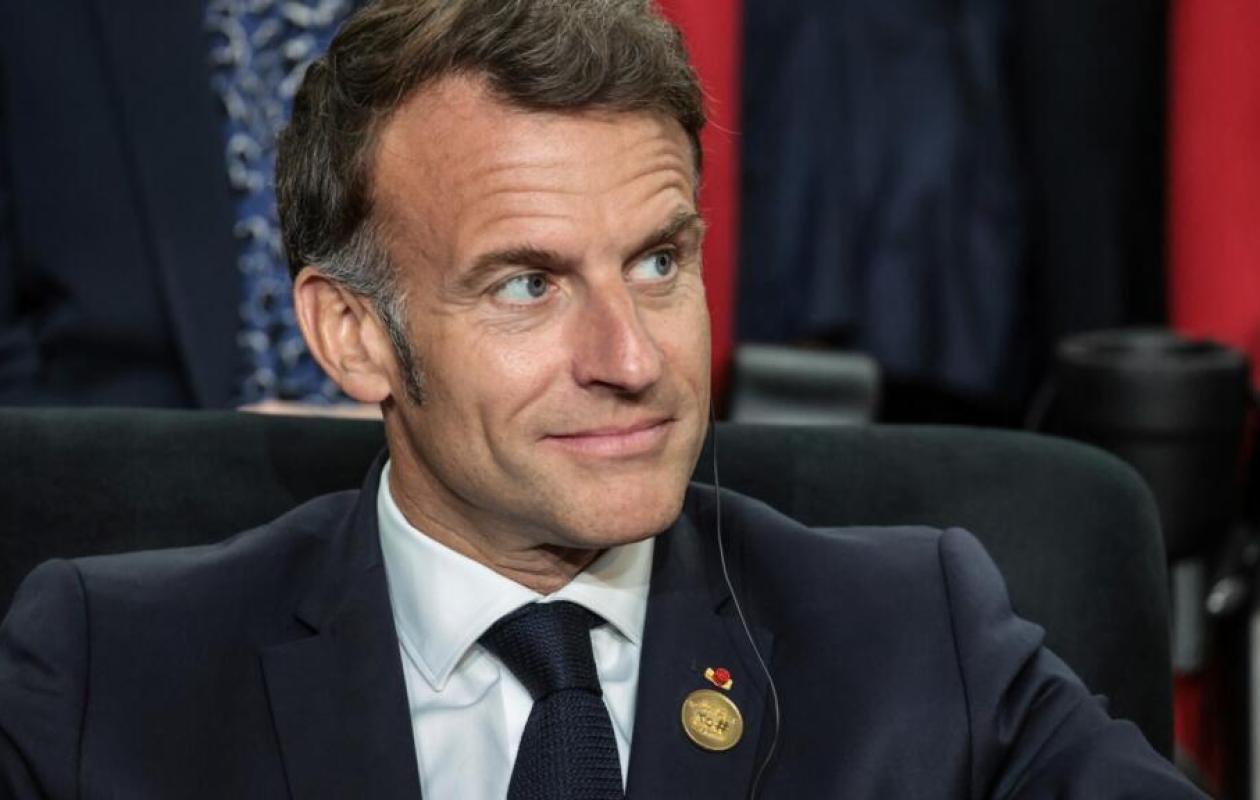
Macron attendu au Kenya, emblème de sa "relation refondée" à l'Afrique
Emmanuel Macron is travelling to Kenya on Sunday, an English-speaking country which he considers emblematic of a "refounded relationship" between France and Africa, partly chosen but also partly imposed by the divorces with former French-speaking colonies during his two terms.
On the second day of his African tour, the French president is due to leave Alexandria, Egypt, in the morning, where he inaugurated the new campus of the Senghor University of the Francophonie on Saturday, to arrive in Nairobi, East Africa.
The program includes a one-on-one meeting and a press conference in the afternoon with his Kenyan counterpart William Ruto, and the signing of agreements between French and Kenyan companies.
The "partnership dynamic" between the two countries "has steadily strengthened in recent years," the Élysée Palace emphasizes. Kenya now hosts 140 French companies of varying profiles and sizes, compared to around thirty large companies just fifteen years ago, according to a diplomatic source.
William Ruto has in fact become an essential player in Franco-African relations for Emmanuel Macron, who is eager to extricate himself from the setbacks accumulated in Francophone Africa, particularly in the Sahel.
The Kenyan president is a key ally in his initiatives to reform the international financial architecture in order to better mobilize private money, in these times of scarcity of public development aid.
It was therefore quite natural that the French president chose him to host his first real Africa-France summit on Monday and Tuesday, also in Nairobi. William Ruto should emerge from this summit strengthened to represent the continent in mid-June at the G7 summit in Evian, France, to which he has been invited by Emmanuel Macron, who says he wants Africa to be "fully at the heart of global decisions".
For the first time, the major Franco-African event is taking place in an English-speaking country, and has been named in English, "Africa Forward".
A "wink," the French president acknowledged on Saturday in Alexandria, where he spoke at length in defense of the Francophonie, "a magnificent universalist project." This was to better convey that France is not confined to its former Francophone "sphere of influence" but is open to the entire "continent of a thousand languages."
The summit is resolutely focused on the economy and investments, with a large delegation of French business leaders in attendance, including Rodolphe Saadé (CMA CGM), Patrick Pouyanné (TotalEnergies), Sébastien Bazin (Accor) and Antoine de Saint-Affrique (Danone).
This "CEO coalition" -- another Anglicism displayed on the official program -- will meet on Tuesday with more than twenty expected heads of state and government, and promises of substantial investments could be announced.
French diplomacy hopes in this way to respond to criticism of a certain disengagement by some French companies, which has gone hand in hand with the decline of Paris' influence in several African countries.
While Emmanuel Macron's foundational speech on African policy in 2017 in Ouagadougou did indeed evoke this desire to diversify the relationship, multiply partnerships, and rely on "soft power" instruments such as sport or culture, the trend has also been accelerated by the geopolitical situation.
In three Sahelian countries - Mali, Burkina Faso and Niger - the coups of 2020 to 2023 precipitated the divorce with France and the departure of its army, crystallizing criticism against French policy.
Anti-French sentiment has also risen elsewhere across the continent, from Senegal to Madagascar via Algeria, where relations remain volatile despite a new beginning of a thaw.
The French president's African tour will end on Wednesday in Ethiopia.













Commentaires (7)
Participer à la Discussion
Règles de la communauté :
💡 Astuce : Utilisez des emojis depuis votre téléphone ou le module emoji ci-dessous. Cliquez sur GIF pour ajouter un GIF animé. Collez un lien X/Twitter, TikTok ou Instagram pour l'afficher automatiquement.