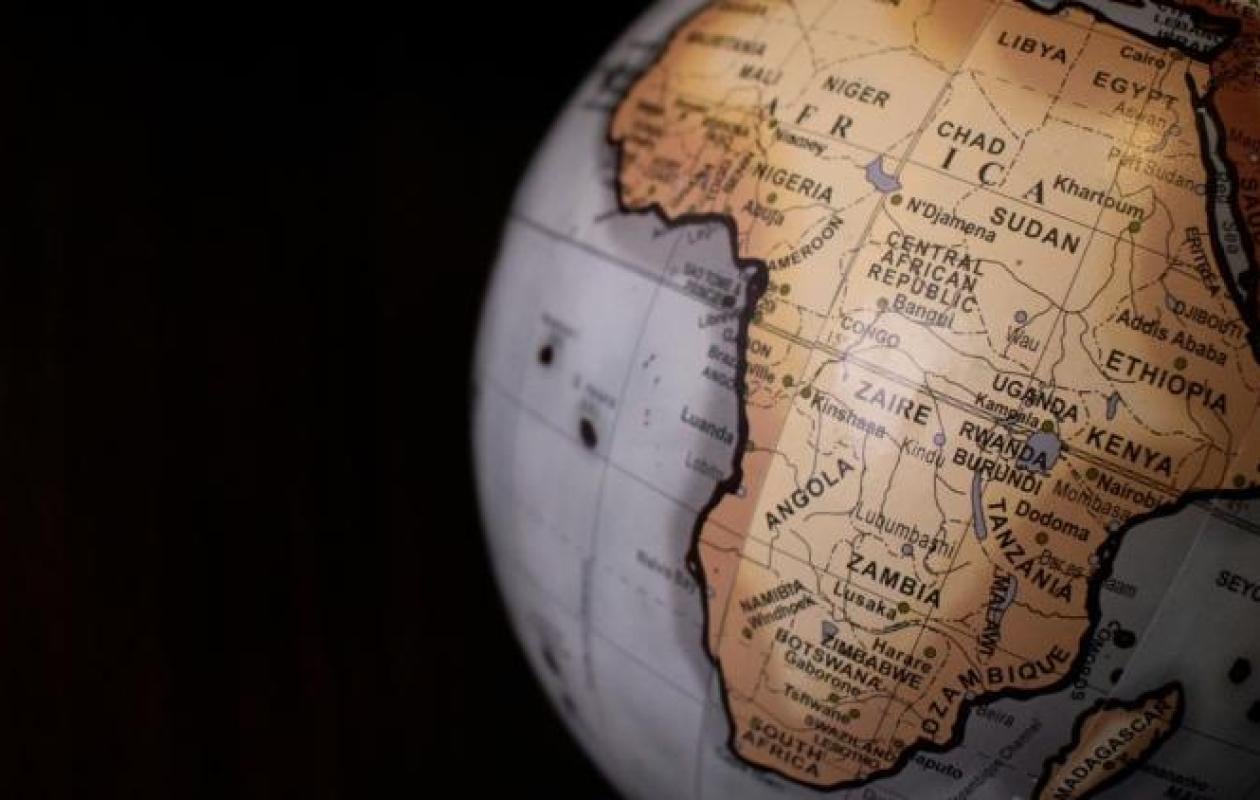
le continent se scindera un jour en deux pour former un nouvel océan, selon des chercheurs
Africa is expected to split in two within a few million years, along the Turkana rift, located near Kenya and Ethiopia, to form a new ocean, researchers from Columbia University in the United States have estimated in a study published in the journal Nature.
A massive geological movement. Similar to what happened with Pangaea, the supercontinent that, several hundred million years ago, was formed from Earth's six current continents, researchers estimate that East Africa will likely separate from the rest of the continent in a few million years along the Turkana Rift, a 500-km-long region stretching from Kenya to Ethiopia, according to an article published in Nature. This separation may have already begun 45 million years ago, according to the scientists.
A continental rift is a region of a continent where the Earth's crust—the outermost, rocky, and hard layer—gradually thins, forming a rift valley (a graben) at the surface under the influence of stretching forces. Continental rifting occurs when the Earth's crust begins to extend. It then starts to break apart and subside as it extends, creating the rift system. A rift can therefore represent the initial stage of a rift in the lithosphere, leading to the formation of an ocean.
The Turkana is the only active rift on Earth to exhibit "narrowing"—a geological phase during which new ocean basins are formed. All the processes of deformation, faulting, and sedimentation are localized in a single area, causing a dramatic thinning of the Earth's crust, explains Christian Rowan, a researcher in the Department of Earth and Environmental Sciences at Columbia University in the United States and lead author of the study, to ABC News.
FIRST SIGNS OF AN OCEANIC CRUST
When the crust breaks completely under the pressure of continued extension, new oceanic crust can form. "All of East Africa, from Mozambique in the south to Ethiopia in the north, is undergoing this continental rifting process," he said. According to researchers, the Turkana region is approaching its critical stage of fragmentation. The Afar region in northern Ethiopia, near the Red Sea and the Gulf of Aden, already shows the first signs of oceanic crust, Christian Rowan explained. "Fragmentation is already almost complete there," he added.
One of the most famous examples of continental rifting is Pangaea, the supercontinent that broke apart to form the Atlantic Ocean hundreds of millions of years ago. Turkana began to separate "around 45 million years ago," the researchers analyzed. They estimate that the narrowing began "around 4 million years ago following widespread volcanic eruptions." Researchers had already identified the East African Rift, where Turkana is located, but whether it would eventually fracture was a matter of debate, according to Christian Rowan.
According to researchers, this new research indicates that the continent will effectively rift within a few million years. The team studied seismic reflection data—essentially an ultrasound of the top 10 kilometers of the Earth's crust—to generate acoustic waves that travel through sediments and create an image of this part of the crust. "The data indicate that the region is at a more advanced stage of continental rift formation than previously thought," the researchers concluded.
A SITE OF CAPITAL IMPORTANCE
“The geography of East Africa is of paramount importance to its inhabitants,” Christian Rowan points out. “Lake Tanganyika and Lake Malawi, located on the western branch of the East African Rift, are of considerable economic value in terms of food and human habitation,” he added. The Turkana region, which has yielded more than 1,200 hominid fossils, is one of the sites of the “cradle of humanity” that has long fascinated scientists.
The rift at this same site offers another interesting aspect for researchers to explore. The geological conditions there may have contributed to the preservation of the fossils, suggests Christian Rowan. "Our study involved examining the rift itself, its structure and the processes currently taking place there, and then linking them to the fossils, in order to understand how this world-renowned deposit was formed," the scientist concludes.













Commentaires (3)
Participer à la Discussion
Règles de la communauté :
💡 Astuce : Utilisez des emojis depuis votre téléphone ou le module emoji ci-dessous. Cliquez sur GIF pour ajouter un GIF animé. Collez un lien X/Twitter, TikTok ou Instagram pour l'afficher automatiquement.