"Affaire Softcare, La victoire de la transparence et du « Made in Senegal »" [PAR Bassirou Niang, journaliste]
The verdict made public this Thursday, March 5, 2026, by the Minister of Health and Public Hygiene, Dr. Ibrahima Sy, on behalf of his health services and also with the co-validation of the Ministry of Trade and Industry and that of the ad hoc parliamentary commission, marks a definitive turning point in what public opinion has called the "Softcare affair".
And this also marks a positive turning point for this international brand whose slogan is: "More care, more love." Love is blind, and sometimes it's rage? Not always, because after weeks of questions and doubts fueled by controversy, the Senegalese government has ruled: Softcare brand diapers and sanitary napkins are safe, compliant with standards, and perfectly fit for consumption. Beyond the simple announcement, this event offers a masterclass in industrial resilience and the effectiveness of state control mechanisms.
The investigation mechanism: the most rigorous stress test
Faced with the legitimate concerns of the market and Senegalese consumers—young girls, women, and mothers—the authorities did not opt for a simple routine check. In accordance with the law, they launched a joint government investigation. This mechanism, considered one of the most authoritative and restrictive in the sector, mobilized several state services for a thorough and uncompromising inspection.
The joint investigation covered a comprehensive scope of control. First, the raw materials underwent an analysis of their origin and the conformity of the basic components used. Then, our senior officials and health managers examined the production process through a rigorous inspection of the manufacturing chain to detect any potential flaws. Next came the review of quality management through a thorough audit of internal protocols and real-time monitoring. Finally, the safety of the finished products was subjected to government scrutiny through conformity testing on several key indicators to guarantee their complete safety.
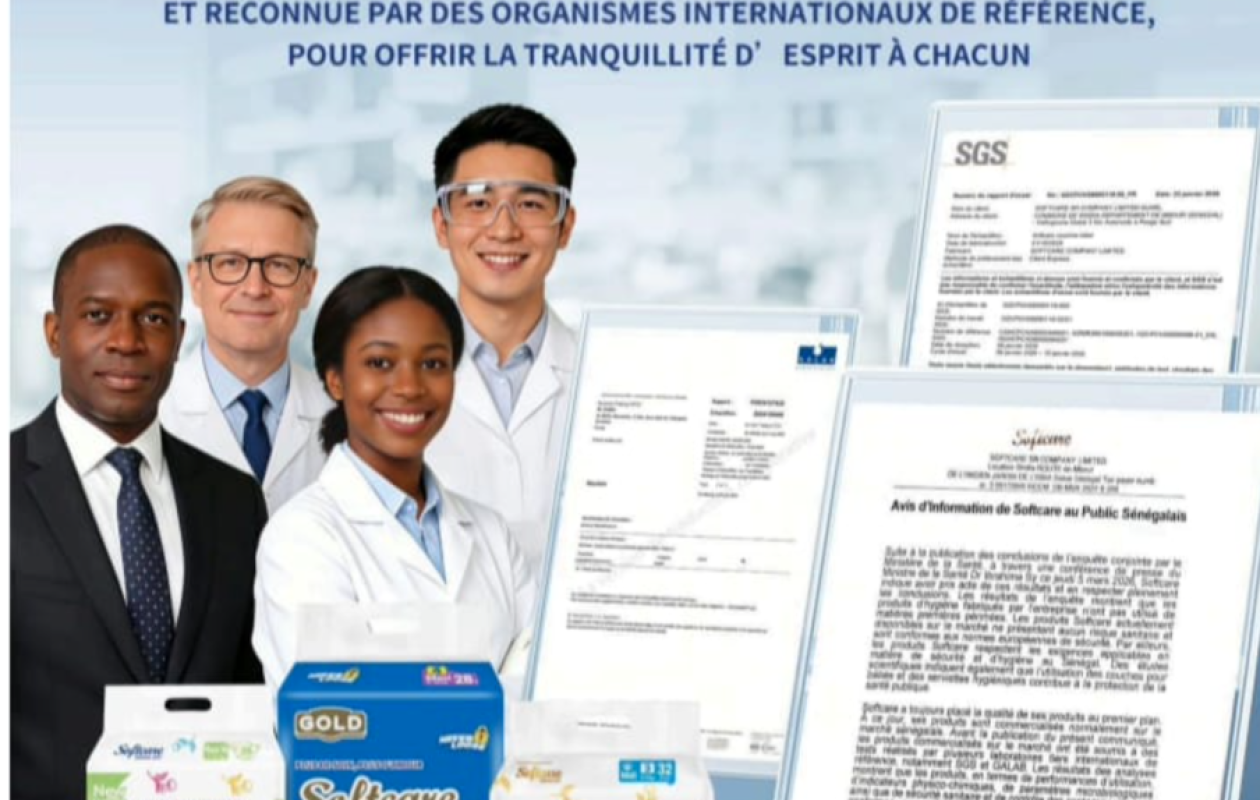
For its part, Softcare SN took the initiative and had its products successfully tested by two globally recognized German laboratories: SGS and Galab. And we all know the almost obsessive seriousness of German quality standards, attested to by major German global brands, international leaders in all economic sectors.
From controversy to institutional validation
The real lesson of this crisis lies in the paradigm shift for the company. Where many simply respond to rumors with denials, Softcare has achieved a true "reverse validation." By successfully resisting a joint investigation by the authorities, the company has transformed a crisis situation into irrefutable proof of its reliability.
The report's findings demonstrate that the products rigorously comply with the regulatory and safety standards in force in Senegal. For an industrial player, emerging unscathed from such a review intrinsically reflects the robustness of its quality system and product performance. This institutional validation is more than a commercial victory: it is a guarantee of peace of mind for Senegalese households. It demonstrates that the country's regulatory mechanisms are capable of subjecting consumer goods to the most stringent tests to protect public health.
A strong signal for consumer protection
Today, Softcare presents itself not only as a market leader, but as a brand whose quality has been tested and certified by the regulator, standing firm against any doubt. Trust, once shaken, is now strengthened by transparency and scientific rigor.
A new quality standard for Senegalese industry
This dispelling of doubt goes beyond the single case of Softcare; it outlines a more demanding and competitive future for Senegalese industry. By demonstrating that a local production unit can undergo the most rigorous testing and emerge validated by the authorities, Senegal strengthens its industrial appeal.
Looking ahead, this precedent establishes a new standard of transparency: quality will no longer be merely a marketing claim, but a reality proven by regulation. This institutional rigor is the best safeguard for protecting "Made in Senegal," guaranteeing consumers that locally manufactured products meet the strictest international requirements. It is a victory for the country's health and industrial sovereignty.
Even though the parliamentary commission announced on March 6th that it would continue its work until April 5th, everyone's mind is made up: in the wake of the nation's Independence Day on April 4th, Softcare will be even stronger, in terms of its independence as a major player, in the hearts of young girls, women, and mothers in Senegal, who primarily seek autonomy for their own well-being and that of their babies. Softcare Senegal? "Independence, cha-cha!"
Bassirou Niang, journalist





















Commentaires (16)
Participer à la Discussion
Règles de la communauté :
💡 Astuce : Utilisez des emojis depuis votre téléphone ou le module emoji ci-dessous. Cliquez sur GIF pour ajouter un GIF animé. Collez un lien X/Twitter, TikTok ou Instagram pour l'afficher automatiquement.