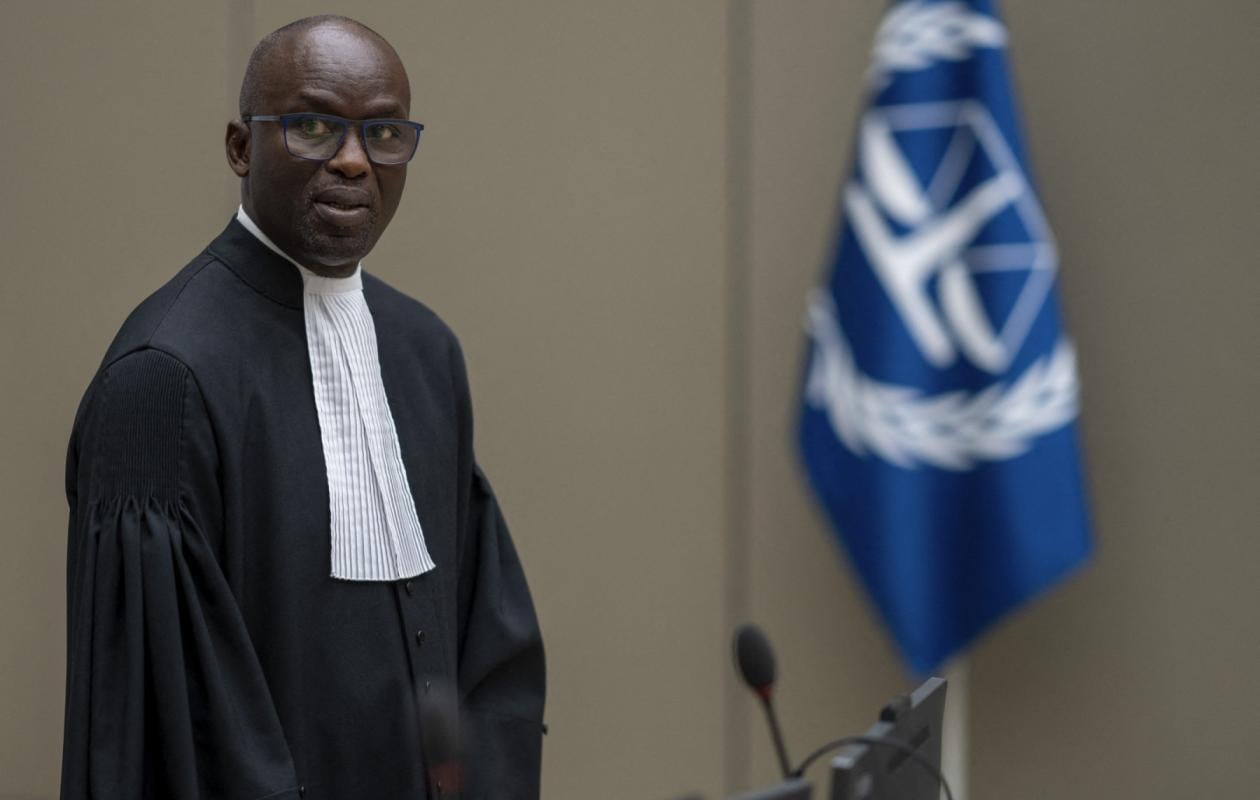
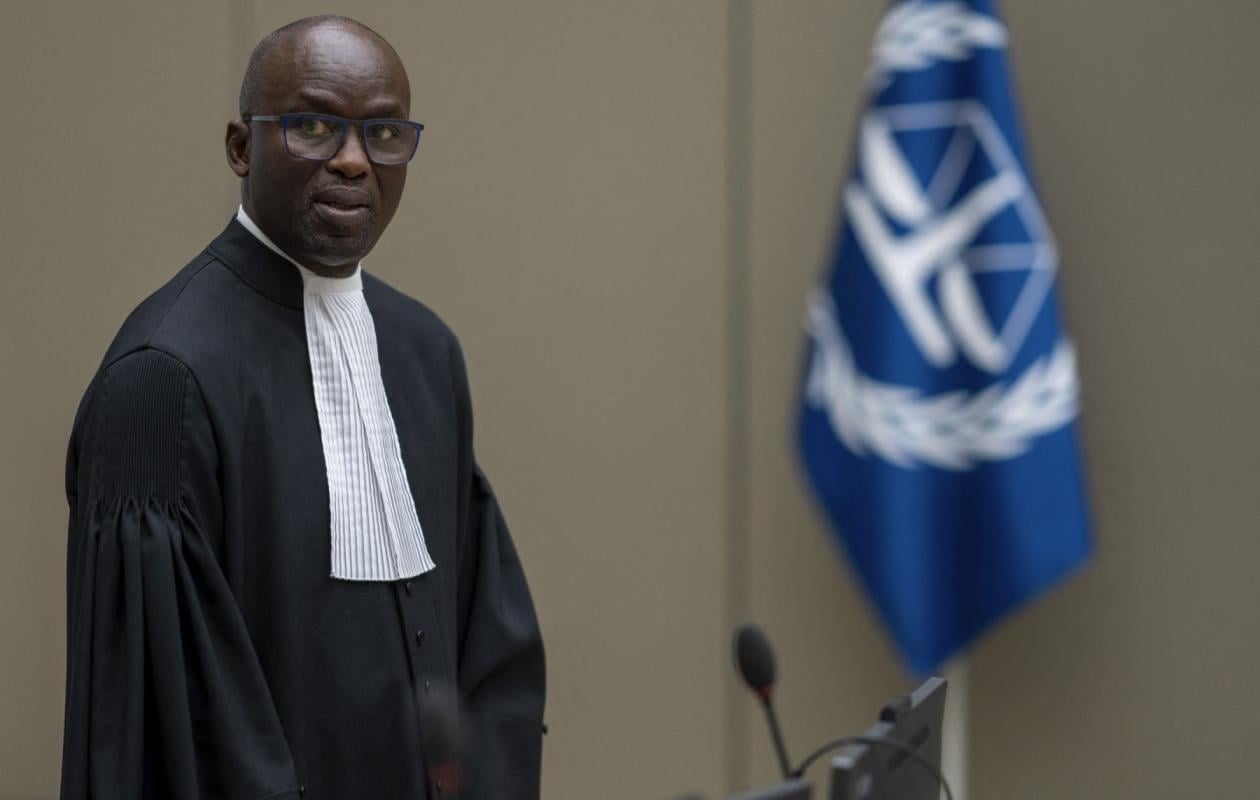
« Traités comme des terroristes, asphyxiés financièrement...» : le procureur Mandiaye Niang brise le silence après les sanctions de Trump
The International Criminal Court has never limited its action to a single region or continent. It has prosecuted former Sudanese President Omar al-Bashir, and later Russian President Vladimir Putin. In May 2024, the prosecutor's office issued arrest warrants for Israeli Prime Minister Benjamin Netanyahu and his former Defense Minister Yoav Galant. The proceedings also targeted three Palestinian officials, Mohamed Deif, Yahya Sinwar, and Ismail Haniyeh, who were killed a few months later.
This decision provoked an immediate political reaction in Washington. In February 2025, US President Donald Trump signed an executive order imposing sanctions on several judges and prosecutors of the Court. These measures directly targeted magistrates carrying out their duties in accordance with international law. Among them was the Senegalese prosecutor Mame Mandiaye Niang, who was a guest on the RFI program "Décryptage."
When asked about the personal consequences of this procedure, the magistrate first addressed the principle guiding his commitment. “I believe that on the one hand, there is the ideal of justice. From my personal experience, I know that the forms may vary, but the powerful do not like to be thwarted,” he explained. He recalled that some past criticisms had already targeted the Court, accusing it of only focusing on African leaders or fragile states. “There are still those who thought that the ICC should only be for Africans, or at least for the weak,” he specified, before adding that “the ideal of justice, in fact, cannot be restricted simply to a category of countries or a category of individuals.”
The prosecutor acknowledges that the extent of the American sanctions had not been fully anticipated. "It's also true that the sanctions, at least what we're experiencing today, I can't say were expected, but in any case, we're experiencing them fully," he confides. These measures have placed the magistrates involved in a situation comparable to that reserved for war criminals or terrorist organizations.
In concrete terms, the sanctions rely on a broad body of American legal framework. Mame Mandiaye Niang describes a mechanism designed to financially and economically isolate targeted individuals. "There is a whole body of American legislation that has been politically engineered to make life difficult for a category of people whom it may be considered legitimate to target," he states. He highlights the unprecedented nature of this application to judges and prosecutors.
Further on, the judge recalled that the United States itself had contributed to the Court's work in the past. "One of the most powerful means of referral is the Security Council," he noted. He indicated that this body, on which the United States sits, has referred important cases to the ICC, notably those of Libya and Darfur. He observes a reversal of position today. "It is now America that believes we should be put on the same list as these terrorists who are being hunted down," he stated.
In everyday life, the effects of the sanctions are felt immediately. Any financial relationship linked, directly or indirectly, to the United States becomes impossible. The Treasury Department adds the individuals concerned to a list consulted by all international economic actors. Banks, insurance companies, and payment platforms suspend all transactions.
For example, credit cards become unusable. "If you take away American Express, Visa, and MasterCard, there are practically none left," observes Mame Mandiaye Niang. Dollar transactions are blocked. Buying a plane ticket or paying for an online service becomes a daily obstacle. Subscriptions taken out in the Netherlands or Senegal are canceled due to the lack of a valid payment method.
The repercussions extend to the family circle. The inability to transfer money complicates providing assistance to relatives. "It also affects the environment, the inability to send money even to your loved ones, your spouse as well," explains the prosecutor. His wife, an employee at the World Bank, is unable to travel to the United States for work. Her bank accounts across the Atlantic are subject to restrictions.
The fear of expanded sanctions intensifies this pressure. The magistrate speaks of a constant risk. Any financial transaction can expose a third party to suspicion. "As soon as there is a certain traceability where your name appears, not only you, but also the person with whom you are conducting the transaction, you subject them to this same risk," he explains.
“One cannot help but be angry,” he admits. This emotion is accompanied by a broader observation about the state of the world. The prosecutor recalls that international criminal justice is the result of a long collective struggle. “We were elected for an ideal that the world has fought for for a very long time, including the United States,” he emphasizes.
He reflects on the origins of this judicial structure. After the conflicts in the former Yugoslavia and Rwanda, the international community created ad hoc tribunals. "At a certain point, there was an international consensus," he recalls. This experience led to the creation of a permanent court. The United States participated in this initial process. Seeing judges treated as pariahs today fills him with profound incomprehension. He describes it as "treatment practically like that of lepers, reserved for terrorists."
The prosecutor distinguishes between legal challenges and political sanctions. Some states have already questioned the Court's jurisdiction. "Many disgruntled countries have challenged our jurisdiction," he notes. Mechanisms exist to manage these disputes. According to him, sanctions represent a break with the past.
The question of the impact on the Court's internal operations arises, and in this regard, the pressure has already had an effect. Mame Mandiaye Niang acknowledges departures within the Prosecutor's Office. Some staff members, faced with the threat of sanctions, have chosen to resign. Special advisors, often American citizens, have withdrawn from their positions to protect their families.
“We’ve seen colleagues who were handling important cases and, under threat of sanctions, prefer to hand in their workbenches,” he explains. The reasons given often relate to their children’s schooling or family ties in the United States.
However, he rules out any questioning of his commitment. He asserts a demanding conception of the judicial function. "For those of us who are here and who have accepted these responsibilities, hesitation is not an option," he affirms. He cites a professional training and culture where the pursuit of comfort is not a central focus. "I come from a school where we are taught that expecting comfort is not for a judge," he concludes.














Commentaires (34)
L’influenceur sénégalo-italien a cédé sa société pour près d’un milliard de dollars, dans un accord prévoyant la création d’un « jumeau digital » réalisé avec l’intelligence artificielle................Depuis trois ans, il est le tiktokeur le plus suivi du monde. Sur la plateforme où, sans un mot, il tourne en dérision des situations inutilement compliquées, Khaby Lame compte plus de 160 millions d’abonnés. Mais l’influenceur sénégalo-italien de 25 ans est désormais plus qu’un créateur de contenu : sa société Step Distinctive Limited vient d’être vendue à une holding basée à Hongkong, Rich Sparkle Limited, pour un montant de 975 millions de dollars (quelque 815 millions d’euros). L’opération implique une transformation de sa production de contenu, avec l’objectif affiché d’en tirer un bénéfice de 4 milliards de dollars par an.
J’espère que les autorités sénégalaises et africaines prendront en charge les contraintes que lui imposent l’administration Trump.
L’homme de 29 ans va devoir répondre de 38 chefs d’accusation lors d’un procès qui s’annonce très médiatisé, à partir de mardi, à Oslo. Il est soupçonné notamment d’avoir violé quatre femmes entre 2018 et 2024. Un procès qui fragilise sa mère, belle-fille du roi, dont le nom apparaît en outre dans les dossiers du prédateur sexuel américain, Jeffrey Epstein.
Bandes de feignants!
aux outils du capitalisme: Master Card, Visa...
Des millions de millionnaires en $ n' ont jamais mis
les pieds aux USA. La Russie est sanctionnée depuis
4 ans et des millions de personnes y vivent sans se soucier
de l' europe ou des USA.
Participer à la Discussion
Règles de la communauté :
💡 Astuce : Utilisez des emojis depuis votre téléphone ou le module emoji ci-dessous. Cliquez sur GIF pour ajouter un GIF animé. Collez un lien X/Twitter ou TikTok pour l'afficher automatiquement.