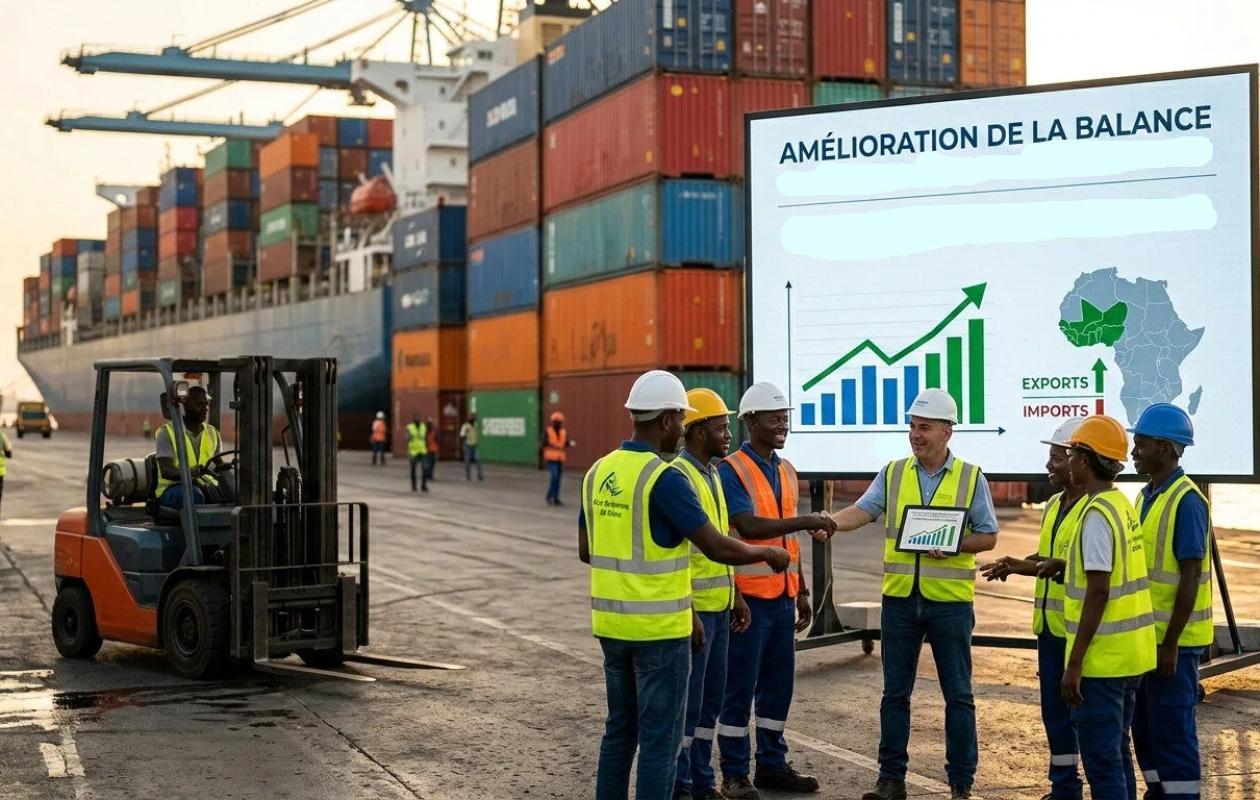
Analyse : Le mirage de la balance commerciale, entre pétrole, or et dépendance.
In public debate, a trade surplus is almost always presented as the infallible barometer of a healthy economy. When a country exports more than it imports, it projects the image of a competitive nation, capable of conquering global markets. While, from an accounting perspective, the signal seems favorable, this interpretation deserves considerable qualification. In reality, a surplus does not systematically reflect robust prosperity; it can sometimes mask worrying structural imbalances.
It all depends on the nature of the exported products and the reasons for the low level of imports. The first scenario concerns economies dependent on raw materials. For countries that primarily export oil, gold, or gas, a simple rise in global prices mechanically improves the trade balance without necessarily transforming the local production structure. Nigeria perfectly illustrates this paradox: long enjoying a surplus thanks to crude oil, the country has remained dependent on imports of refined products and capital goods due to the lack of a robust manufacturing industry.
Similarly, gold exports from Mali or Burkina Faso generate significant external revenue, which does not necessarily translate into a general increase in income or employment, as extractive activity provides little direct labor. Furthermore, a surplus can be a symptom of weak domestic demand. If households consume less and businesses cease investing, imports fall. The trade balance then improves, not through increased economic performance, but through impoverishment and a slowdown in private investment.
The other limitation lies in the low level of local processing. Exporting raw cocoa, as Côte d'Ivoire does, or unprocessed cotton, allows for impressive figures, but leaves the bulk of the added value in industrialized countries. Wealth leaves the country in its raw form only to return as finished products that are far more expensive. Finally, if the profits generated are massively repatriated, the surplus never benefits local purchasing power. Conversely, a deficit can sometimes be "virtuous" if it corresponds to a massive investment in machinery and infrastructure that will prepare for future growth. In economics, what matters is therefore not just the balance, but the real value that remains within the country.










![[EXCLUSIF] Affaire Pape Cheikh Diallo : 88e interpellation, l'identité du marabout proche des lutteurs arrêté dévoilée](https://image.seneweb.com/content/news/2026-18-30//thumb_1260x800_69f3ec2461579_kX0bYOesMf.jpeg)
![[EXCLUSIF] Affaire PCD : Un célèbre acteur et 2 agents du Port écroués, le maître coranique C. B. Mbacké et un vétérinaire libérés](https://image.seneweb.com/content/news/2026-18-30//thumb_1260x800_69f390db21da9_TjrX268QWW.jpg)












Commentaires (2)
Participer à la Discussion
Règles de la communauté :
💡 Astuce : Utilisez des emojis depuis votre téléphone ou le module emoji ci-dessous. Cliquez sur GIF pour ajouter un GIF animé. Collez un lien X/Twitter, TikTok ou Instagram pour l'afficher automatiquement.