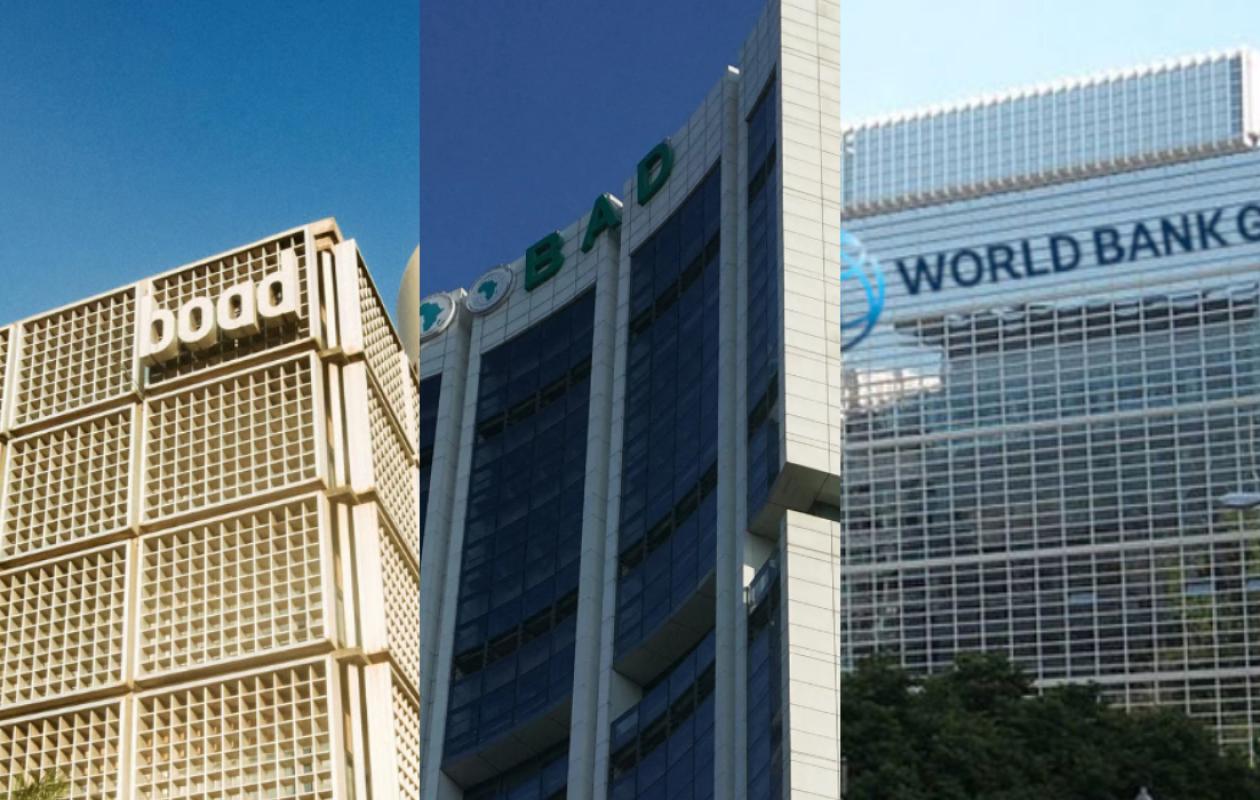
BOAD, BAD, Banque mondiale : Les institutions qui accompagnent les transformations économiques
When a bank grants a mortgage to a household or finances a company's working capital needs, its objective is generally to recover its money quickly while earning interest. Development banks operate according to a different logic. Their role is to finance projects with significant economic benefits, but whose profitability is often too slow, too uncertain, or too complex to easily attract traditional private financing.
This mission explains why institutions like the West African Development Bank (BOAD), the African Development Bank (AfDB), and the World Bank intervene in sectors such as infrastructure, energy, agriculture, water, transport, and education. These projects often require very high levels of investment and have a long-lasting impact over several decades.
The construction of a highway, a hydroelectric dam, or a water supply network clearly illustrates this reality. The necessary sums often amount to hundreds of millions, or even billions of dollars, while the revenues generated can take many years to recoup the costs incurred. Few commercial banks are willing to tie up their resources for such long periods.
Development banks were specifically created to address this shortfall. They mobilize capital from governments, financial markets, and partner institutions to redirect it towards projects considered priorities for economic development.
Their model is based on a long-term perspective. While a traditional bank loan can be spread over a few years, financing granted by development banks can extend to fifteen, twenty, or even thirty years, depending on the nature of the projects. This ability to offer long maturities is one of their key distinguishing features.
The question of maturity is fundamental. Infrastructure with a lifespan of several decades should ideally be financed with long-term resources. Financing a dam designed to operate for fifty years with loans repayable in three or four years would create a financial imbalance that would be difficult to sustain.
The figures give an idea of the scale of the needs involved. The African Development Bank estimates that the African continent needs to mobilize between $130 and $170 billion annually to meet its infrastructure needs, while the annual financing gap remains between $68 and $108 billion. This shortfall particularly affects roads, electricity grids, port infrastructure, water supply systems, and urban amenities.
In response to these needs, development banks often act as catalysts. They do not necessarily finance projects on their own. Their involvement frequently helps attract other investors who might have hesitated to commit without the presence of a recognized institution.
This function is particularly visible in African energy projects. The Korhogo solar power plant in Ivory Coast, whose financing was recently supported by a structured green bond with the support of Africa Finance Corporation, is part of a logic where several financial actors intervene simultaneously in order to spread the risks and mobilize more capital.
The BOAD plays a comparable role at the WAEMU level. Established in 1973, it has approved several trillion CFA francs in financing across the eight member states since its inception. According to its institutional data, the bank's cumulative commitments now exceed 9 trillion CFA francs. Its interventions cover a wide range of sectors, from transport infrastructure to energy, agriculture, housing, and the private sector.
The African Development Bank operates on a larger scale. In 2024, the AfDB Group's financing approvals exceeded $10 billion. The institution operates across the continent and finances governments, businesses, and regional projects alike.
The World Bank has even greater resources. Through the International Bank for Reconstruction and Development (IBRD) and the International Development Association (IDA), it commits tens of billions of dollars annually to emerging and developing economies. In fiscal year 2024, the World Bank Group's commitments exceeded $100 billion.
The activities of these institutions are not limited to loans. They also provide guarantees, sometimes take equity stakes in certain projects, offer technical assistance, or help structure complex financing arrangements. This diversity of instruments reflects a simple economic reality: some projects may not lack profitability, but struggle to find a financial structure capable of reassuring investors.
Development banks also play a significant role in financing the energy transition. According to the International Energy Agency, the energy investments needed in Africa amount to hundreds of billions of dollars over the next few decades. A large portion of these resources will need to be mobilized even before projects begin generating revenue.
This issue directly concerns Senegal. The stated ambitions in the energy, agriculture, infrastructure, and industrial transformation sectors require investment volumes that far exceed the state's budgetary capacity. Development banks therefore appear as important partners for mobilizing long-term financing compatible with these objectives.
Their role is even more important in a context marked by rising international credit costs. Since the global interest rate hike that began in 2022, many African countries have been borrowing at higher rates on financial markets. Financing offered by development banks often allows for longer maturities and more favorable terms than those available on commercial markets.
Development banks thus occupy a unique position in the global economy. They do not replace commercial banks, but rather intervene where long-term financing needs exceed the capacity or risk appetite of private actors. Behind the major infrastructure projects, energy networks, agricultural programs, and industrial investments that are gradually transforming economies, these institutions are often found, their mission being less about financing immediate consumption than about preparing for future growth.

















Commentaires (1)
Participer à la Discussion
Règles de la communauté :
💡 Astuce : Utilisez des emojis depuis votre téléphone ou le module emoji ci-dessous. Cliquez sur GIF pour ajouter un GIF animé. Collez un lien X/Twitter, TikTok ou Instagram pour l'afficher automatiquement.