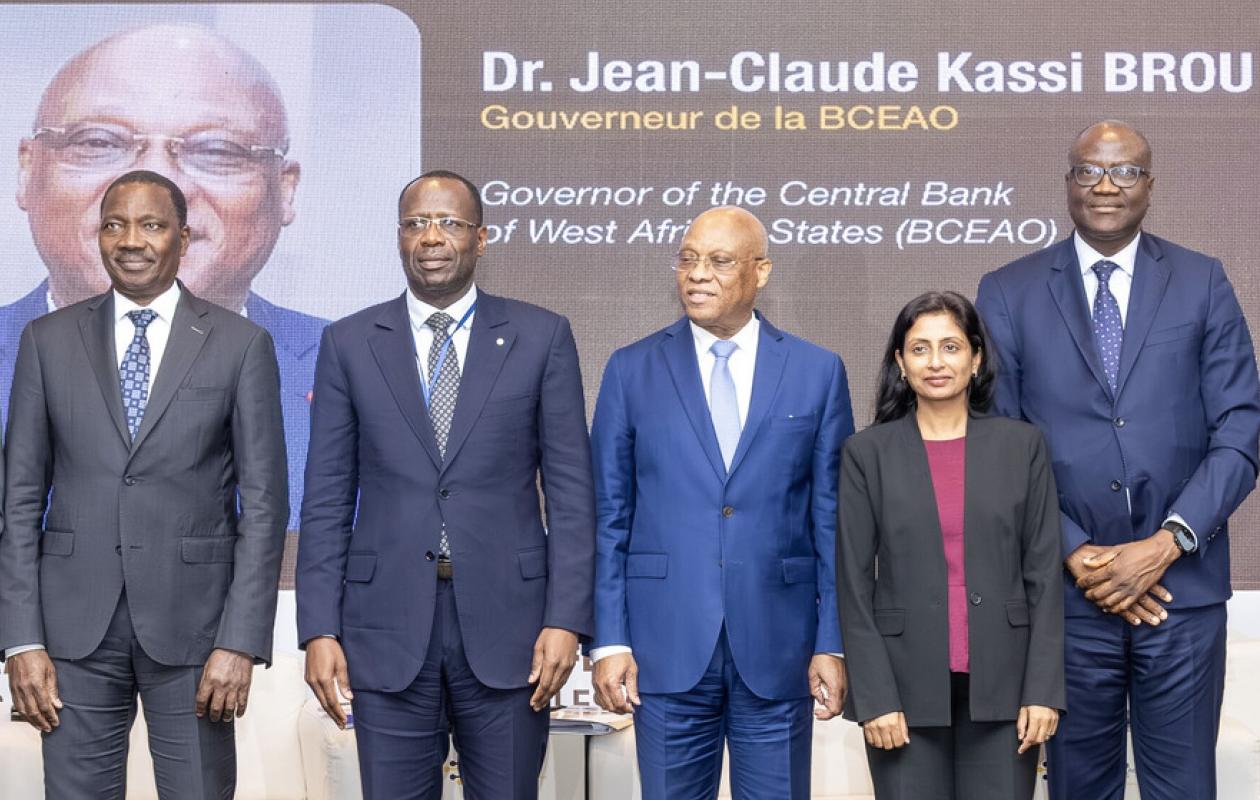
Crypto actifs en Afrique, risques et avantages : Diagnostics et recommandations de six Gouverneurs de banques centrales
Crypto-assets and technological innovations were at the heart of a day of intense discussions at the international conference organized by the Central Bank of West African States. The debates concluded with in-depth exchanges between the governors of six African central banks during a high-level roundtable.
During this meeting, the extent to which these elements are transforming financial systems was highlighted, offering opportunities, particularly in the areas of financial inclusion, payment modernization, and improved access to financial services. The governors, however, made important recommendations regarding the risks associated with the volatility of crypto-assets, cyber threats, and money laundering, among others.
Cooperation as the first line of defense
Agostinho Fernandes, governor of the Central Bank of São Tomé, emphasized that “crypto-assets are already present on the continent.” Although they have not yet appeared in his country, he stressed that now is the time to prepare to “take advantage of this opportunity, but above all, to be mindful of the risks.”
To mitigate these risks, he emphasizes the need for cooperation, especially at the sub-regional level, particularly among central banks "to benefit from each other's experiences." He also recommends cooperation within each country and with data protection authorities, law enforcement agencies, and even Interpol.
“Because cyberattacks, which are a major threat, can come from anywhere. So there needs to be international cooperation to try to track down these threats,” he said.
Innovation, but with safeguards
The governor of Liberia's central bank, Henry F. Saamoi, also conceded that it is no longer possible to ignore these digital innovations. On the contrary, they require close attention. "Innovation is inevitable. We must deal with it. We must continue to innovate. Innovation can foster efficiency, inclusion, and growth. But what we want to emphasize in Liberia is that innovation without safeguards can destabilize fragile economies like ours," he warned.
He said that, in his country, regulations for crypto-assets are being considered to govern their environment. This measure is part of a systemic prudence approach, a desire to protect consumers, and an alignment with international standards.
Framework for responsible innovation
The Governor of the Central Bank of Mauritius, Dr. Priscilla Muthoora Thakoor, stated that her country is heavily reliant on foreign capital flows. Therefore, innovation and digital transformation are a matter of economic survival. The country's vision is to create "a framework that promotes responsible innovation," she said.
And this framework goes "towards recognizing that only central bank money is the legal instrument for payments." It also aims to be cautious, relying on "a rigorous set of legal texts and guidelines, in line with international standards and best practices," she says.
Ms. Thakoor urged close collaboration between regulators and ecosystem players, while drawing attention to the importance of macroeconomic fundamentals to avoid controlled adoption of crypto-assets and precipitating digital dollarization.
The central role of trust
Yvon Sana Bangui, Governor of the Bank of Central African States (BEAC), emphasized the central role of institutional trust, particularly regarding the mission of central banks. "That of guaranteeing monetary and financial stability, the mission of protecting savers and consumers of all innovative products," he said.
And this protection, the governor indicates, comes through regulation. At the CEMAC level, he states that they are receiving support, calling upon specialists to take into account all the complexities.
Jean Claude Kassi Brou, Governor of the BCEAO, which organized the conference, emphasized the wealth of contributions on the issue. In addition to regulations, three key aspects emerged from the discussions, he said. The first of these remains infrastructure. "Because there really needs to be an appropriate infrastructure in place to be able to manage all these risks," he explained.
Three main lessons
Then, the second necessity is related to capabilities and human resources. "Having the skills to have people who can effectively monitor, continuously, all these risks that we are trying to anticipate and so that we can build a resilient system," explains the governor of the BCEAO.
The third aspect that emerged from the speeches, he said, relates to the paramount need to engage in a dynamic of cooperation. "We must avoid regulatory arbitration," stated Jean-Claude Kassi Brou, who called for the harmonization of regulations.
At the ECOWAS level, a similar dynamic has been initiated. "We should even be able to go beyond ECOWAS, to the ABCA level. This is to be able to achieve even more advanced levels of harmonization," he indicated. Dr. Rogério Lucas Zandamela, Governor of the Central Bank of Mozambique, also joined the discussions.
“This is a very useful meeting….”
In summary, the Governor of the BCEAO drew a satisfactory conclusion from the discussions: "This is a very useful meeting. Because it allowed everyone to see where they stand and what steps need to be taken to get up to speed, or at least to the most appropriate level," he said.

















Commentaires (1)
Participer à la Discussion
Règles de la communauté :
💡 Astuce : Utilisez des emojis depuis votre téléphone ou le module emoji ci-dessous. Cliquez sur GIF pour ajouter un GIF animé. Collez un lien X/Twitter, TikTok ou Instagram pour l'afficher automatiquement.