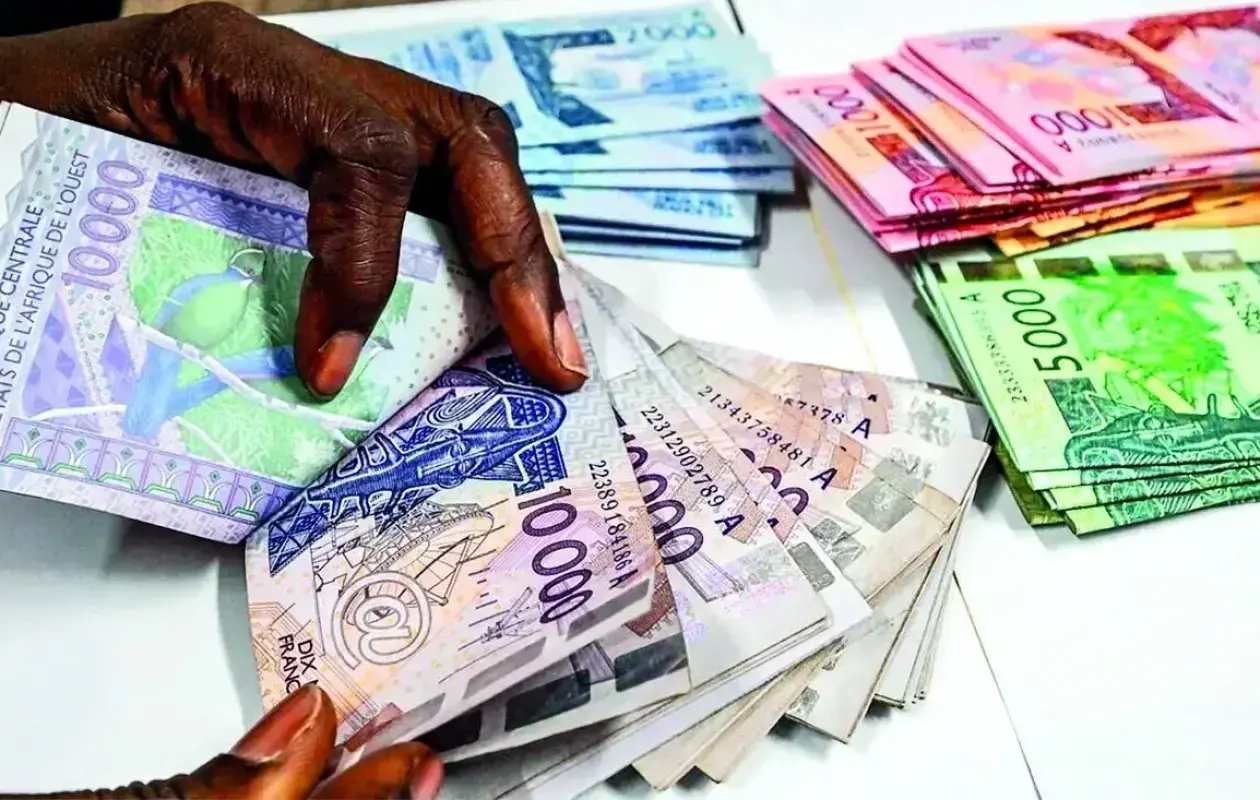
Les secousses financières ne viennent pas toujours des grandes places de marché
Major financial crises do not always begin with a spectacular stock market crash. The 1929 crisis remains associated with Wall Street, but contemporary vulnerabilities often develop elsewhere, in real estate, private credit, local public debt, payment arrears, or parallel foreign exchange markets. For African economies, these less visible areas deserve particular attention, as they can weaken banks, businesses, and public finances without relying on a highly developed stock market.
In West Africa, the primary source of risk often lies in the relationship between states and banks. The IMF warned in 2025 about the rapid growth of public debt held by domestic banks in sub-Saharan Africa. Reuters, citing the same report, indicated that approximately half of the region's public debt was now held by local banks. This development allows states to finance themselves in local currency, but it also creates a strong dependence between fiscal health and banking stability.
In the WAEMU, this reality is evident in the growing weight of government bonds on bank balance sheets. When states borrow heavily on the regional market, banks find these bonds a profitable and relatively safe investment. However, if public finances become strained, the risk is not limited to the budget; it can spread to the banking system. The problem, therefore, does not stem from a stock market crash, but from a gradual concentration of risk on financial balance sheets.
Senegal illustrates another form of vulnerability: that of opaque public commitments. The Court of Auditors' audit, published in February 2025, on the state of public finances between 2019 and March 2024, highlighted significant discrepancies in the accounting of certain commitments and in budgetary transparency. In this type of situation, a crisis can arise from a lack of confidence in the quality of public accounts, well before any panic occurs in the financial markets.
Payment arrears are also an underestimated channel. A company may have a signed public contract, completed work, and a recognized receivable, but still find itself in difficulty if payment is delayed. When these delays multiply, they weaken subcontractors, slow down construction projects, reduce the cash flow of SMEs, and increase bank defaults. The shock remains diffuse, but it can have a systemic effect in an economy where many businesses depend on public procurement.
Private credit is another area to monitor. In Senegal, the World Bank's private sector assessment indicated that only 22.6% of businesses had access to a bank loan or line of credit. This weakness in formal credit is pushing many SMEs toward self-financing, supplier advances, microfinance, or more expensive informal channels. The risk, therefore, is not only found in banks but also in the less documented debt of businesses.
Parallel exchange markets can also reveal deep-seated tensions. Nigeria provided a recent example with the gap between the official and parallel exchange rates before the exchange rate reforms initiated in 2023. When foreign currency becomes difficult to access, importers, manufacturers, and households face increased costs, while expectations of depreciation can accelerate the flight to the dollar. Here again, the epicenter of the crisis lies not in a stock exchange, but in the daily circulation of foreign currency.
Real estate also warrants a financial analysis. In cities like Dakar, Abidjan, and Accra, the rapid rise in land prices attracts savings and sometimes fuels speculative activity. As long as prices are rising, the market appears solid. But when incomes don't keep pace, when credit becomes more expensive, or when buyers become scarce, real estate assets can become difficult to sell. A liquidity crisis can then emerge in a sector that is nevertheless perceived as a safe haven.
African precedents show that the most serious financial crises do not always originate in listed markets. Mozambique was rocked in 2016 by the hidden debt scandal, with approximately $2 billion in undeclared loans linked to state-owned enterprises. Ghana had to restructure its debt after a sharp deterioration in its financing conditions. These episodes serve as reminders that major risks can arise from poorly monitored debt, opaque public commitments, or refinancing that has become too costly.
For West African economies, attention cannot be limited to stock market indices or the most visible bond issues. Fragilities also exist in payment delays, quasi-public debt, parallel foreign exchange markets, urban real estate, informal credit, and bank balance sheets exposed to sovereign debt. It is often in these less-discussed areas that future financial tensions can accumulate.







![[ EXCLUSIF] Escroquerie au visa : Ass Dione passe aux aveux, le montant du préjudice dévoilé](https://image.seneweb.com/content/news/2026-21-21//thumb_1260x800_6a0e4fa45e2f9_JtdXe63zlf.jpg)












Commentaires (0)
Participer à la Discussion
Règles de la communauté :
💡 Astuce : Utilisez des emojis depuis votre téléphone ou le module emoji ci-dessous. Cliquez sur GIF pour ajouter un GIF animé. Collez un lien X/Twitter, TikTok ou Instagram pour l'afficher automatiquement.