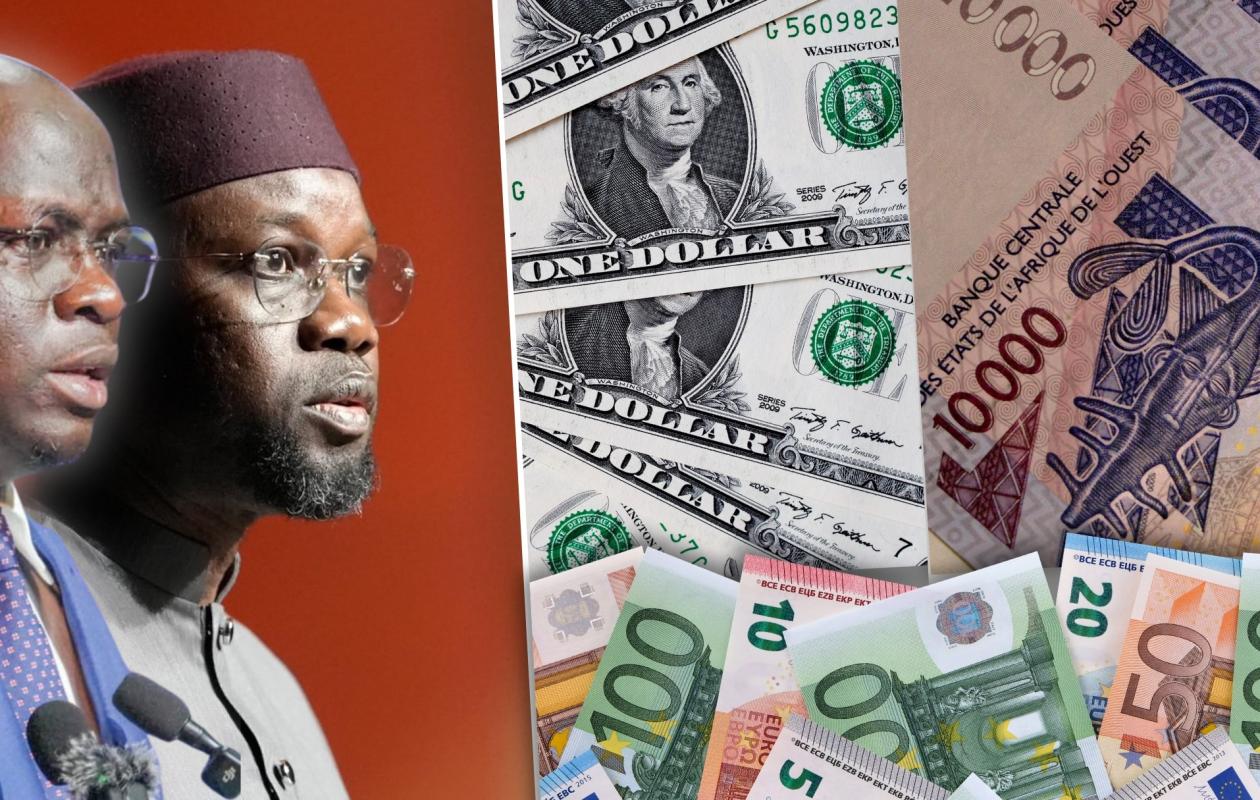
Restructurer ou ne pas restructurer la "grosse" dette : L’avis “cash” de spécialistes sénégalais
Restructure or not to restructure? Senegal's staggering public debt is currently a major burden for the country's authorities. Official government documents cite a total debt level reaching 119% of GDP (23,666 billion CFA francs), while the International Monetary Fund (IMF) puts the figure at 132% of GDP. Several options are on the table for the authorities. However, the one that seems to be favored by financial institutions remains restructuring.
“The nature and choice of specific debt operations, including the decision to restructure or not the bonds, fall within Senegal’s sovereignty,” stated IMF Communications Director Julie Kozack on December 5. The ball is therefore in the court of the Senegalese authorities. Should they restructure this debt or not to gain greater financial flexibility?
“If Senegal were in a situation where we had to talk about debt restructuring, I wouldn’t mince words. I would have said, ‘Let’s move towards restructuring.’ But we are not in that situation,” the Senegalese Minister of Finance declared to the National Assembly on November 29th. Is this current stance of the Senegalese government the appropriate one, given the delicate nature of the current situation? Several Senegalese experts have offered their opinions on the matter.
Dr. Assane Beye, a lecturer and researcher at the Faculty of Economics and Management at the University of Dakar, clarifies that debt restructuring does not automatically mean a country is bankrupt. The economist points out that countries like Jamaica in the early 2010s, Uruguay, and even more recently Kenya, "have successfully implemented it." In Senegal's case, he believes the most important thing is that creditors do not suffer losses, that their principal is not affected, and that interest payments are not reduced.
“Refusing restructuring risks budgetary asphyxiation.”
“Often, restructuring is attempted before an actual default occurs, precisely to avoid a more costly crisis. In practice, announcing a restructuring can temporarily affect access to financial markets, especially if the terms impose a loss for some creditors,” he told Seneweb. The economist even questions whether there is currently a difference between a restructuring and what the Senegalese authorities are doing, “since there is increasing talk that we are borrowing to pay off these debts.”
Professor Amath Ndiaye is more emphatic: “Refusing restructuring risks budgetary asphyxiation. The time for clear thinking is now: restructure today to grow tomorrow,” he declared. For the economist, who was a consultant to the World Bank and the African Development Bank (AfDB), “an orderly restructuring, overseen by the IMF, would allow for longer maturities, reduced immediate debt service, and the restoration of financial credibility, as seen in Ghana (2023-2024) or Côte d'Ivoire (2011).” This would also pave the way for new foreign direct investment, he stated in an opinion piece published in mid-November.
“No one can understand why we refuse to restructure…”
Economist Moubarack Lô believes there shouldn't even be a debate on the issue: "Today, no one can understand why we can't agree to restructure and renegotiate the debt," he states. In his opinion, this is the option that should be prioritized by the government, as it is "the most realistic way to avoid embarking on a difficult path." For him, "nothing justifies mobilizing 5 trillion or even 6 trillion CFA francs every year to pay off a debt."
Financial expert Mouhamed Dia is equally adamant: “If we reject the restructuring of our debt, a right granted to us as a sovereign nation, we will not have access to Eurobonds, a borrowing instrument that has been of great help to us in the past.” He believes that regional markets are not currently able to fully meet Senegal’s financing needs.
The financial expert explains that restructuring could allow for longer repayment periods and postpone certain deadlines for an extended time. This would offer the country better cash management. Restructuring could also lower interest rates if lenders agree to reduce current rates. This, in turn, would decrease the cost of debt. Mr. Dia warns, however, that "we will soon be in a situation where we have no other option, since the global financial system is closely interconnected and once we expose one institution to risk, it triggers a domino effect on all other financial institutions."
As early as December 4th, Bank of America Research stated that a restructuring of Senegal's external debt was "increasingly likely." On December 11th, EMsights Capital Group, an American asset manager, indicated in turn that "a default (or a restructuring closely resembling one) appears increasingly inevitable." For the moment, the Senegalese government is holding firm to its position. But for how long?













Commentaires (14)
Si des pays ont, semble-t-il, réussi avec un programme d'ajustement structurel, d'autres ont aussi réussi à remettre sur pied leur économie sans le FMI. Les exemples font foison. Nos autorités sont assez outillés pour prendre cette décision de souveraineté. Ce ne sera pas facile. Nous le savons et devrons accepter de souffrir pendant un moment (2 à 3 ans) pour commencer à sortir de cette situation délicate.
D'autres pays l'ont réussi. Pourquoi pas nous ?
Nous devons croire en notre Plan de Redressement Economique et Social qui a un visage résolument humain et réaliste.
Wa salaam.
La mise en oeuvre de ces solutions implique la mise en place d'une batterie de décisions très importantes. Allez écouter Ndongo Samba Sylla qui explique très clairement les premières décisions à prendre et leurs conséquences dans l'économie du pays.
Encore une fois tous les économistes qui conseillent une restructuration doivent aller se recycler ou tout bonnement prendre leur retraite. C'est fini la restructuration. Ou alors la restructuration sera nécessaire si toutefois Diomaye pressé par les lobbys qui l'entoure n'accepte pas les solutions que, à mon avis, lui ont proposé Ousmane Sonko et le ministre des finances. Moi je reste persuadé que Sonko et Sarr ont la solution sur la table.
Que Dieu bénisse le Sénégal et l'Afrique
La question est complexe. Toutefois, le FMI et la banque mondiale devraient pouvoir nous financer toute cette dette et nous faire payer avec un certain différé, histoire relancer l'investissement et lancer l'économie.
Notre dette eu égard des FONDS DORMANTS dans beaucoup de pays riches est MODESTE; il est temps de présenter des PROJETS POUVANT RÉVEILLER CES FONDS DORMANTS.
AC, ingénieur GC
On sait où ça va finir...
"Le PM SONKO et le Ministre de l'économie et des finances ont la solution " / mais il reste au PR Diomaye le courage d'aller vers les propositions de Ousmane Sonko et son ministre..." Cette distribution factices des tâches et des rôles vient plomber ton raisonnement. Pour des raisons politiciennes vous vous jetez dans la vase pour vous positionner comme un opportuniste primaire. Le PM Einstein n'avait pas mêlé le PR à sa conférence (ou point) de presse de septembre 2024 et il a toujours tous les pouvoirs pour prendre les décisions qui s'imposent. Dommage que DIOMAYE "l'orphelin au sein du Pastef" soit aujourd'hui le proscrit à abattre.
Participer à la Discussion
Règles de la communauté :
💡 Astuce : Utilisez des emojis depuis votre téléphone ou le module emoji ci-dessous. Cliquez sur GIF pour ajouter un GIF animé. Collez un lien X/Twitter, TikTok ou Instagram pour l'afficher automatiquement.