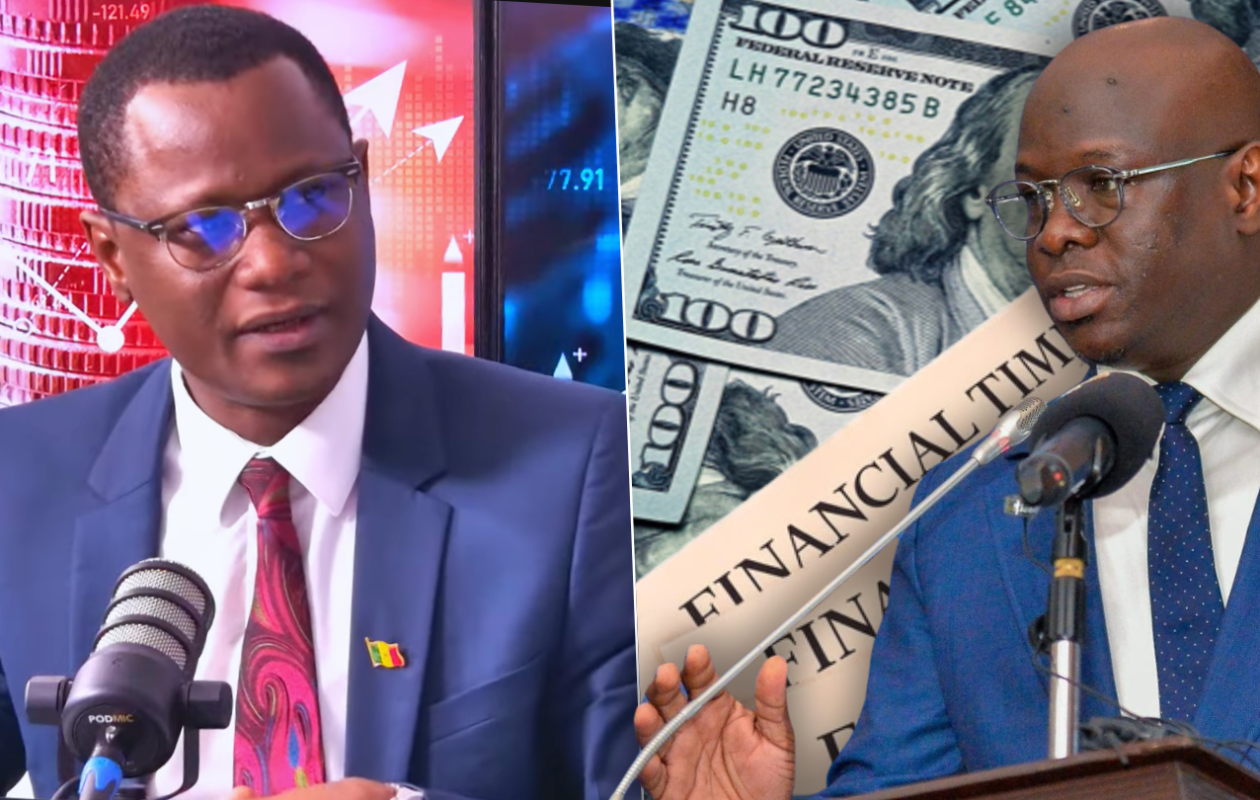
Les TRS, avantages et risques, dette cachée ou pas…: Les éclairages très précis de Dr. Serigne Moussa Dia (Economiste)
Since Monday, the issue of Total Return Swaps (TRS) has been the subject of debate. According to the Financial Times, Senegal has taken out loans totaling $650 million without disclosing them. The opposition, in particular, is calling it a hidden debt. But is it really a hidden debt? What is a TRS in simple terms? What are its advantages and risks? In this interview with Seneweb, Dr. Serigne Moussa Dia, an economist, provides valuable insights.
What are TRS in terms that are accessible to laypeople?
A Total Return Swap, or TRS, is a contract between two financial parties where one cedes to the other all economic gains related to an asset (income, capital gains, everything) in exchange for a fixed or variable periodic payment, usually indexed to an international market rate.
To make this concrete: imagine you own a rental property. You entrust it to a management company that pays you a guaranteed fixed rent each month. In exchange, they collect the actual rent, capital gains on resale, everything. You've traded the real return on your property for a predictable cash flow. That's exactly the logic behind the TRS (Total Return on Investment).
In the case of Senegal, the State used securities of its own debt (Treasury Bonds or OATs) as a reference asset in this arrangement, allowing it to mobilize immediate liquidity without triggering a classic bond issue on the market, with all the delays and formalities that this implies.
What are the advantages, risks, and relevance of using this instrument?
The advantages are real:
First, flexibility. Liquidity is accessed quickly, without roadshows, syndication, or waiting for market windows. Second, if the rate obtained is indeed lower than the market rate at the time of the transaction, the cost savings are tangible and demonstrable. Third, the instrument allows for managing ad hoc cash flow needs with an operational flexibility that traditional methods don't always offer.
The risks warrant attention: First, market risk: if the value of the reference assets declines, the counterparty may demand adjustments. Second, counterparty risk: if the other party defaults, the state finds itself exposed without a safety net. And the most insidious risk: these instruments can create unbudgeted contingent liabilities that only materialize in the worst economic conditions, precisely when room for maneuver is at its narrowest.
Was it a good idea?
Yes, and it must be clearly defended. The current team at the helm of Senegal's public finances manages the debt with particular rigor and care. It was this team that uncovered the inherited discrepancies, underwent the shock of transparency, and worked methodically to rebuild the country's budgetary credibility. To criticize the use of a TRS (Treasury Reform Scheme) without considering this context of rehabilitation would be intellectually dishonest.
From a technical standpoint, Treasury Bonds (TBS) have their place in a sovereign treasury's arsenal. Several emerging countries use them routinely. The real question, therefore, is not "was it inherently risky?" but rather: are the precise contractual terms of the TBS consistent with the debt sustainability objectives as defined in the multi-year debt management strategy? Given the stated rigor, there is no reason to doubt it. Publishing the detailed terms of the contract would simply put an end to the debate.
But I want to raise a more fundamental question here: why is Senegal forced to resort to this type of instrument? Precisely because the BCEAO is not fully playing its role. And that's where the real debate begins.
What this appeal tells us about our public finances and our cash flow
This is the most revealing question. When a sovereign treasury resorts to such a sophisticated derivative instrument, it's a signal. In our case, it reflects a worsening cash flow situation . Market data confirms this: at the January 2026 auction, Senegal's 3-year OATs were accepted at 7.28% and 5-year OATs at 7.69%, levels that have risen significantly. The yield curve showed an anomaly documented by UMOA-Titres: the 5-year bond was more expensive than the 7-year and 10-year bonds, reflecting a specific risk premium over the 2026-2027 horizon, the period of Eurobond repayments. The Bank of France confirms a general increase in sovereign spreads in the WAEMU since 2023, with Senegal among the countries affected.
Faced with these rising costs on traditional debt financing, the Debt Management Department is seeking alternatives. The Treasury Bond Scheme (TBS) is one such alternative. It represents active and rigorous debt management. However, the root cause of this situation must be addressed: Senegal is borrowing at such high rates on its own regional market partly because the Central Bank of West African States (BCEAO) remains inactive, despite having the necessary tools to intervene. As a result, the Senegalese state is paying the price for regional institutional inaction.
The deficit, revised upwards following the 2024 audits, combined with debt servicing that absorbs a growing share of tax revenues, places the country in a demanding financing situation. However, this reality is documented, acknowledged, and managed by the current government, which fundamentally changes the nature of the situation compared to what existed before 2024.
What impact will this have on the Senegal-IMF relationship? Is the gap likely to widen?
Relations with the IMF have been strained since the suspension of the $1.8 billion program following the revelation of undeclared borrowing by the previous administration. Senegal now finances its needs primarily on the regional market, in a context where this market is becoming increasingly demanding.
Regarding the TRS specifically: Parliament was informed via the Finance Act, and the IMF was notified as part of the program reviews. Therefore, the criticism of a lack of communication is unfounded. The remaining issue is the level of detail in the information provided: an aggregated budget line item is not equivalent to communicating the precise contractual terms, counterparties, and conditional commitments. It is on this point that the vigilance of oversight institutions remains justified.
Is the divide likely to widen? It's not inevitable. But what concerns me more is the silence of the BCEAO in this debate.
For what?
I'll be direct: the BCEAO is not playing its role in managing this Senegalese financing crisis, and this inaction has concrete consequences for the entire zone.
Here's why this criticism is valid. It was the BCEAO itself that, through its 2010 reform, eliminated all direct monetary financing to states and steered commercial banks towards the massive subscription of sovereign government bonds. It therefore deliberately created a structural interdependence between the health of Senegal's public finances and the soundness of the banking system across the entire WAEMU.
The figures document the scale of this exposure. Senegal represents 15% of the region's GDP and is its second-largest economy. Since the beginning of 2026, more than $1 billion of Senegalese securities have been absorbed by regional banks. These securities constitute between 25% and 30% of some banks' total assets. Fitch has warned of the risk of systemic contagion. S&P has explicitly highlighted Ivorian banks' exposure to Senegalese debt. Economists Kessler and Ndiaye have documented how a Senegalese default would create vulnerabilities exceeding the regional banking system's capacity to cope.
What should the BCEAO do, in your opinion?
In this context, the BCEAO should intervene through a partial purchase of Senegalese debt on the secondary market. Its statutes do not prohibit the purchase of securities on the secondary market; they only prohibit direct monetary financing. This precise legal nuance opens a legitimate avenue for action. This would not be budgetary support for a state, but rather a regional financial stability operation , which falls squarely within its primary mission.
This is the logic followed by the ECB with its OMT program during the eurozone crisis, and by the Fed in 2008: when a systemic actor is under strain, the central bank intervenes to stop the contagion, not to bail out a government. The BCEAO created the banking system's exposure to Senegalese securities. It therefore has a responsibility to intervene to protect that same system. To fail to do so is to leave Senegal to bear alone the cost of a risk that is actually shared by the entire zone. If Senegal were to default today, the financial system of the entire WAEMU would pay the price. And the BCEAO could not claim ignorance.
Regarding TRS (Total Revenue Service), the Ministry of Finance mentioned a rate of 7%. Do you find this reassuring?
Regarding the 7% rate: The Ministry's argument is factual and deserves to be clearly defended. Market data shows that 5-year Senegalese government bonds (OATs) reached 7.69% in January 2026. If the Treasury bond was contracted at 7% in this context, the rate advantage is real. Period.
Analytical rigor requires the inclusion of other variables: commissions and structuring fees, early termination clauses, potential margin calls, and the opportunity cost of committing the reference assets. Without access to the full terms of the contract, the 7% figure is a necessary but insufficient piece of information to fully assess the transaction. This is not a criticism of the government; it is the rigor applied to all debt management transactions, regardless of their quality.
Is this a hidden debt?
No, and I want to be very clear about this, because confusing the two situations would be a serious intellectual error that undermines both the truth and the current government.
This is not a hidden debt in the sense of what we discovered under the Macky Sall administration. What the Court of Auditors documented in its 2024 report was systematic and deliberate underreporting: billions of dollars in commitments absent from official statistics, instruments structured precisely so as not to appear in the budget aggregates submitted to Parliament and partners. This was a fraud against budget transparency, with a clearly established intent and method.
The TRS (Tax on Revenue) in question today is included in the Initial Finance Law, along with its collection methods. Parliament has been informed. The IMF, as part of its program reviews, is aware of it. This is absolutely not the same situation, and this must be stated unequivocally to avoid perpetuating confusion that is detrimental to the current government.
The only remaining, legitimate question concerns the level of detail in the information: an aggregated budget line is not equivalent to the communication of precise contractual terms. It is in this area that vigilance remains relevant, not in the area of concealment.
Interview by Youssouf SANE


















Commentaires (7)
Participer à la Discussion
Règles de la communauté :
💡 Astuce : Utilisez des emojis depuis votre téléphone ou le module emoji ci-dessous. Cliquez sur GIF pour ajouter un GIF animé. Collez un lien X/Twitter, TikTok ou Instagram pour l'afficher automatiquement.