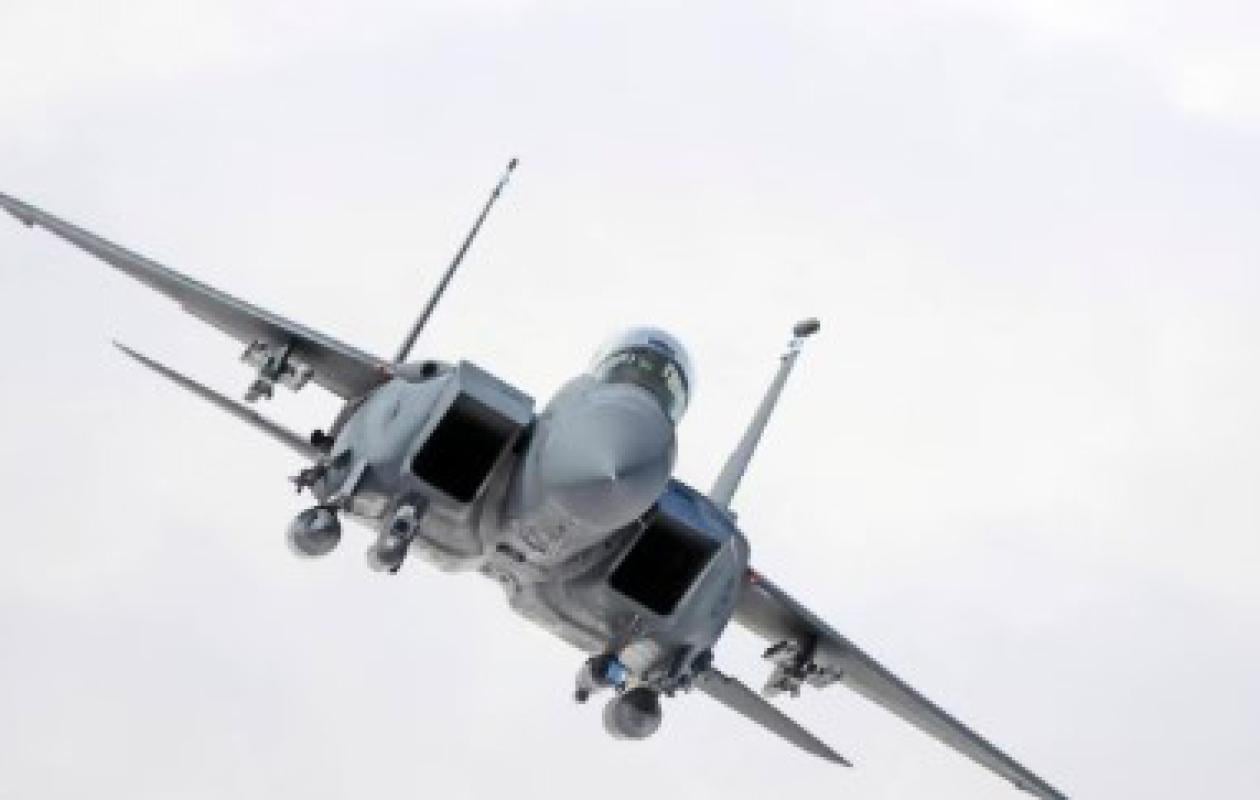
L'Iran affirme avoir abattu un avion américain et en chercher l'équipage
A US fighter jet was shot down in Iran and operations were underway Friday to find the pilot, according to Iranian and US media, in the first such setback since the start of the war in late February triggered by US-Israeli bombings.
When contacted by AFP on this matter, the United States military command for the Middle East (Centcom) did not immediately respond.
Iranian state television broadcast footage from the Kohgiluyeh and Boyer-Ahmad region (southwest) showed what it described as the wreckage of the downed aircraft, with police announcing a reward for information leading to the capture of its occupants.
"If you capture the enemy pilot(s) alive and hand them over to the police and armed forces, you will receive a generous reward," the journalist said.
The Fars news agency announced an ongoing operation "to find the pilot".
More than a month after the start of the American-Israeli offensive on February 28, this is the first known loss of an aircraft on Iranian soil, a sign that the Islamic Republic still has anti-aircraft capabilities despite weeks of intense bombing.
The incident follows another day of inflammatory rhetoric and US-Israeli strikes against Iran.
Meanwhile, Tehran has launched further missiles at Israel and Gulf monarchies allied with the United States, responding to adversary attacks and threats from Donald Trump to devastate its infrastructure.
The Israeli army did not specify the targeted locations, but military radio mentioned damage at a train station in Tel Aviv.
According to Iranian media, the Revolutionary Guards, the ideological army of the Republic, targeted this city and the seaside resort of Eilat (south).
Alerts urging Israelis to take shelter in the event of an attack are now much more precise, thanks to artificial intelligence tools. "The alert is ultra-localized," explains Sarah Chemla, 32, a Tel Aviv resident, who only wakes her children if her neighborhood is specifically threatened.
In the United Arab Emirates, a Gulf country regularly targeted by Iran, 12 people, Nepalese and Indians, were injured after an attack was intercepted in Abu Dhabi, where a gas complex was shut down after a fire.
In Kuwait, a drone strike on a refinery caused fires, and a power and desalination plant was hit.
The Iranian army had previously stated that it was targeting American, Israeli, and US "host and allied countries" sites.
She was responding to the American president who had threatened to destroy Iranian infrastructure, proclaiming on her Truth Social network that "bridges are next, then power plants!".
On Thursday, US-Israeli bombings notably destroyed a bridge under construction near Tehran and damaged the Iranian Pasteur Institute.
Israel, for its part, estimated that "70% of Iran's steel production capacity" had been destroyed. Since Thursday, the two largest steel plants there have been shut down.
Trump had announced on Wednesday "two to three" weeks of intense strikes to send Iran "back to the Stone Age" if Tehran did not accept a negotiated solution.
With no way out in sight, former Iranian foreign minister Mohammad Javad Zarif called on Tehran, in an opinion piece published by an American magazine, to "reach an agreement" to end the war.
In exchange for lifting sanctions, he urged his country to "limit its nuclear program and reopen the Strait of Hormuz," a strategic waterway for global trade in hydrocarbons, fertilizers, and other goods, which is currently paralyzed.
The war has already claimed thousands of lives, mainly in Iran and Lebanon, which the Israeli army invaded to fight the pro-Iranian Hezbollah movement in response to attacks on Israel since March 2.
The Israeli army claims to have already struck more than 3,500 targets across Lebanon and "eliminated" approximately 1,000 fighters.
The United Nations Interim Force in the country announced on Friday that three peacekeepers had been injured by an explosion whose origin has not been determined.
On the economic front, the war continues to fuel serious concerns, as Iran's near-closure of the Strait of Hormuz has led to a surge in oil and other commodity prices, raising the specter of a global inflationary crisis.
Iran, accused by some 40 countries of wanting to "hold the world economy hostage", has warned that the strait will remain closed to countries deemed hostile.
Nevertheless, a container ship belonging to the French group CMA CGM crossed the strait on Thursday, displaying a "French owner" signal on its navigation signal. This is the first known passage of a vessel from a major European shipping group through this route since the shutdown.
The Gulf countries have called on the United Nations Security Council to give its approval for a liberation by force of the strait.
A vote scheduled for Friday on a draft resolution to that effect was postponed due to a lack of consensus in the Security Council. Tehran, for its part, warned the UN body against any "provocative action".
Donald Trump, who has been making contradictory statements about the strait, said on Friday that the United States could "open" the strait and "take the oil" with "a little more time".
The economic repercussions of the war continue to spread.
Bangladesh has reduced the opening hours of offices and shops from Friday to lower energy consumption.
In Islamabad, Pakistan, public transport has been made free for a month in response to rising petrol and diesel prices. And in Australia, hundreds of petrol stations in rural areas are running out of fuel at the start of the Easter weekend.
AFP





![[EXCLUSIF] Expulsion de la famille Srour : L'accusée Khady Diagne se prononce, documents à l'appui](https://image.seneweb.com/content/news/2026-20-14//thumb_1260x800_6a05cc2715573_a9nMMiStMC.jpg)









Commentaires (9)
Participer à la Discussion
Règles de la communauté :
💡 Astuce : Utilisez des emojis depuis votre téléphone ou le module emoji ci-dessous. Cliquez sur GIF pour ajouter un GIF animé. Collez un lien X/Twitter, TikTok ou Instagram pour l'afficher automatiquement.