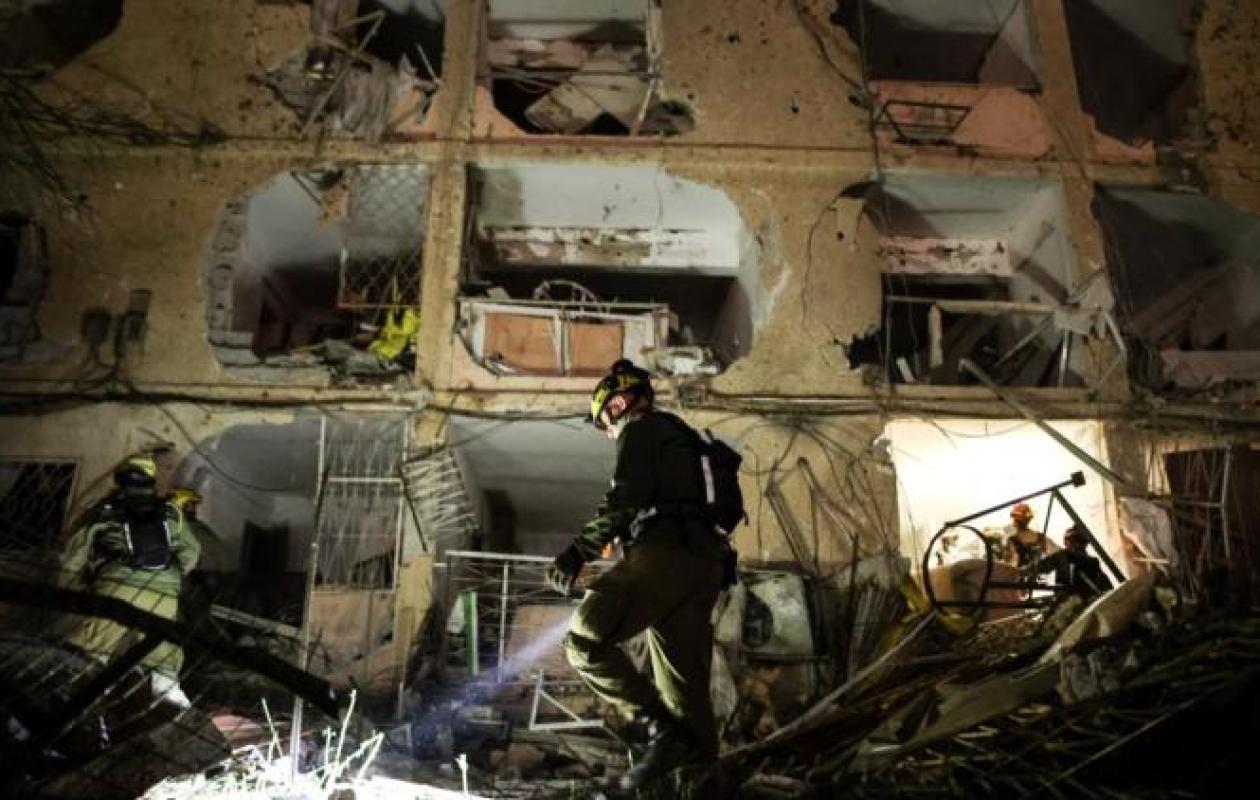
L'Iran menace de frapper des infrastructures clés après un ultimatum de Trump
Tehran threatened on Sunday to strike key infrastructure in the Middle East, immediately responding to Donald Trump's ultimatum to reopen the Strait of Hormuz within 48 hours, following particularly destructive Iranian strikes in southern Israel.
Without a full and unconditional reopening of this strategic strait for the global supply of hydrocarbons, the United States will "strike and destroy" Iranian power plants "STARTING WITH THE BIGGEST!", the US president warned on his Truth Social platform Saturday night.
Iran responded to this demand without delay: if Washington carries out its threat, the Iranian army will then target "energy, information technology and water desalination" infrastructure in the region.
On the 23rd day of the war, which began on February 28 with the joint US and Israeli offensive against Iran, attacks continue in the Middle East.
Early Sunday morning, the Israeli army said it was conducting strikes "in the heart of Tehran", without providing further details.
Early this morning, explosions were also heard in Jerusalem by AFP journalists, following an alert for Iranian missiles. This was the first such incident since the two Iranian attacks the previous day in southern Israel, which were particularly significant due to the extent of the damage caused and the number of injuries, exceeding one hundred.
On Saturday, Iran first struck a residential area of Dimona, a city housing a strategic nuclear research center in the Negev desert, injuring around thirty people, one of them seriously.
Then Tehran attacked the city of Arad, injuring 84 people, 10 of them seriously. "There was a 'boom, boom'! My mother screamed," 17-year-old Ido Franky told AFP. "It's frightening... This city had never experienced anything like this."
"This is a very difficult night in the battle for our future," Israeli Prime Minister Benjamin Netanyahu said in a statement. "We are determined to continue striking our enemies on all fronts."
The start of the fourth week of the conflict in the Middle East has shown a shift in attacks on nuclear infrastructure. By targeting Dimona, nearly five kilometers from the Israeli nuclear research center, Iran said it was retaliating against an "enemy" strike against one of its nuclear complexes at Natanz, south of Tehran.
The Israeli army claimed it was "unaware" of such a strike, with the public broadcaster Kan reporting that it was an American action.
According to the Atomic Energy Organization of Iran, "no leaks of radioactive materials have been reported" at this site which was already bombed in early March.
"No abnormal levels of radiation were detected," the International Atomic Energy Agency (IAEA) stated after the strike on Dimona. However, its director, Rafael Grossi, called for "maximum military restraint" to avoid any risk of a nuclear accident.
Israel is considered the only country in the Middle East with nuclear weapons but maintains ambiguity on the subject.
By launching, with Israel, the military offensive against Iran on February 28, Donald Trump had said in particular that he wanted to eliminate the Iranian nuclear threat, already targeted by the twelve-day war in June 2025.
Western nations suspect Iran of seeking to acquire nuclear weapons, which it denies. Talks on the subject were taking place in February before being abruptly halted by the outbreak of war.
Iranian retaliatory strikes are also continuing in the Gulf countries, as Tehran seeks to destabilize the global supply of hydrocarbons.
On Sunday, three ballistic missiles targeted the Riyadh region, the capital of Saudi Arabia. One was intercepted and two landed in uninhabited areas, according to the Saudi Ministry of Defense, which also reported, as in previous days, the destruction of several drones.
The United Arab Emirates also said they were responding to missile and drone attacks from Iran.
Iranian state media also claimed that a drone attack had targeted a military base at Baghdad airport.
Tehran's de facto blockade of the Strait of Hormuz, a crucial trade route, is exacerbating the surge in oil and gas prices, a source of concern for the global economy.
Near the strait, an "unknown projectile" exploded on Sunday near a bulk carrier sailing in the Gulf north of the Emirati city of Sharjah, the British maritime agency UKMTO said, adding that the crew was safe.
Around twenty countries, including the United Arab Emirates, the United Kingdom, France and Japan, have said they are "ready to contribute to the efforts" needed to reopen the strait.
The European Commission has called on member states to reduce their gas filling targets for next winter, in order to ease pressure on prices.








![[Billet d’humour] Diomaye Président : Mbour, le test qui interroge](https://image.seneweb.com/content/news/2026-19-10//thumb_1260x800_6a008342c328b_0bscHsJLlN.jpeg)










Commentaires (2)
Participer à la Discussion
Règles de la communauté :
💡 Astuce : Utilisez des emojis depuis votre téléphone ou le module emoji ci-dessous. Cliquez sur GIF pour ajouter un GIF animé. Collez un lien X/Twitter, TikTok ou Instagram pour l'afficher automatiquement.