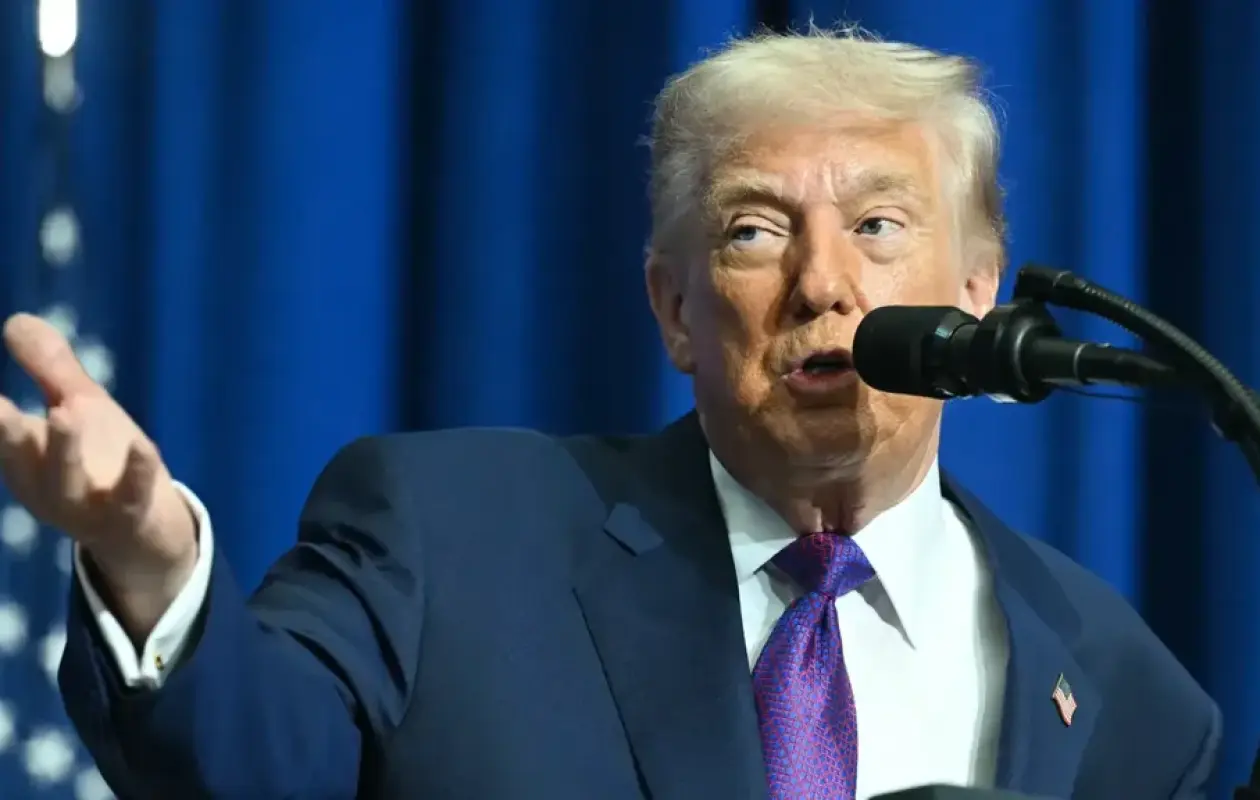
Le nouveau guide suprême iranien "ne tiendra pas longtemps" sans son aval, menace Trump
Donald Trump warned on Sunday that Iran's new supreme leader "will not last long" without his approval, even before the name of Ali Khamenei's newly chosen successor was revealed.
"He will have to get our approval. If he doesn't get our approval, he won't last long," the American president threatened, while Iranian Foreign Minister Abbas Araghchi reaffirmed that the choice of Ayatollah Ali Khamenei's successor rests with "the Iranian people" and "no one else."
The new supreme leader was chosen on Sunday by the Assembly of Experts, composed of members of the clergy elected by universal suffrage, to replace Ali Khamenei, who had been in power since 1989 and was killed on the first day of the war on February 28.
Since his death, the name of his son, Mojtaba Khamenei, considered one of the most influential figures in the government, has been circulating among the contenders. For this position traditionally reserved for a religious leader, the name of Hassan Khomeini, the grandson of the founder of the Islamic Republic, Ayatollah Ruhollah Khomeini, has also been mentioned.
Israel has already announced on Wednesday that the new supreme leader would be "a target".
Donald Trump, who at the start of the war had urged the Iranian people to overthrow the Islamic Republic, had already indicated on Thursday that he would not accept Mojtaba Khamenei taking over. Washington's stated objective is the destruction of Iran's ballistic missile capabilities and to prevent it from acquiring a nuclear weapon—an intention Tehran denies having.
"unbreathable"
The appointment of the new supreme leader comes as Iran, still reeling from intense airstrikes, asserts it is prepared for "at least six months of war," ignoring calls for "unconditional surrender" from Donald Trump. Trump has mentioned the possibility of future ground troops being sent to Iran to monitor the country's enriched uranium stockpiles.
On Sunday afternoon, explosions were heard in the capital, which was already plunged into darkness in the early morning and enveloped in a black veil, according to AFP journalists.
The Israeli army said it had struck "several" fuel tanks used, it said, to power military infrastructure, before announcing in the afternoon that it had struck the headquarters of the Aerospace Force of the Islamic Revolutionary Guard Corps, the elite force of the Islamic Republic.
This is the first reported attack on Iranian oil infrastructure since February 28.
Nearby, security forces in raincoats, to protect themselves from toxic fallout, and equipped with respiratory protection masks, are filtering traffic. The windows of the surrounding residential buildings have been completely shattered by explosions.
Fuel distribution is now limited to 20 liters per vehicle, and queues are stretching along Tehran's gas stations, AFP observed on Sunday, the day Iran resumed operations after a week-long holiday declared following the death of Ali Khamenei.
"The air has become unbreathable," testifies a resident reached by telephone from Paris. "The war is spreading. This is not what we wanted. We didn't want them to bomb our national resources and make us even poorer than we already are."
According to the latest figures from the Iranian Ministry of Health, more than 1,200 people have been killed and more than 10,000 civilians injured, claims that AFP has not been able to verify.
- "Precision strike" -
Meanwhile, in Lebanon, the heart of Beirut was hit overnight, targeting a hotel in the Raouche district, located on the tourist waterfront, which had previously been spared from Israeli strikes. Israel described it as a "precision strike" against "senior commanders" of the Quds Force, the foreign operations branch of the Islamic Revolutionary Guard Corps. The latest death toll from the Israeli strikes has risen to 394, according to the Lebanese Minister of Health.
- Gulf countries targeted -
In response to the bombings, Iran continues to retaliate by launching missiles and drones towards infrastructure in the Gulf, a region rich in hydrocarbons and home to several American military bases.
Kuwait reported strikes on fuel tanks at its airport, Bahrain reported damage to a desalination plant.
In Saudi Arabia—the world's second-largest oil producer after the United States, with Iran among the top ten—a drone attack targeted the diplomatic quarter of Riyadh, which the Saudi government claims was thwarted. Another strike targeted the Shaybah oil field in the southeast of the country, while a projectile that landed in a residential area south of Riyadh killed two people.
Explosions were also heard in Abu Dhabi, as well as in Israel where rescue workers reported six injured.
"irresponsible" -
Iranian President Massoud Pezeshkian reiterated on Sunday that "if the enemy tries to use the territory of a country to launch an aggression against our territory, we will be forced to retaliate."
The head of the Arab League describes Iran's attacks on its neighbors as "irresponsible".
China and Russia, for their part, remain largely on the sidelines despite their close ties with Tehran.
The conflict is paralyzing a large part of the hydrocarbon flows from the Gulf. The Strait of Hormuz remains at the center of concerns, with some 20% of the world's oil production and nearly 20% of liquefied natural gas (LNG) usually passing through it.




![[EXCLUSIF] Un gendarme auxiliaire tombe dans l'affaire Pape Cheikh Diallo](https://image.seneweb.com/content/news/2026-17-26//thumb_1260x800_69ee19493167f_XiDKaJHO1e.jpg)








Commentaires (8)
Participer à la Discussion
Règles de la communauté :
💡 Astuce : Utilisez des emojis depuis votre téléphone ou le module emoji ci-dessous. Cliquez sur GIF pour ajouter un GIF animé. Collez un lien X/Twitter, TikTok ou Instagram pour l'afficher automatiquement.