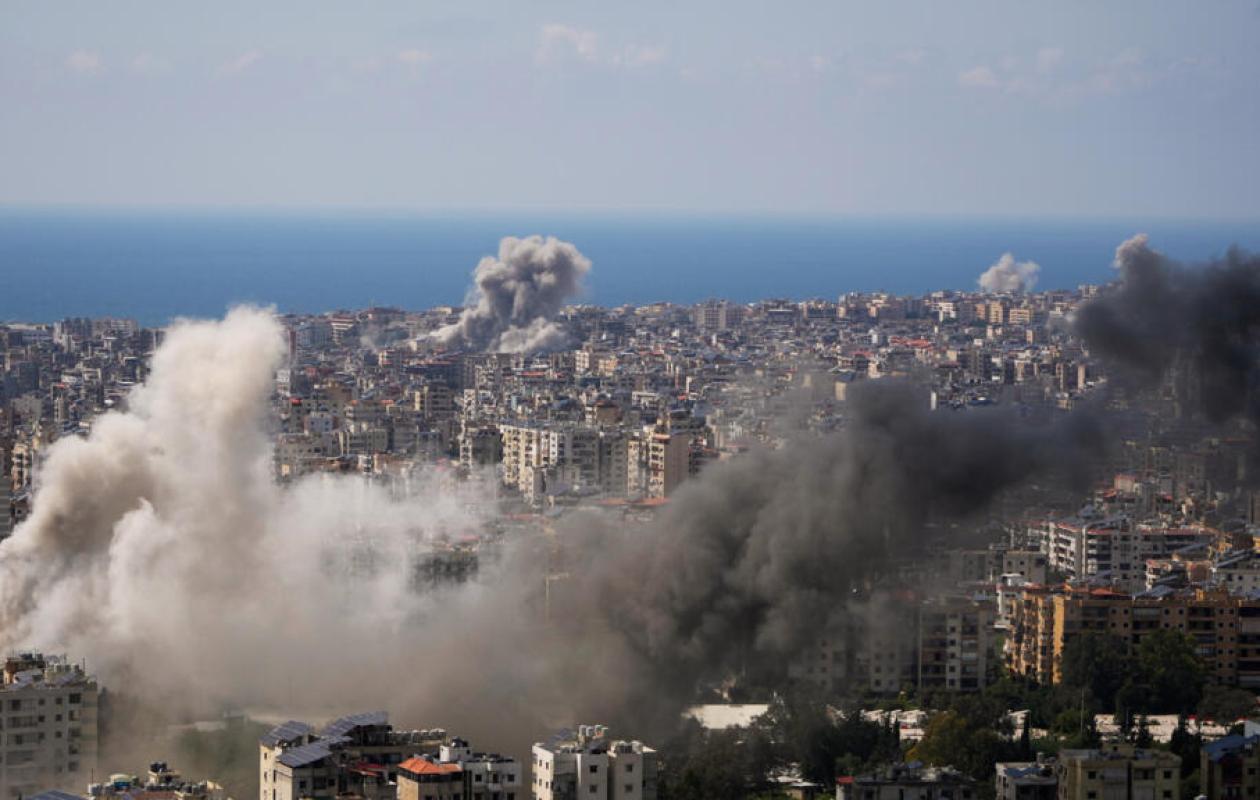
Israël bombarde le Liban, fragilisant la trêve avec l'Iran
The truce between Iran and the United States appeared to be hanging by a thread on Wednesday evening, with Tehran threatening to resume hostilities after Israel's deadly strikes on Lebanon.
Vice President JD Vance, who is scheduled to lead the U.S. delegation in talks with Iran in Pakistan on Saturday, said it was up to Iranian leaders to decide whether the truce failed because of Lebanon.
"If Iran wants this negotiation to fail because of a conflict in which they are getting thrashed in Lebanon, which has nothing to do with them, and which the United States has never said was part of the ceasefire, that's their choice," he said Wednesday before leaving Budapest.
Simultaneous Israeli strikes on Lebanon, particularly residential areas of Beirut, left 182 dead and 890 wounded on Wednesday, according to the latest figures from the Ministry of Health.
The Israeli army announced that it had carried out its "largest coordinated strike" against Hezbollah since the outbreak of the war on February 28, saying it had targeted "hundreds" of members of the pro-Iranian movement, including a commander.
A series of strikes targeted several neighborhoods in the heart of the capital without warning, causing scenes of panic.
"I saw the plane hit, people start running in all directions, and smoke rising," said Ali Younes, who was waiting for his wife near the Mazraa corniche, one of the targeted areas.
However, a ceasefire in Lebanon constitutes one of the "essential conditions" of Iran set out in its ten-point plan, the basis of the truce with the United States, Iranian President Massoud Pezeshkian insisted on Wednesday evening, according to the Isna agency.
The speaker of the Iranian Parliament, Mohammad Bagher Ghalibaf, deemed the ceasefire and negotiations with the United States "unreasonable".
Despite the cessation of Israeli-American bombings on Iran, after 39 days of a conflict that has left thousands dead, mainly in Iran and Lebanon, calm is still far from returning to the region, and uncertainty remains on the terms of the agreement.
Pakistan, which mediated the ceasefire, called on the parties to exercise "restraint".
"Ceasefire violations have been reported in a few places in the conflict zone, which undermines the spirit of the peace process," said Pakistani Prime Minister Shehbaz Sharif.
Representatives from both sides are due to meet in Islamabad on Saturday to negotiate a settlement to the war, beyond the two-week truce agreed on Tuesday night, at the last minute, before the expiry of an ultimatum from Donald Trump.
"I saw a strike, it was very strong, children were killed, others had their arms cut off," Yasser Abdallah, who works in an appliance store in an area near the site of one of the bombings in the Lebanese capital, told AFP.
These attacks have drawn widespread condemnation, from the UN to Iraq and Jordan.
The UN High Commissioner for Human Rights, Volker Türk, deemed the scale of the killings "appalling" and called on the international community to help end the "nightmare".
Lebanese Prime Minister Nawaf Salam has declared a national day of mourning on Thursday.
For its part, Hezbollah said it had the "right to retaliate." Iran's Revolutionary Guards also threatened to respond after the "brutal massacre" in Beirut.
The Pakistani Prime Minister had nevertheless declared that the ceasefire applied "everywhere", including in Lebanon, which Washington subsequently denied.
Another factor that could further weaken the ceasefire is that a senior White House official asserted that a ten-point plan publicly released by Iran was not the document serving as the basis for negotiations with the United States.
A list published by the Islamic Republic specifically mentions "maintaining Iranian control over the Strait of Hormuz, accepting uranium enrichment, and lifting all primary and secondary sanctions."
Donald Trump said he was ready to "discuss" "lifting (...) the sanctions" that are suffocating Iran's economy, but assured that there would be "no uranium enrichment".
The tone remains martial on the side of its Israeli ally: the ceasefire "is not the end of the campaign" against Iran, declared Prime Minister Benjamin Netanyahu, adding that Israel was "ready to resume the fight at any time".
Israeli police, however, announced that the holy sites of the three monotheistic religions in Jerusalem will reopen on Thursday.
After a Tuesday marked by strikes and threats of annihilation of "Iranian civilization" uttered by Donald Trump, the announcement of a truce came in the middle of the night in Iran.
"I still have pain because of the fear," Simin, a 48-year-old English teacher, told AFP. "The shock and psychological pressure were so intense that even now, we don't know whether we should feel relieved by the truce or not."
In the Gulf, caution is the order of the day as Iran has continued its retaliatory attacks on Kuwait and the United Arab Emirates, which intends to demand that Iran pay for "damages and reparations." Tehran said it was responding to airstrikes carried out after the ceasefire against its own oil facilities.
And according to the Financial Times, a drone attack targeted a major oil pipeline in Saudi Arabia.
Despite these incidents, the announcement of a gradual reopening of the Strait of Hormuz, a strategic corridor through which normally 20% of the world's hydrocarbon consumption passes, triggered a wave of relief on global markets, manifested by a fall in oil prices and a rebound in stock markets.
Two ships, one Greek and the other flying the Liberian flag, were able to cross the strait on Wednesday, but some players in the maritime transport sector have decided not to risk it yet, while more than 800 vessels are immobilized in the Gulf.
















Commentaires (2)
Participer à la Discussion
Règles de la communauté :
💡 Astuce : Utilisez des emojis depuis votre téléphone ou le module emoji ci-dessous. Cliquez sur GIF pour ajouter un GIF animé. Collez un lien X/Twitter, TikTok ou Instagram pour l'afficher automatiquement.