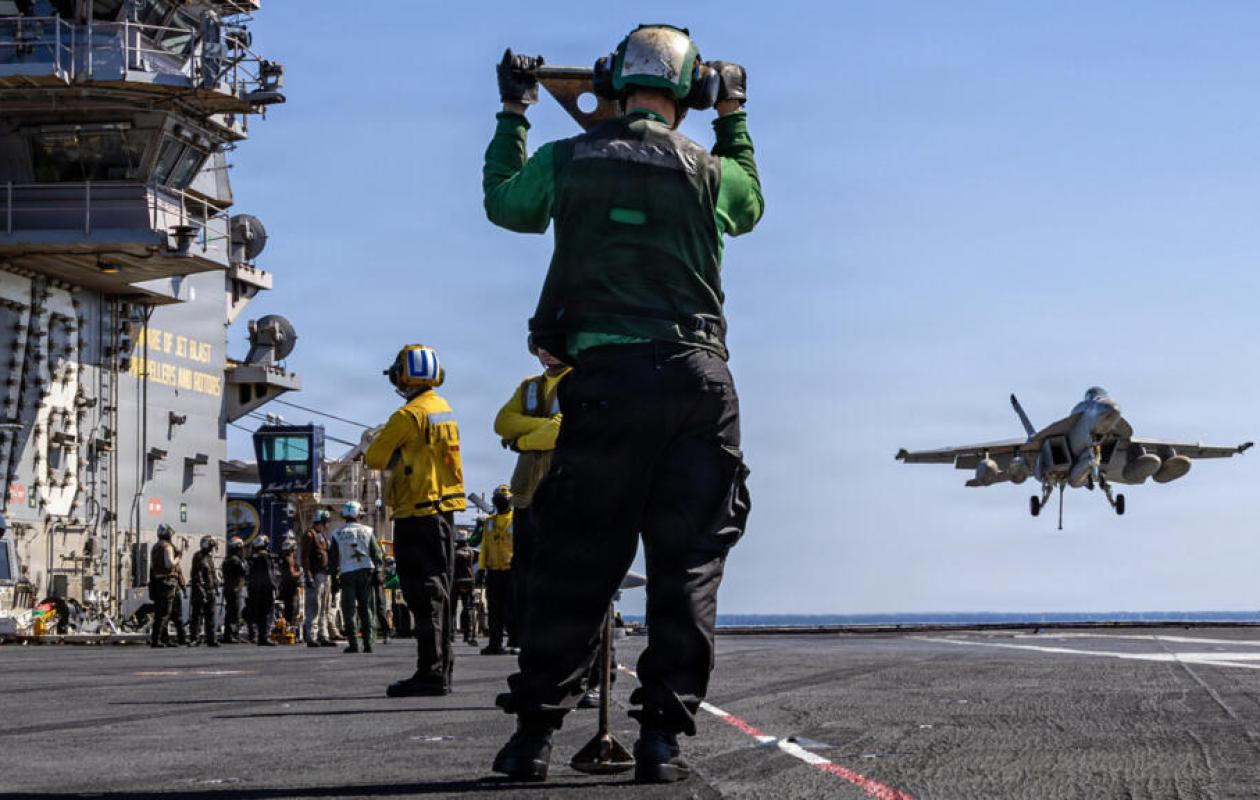
Moyen-Orient : l'armée américaine au défi d'une guerre prolongée avec l'Iran
How long will the American army be able to keep up the pace? Twenty days after the start of the Israeli-American offensive, the prospect of a "four or five week" war, as mentioned by Donald Trump, seems to be receding as Iran continues to strike the energy infrastructure of the Gulf on Thursday, March 19, and the hypothesis of a ground intervention gains credibility.
From the outset of the conflict, several experts warned in particular about the level of American missile stocks, which had already been used in June 2025 during the 12-day war waged against Tehran by Israel and then the United States.
According to a recent report by the American think tank Foreign Policy Research Institute (FPRI), the Israeli-American coalition fired a total of 5,197 munitions during the first 96 hours of Operation Epic Fury. Specifically, American fighter jets dropped 535 guided bombs, while the US Navy launched 375 Tomahawk cruise missiles. Defensively, the US military committed 325 PAC missiles used by Patriot batteries and 80 THAAD missiles, the two most advanced American air defense systems.
The figures mentioned reflect the intensity of the first hours of the operation but also raise questions about the sustainability of a long-term conflict, even for the arsenals of the world's leading military power.
Industrial challenge
The cost is already staggering for Washington: the first week of the war against Iran cost the United States more than $11.3 billion, according to a Pentagon briefing for members of Congress. To continue funding the American intervention, the Department of Defense has approached the White House for approximately $200 billion (€170 billion) in congressional funding, the Washington Post reports.
"For now, we don't know what this money could be used for. What portion would be intended for the continuation of operations in this conflict? Or is it to replenish our stocks of weapons, particularly anti-aircraft missiles and fighter jets?", asks Brian Finucane, former advisor to the State Department and expert at the International Crisis Group.
As the FPRI points out, the US military has lost several advanced radar systems in the Gulf states. At the beginning of the conflict, a Kuwaiti allied aircraft also shot down three US F-15 Eagles in a highly unusual incident. Furthermore, the loss of 11 MQ-9 Reaper drones has further increased the damage.
Beyond the question of cost, the entire American military-industrial complex is being put to the test because manufacturing such sophisticated equipment and munitions takes time and requires materials, such as rare earths, whose availability is not guaranteed.
"Whether in Ukraine or Iran, we are faced with a major issue, which is the use of low-cost drones in large numbers. However, air defense systems are not adapted to this threat, the munitions used are extremely expensive and stocks are limited," summarizes General Dominique Trinquand, an expert in international relations and former head of the French military mission to the UN in New York.
Faced with the predictable threat of Iranian drones in the Gulf states, the American military is attempting to adapt. This is evidenced by the deployment of Ukrainian operators tasked with combating the Shahed using interceptor drones, an area in which Kyiv possesses internationally recognized expertise.
Extended deployment
However, "the US military should be able to maintain the current pace of operations against Iran for at least several months, if the Trump administration so decides," says Justin Bronk, a research fellow at the Royal United Services Institute (RUSI) in London. "Ammunition consumption has been considerable so far, but that doesn't make operations unsustainable in the short term. The problem lies more in the significant impact on US strategic stockpiles."
A long war also means equipment that wears out more quickly, as evidenced by the recent misfortunes of the USS Gerald Ford, the world's largest aircraft carrier and centerpiece of the American armada. After experiencing several technical problems, notably with wastewater disposal, a fire forced the ship to suspend operations and head to Crete for repairs.
This episode comes as this giant of the seas and its 4,500 sailors approach ten months of deployment, a situation which weighs on the morale of the crew, already mobilized during the operation in Venezuela which led to the capture of President Nicolas Maduro.
"Very long deployments at sea cause a lot of problems. In France, ships have two crews or at least one and a half crews, which allows for crew changes. The Americans do not have this practice. It must be said that they have many aircraft carriers: 11 while we only have one," emphasizes Dominique Trinquand.
"This is the longest deployment since the Vietnam War, so I wouldn't be at all surprised if we found that these aircraft are worn out and on their last legs," says Brian Finucane. "However, we can't generalize this situation to the entire U.S. military. It's therefore difficult to know what role this might play in the future."
The risk of getting bogged down
However, a prolonged deployment in Iran could have consequences for US capabilities in the Indo-Pacific region, warns Justin Bronk.
"Sustained operations against Iran on this scale will have an increasing impact on the training, deployment cycles and readiness of the US Air Force and Navy for a conflict involving Chinese forces in the Indo-Pacific region. This is therefore probably where the US military will feel the strongest pressure to quickly complete current operations," the expert believes.
According to Brian Finucane, beyond the issue of ammunition stocks or human resource management, the main challenge for the American army lies in "the lack of a clear objective in this conflict".
"The American armed forces seem to measure their success by the number of targets hit, but ultimately, we don't really know where that leads. Focusing on the United States' ability to bomb Iran is probably not the right way to approach the problem," he believes. "The constraints on our ability or willingness to continue this war are more political in nature, in the sense that it leads to higher energy costs and increases the pressure exerted by our partners in the region, while more and more Americans feel the effects of the conflict."
Read also
With the deployment of the USS Tripoli and its marines to the Middle East, is a ground operation on the horizon?
Faced with the risk of a stalemate, several scenarios are emerging for the coming weeks. One is a negotiated ceasefire agreement, coupled with a new nuclear deal. This option is unlikely, however, given that Donald Trump has demanded the "unconditional surrender" of Iran, which, for its part, is demonstrating its determination to continue the war.
Another possibility would be for the American president to proclaim victory by claiming to have "destroyed all Iranian ballistic missile sites, for example, just as he said in June that he had destroyed all of Tehran's nuclear capabilities. In short, to claim a victory that will probably not be complete," predicts Dominique Trinquand. "He might seek this exit strategy for at least two reasons: first, because of the overheating markets, which is very important to him, but also because of the lack of support from the American public."
As Washington prepares to deploy more Marines to the region, the latest scenario would involve a ground military intervention. This red line would plunge the US Army into a new phase of the conflict, as perilous militarily as it is politically for the American president.











![[EXCLUSIF] Kaolack : Un vigile de banque et un fils de notable à la tête d'un réseau d'actes contre nature sur des mineurs](https://image.seneweb.com/content/news/2026-17-24//thumb_1260x800_69ebcedead0ea_Zz76TxOZR9.jpeg)










Commentaires (0)
Participer à la Discussion
Règles de la communauté :
💡 Astuce : Utilisez des emojis depuis votre téléphone ou le module emoji ci-dessous. Cliquez sur GIF pour ajouter un GIF animé. Collez un lien X/Twitter, TikTok ou Instagram pour l'afficher automatiquement.