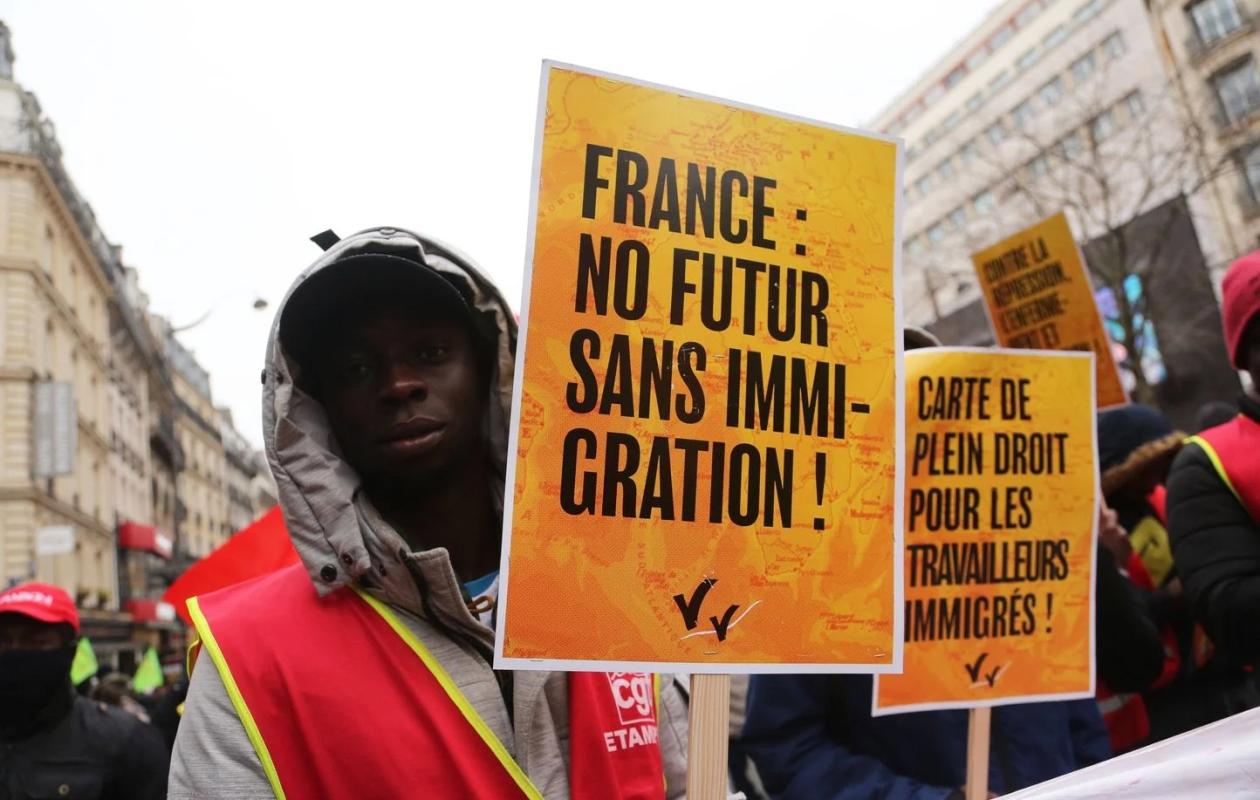
Un test civique, futur passeport des étrangers souhaitant s’installer en France
The rules are tightening for foreigners who want to settle permanently in France starting in January. According to a decree published at the last minute in October before the departure of former Interior Minister Bruno Retailleau, foreigners applying for a multi-year residence permit or resident card for the first time, as well as those applying for naturalization, will first have to pass a civics test (in addition to the interview at the prefecture, which remains in effect).
This test was introduced by the latest immigration law, enacted in January 2024, as part of the "Republican Integration Contract" (CIR) signed by all non-European foreigners legally residing in France, which also includes a language exam. Lasting forty-five minutes, the test, developed by the Ministry of the Interior, will be administered digitally in approved testing centers responsible for setting the fees.
The test consists of forty multiple-choice questions across five themes: "Principles and Values of the Republic" (motto, secularism), "Rights and Responsibilities of Life in France," "Institutional and Political System" (right to vote, foundations of the European Union), "History, Geography, and Culture," and "Life in French Society" (access to healthcare, labor law). To achieve this feat, a score of 80% is required, thus passing the test, which is now an essential prerequisite for obtaining a long-term qualification with no limit on the number of attempts.
Different levels of difficulty are planned depending on the type of residence permit applied for and the language level required for each. The initial version was subsequently "made more challenging by the office of the former Minister of the Interior before his departure," a source close to the matter revealed, much to the dismay of migrant rights organizations who fear a "high" failure rate.
Concerns of associations
“To understand political issues, a good level of written French and the ability to grasp concepts are essential,” points out Hélène Ceccato, in charge of French language learning for Secours Catholique (Catholic Relief Services). “Foreigners are expected to have a higher level of French than French citizens: a significant portion of French people are illiterate, and a considerable number have not attended university,” she emphasizes, noting that the B2 level of French required for naturalization is also the level required for university admission.
On its website, the Directorate General for Foreigners in France (DGEF), responsible for developing the content of the civic test, has made revision sheets available. These sheets explain, for example, that the Constitution of October 4, 1958, is the founding text of the Fifth Republic and that it is composed of a Preamble and 108 articles, and that decentralization consists of the transfer of powers and resources from the State to other authorities, called local authorities. They also state that since the 2024 elections, France has 81 Members of the European Parliament, and that the national holiday commemorates the storming of the Bastille prison by Parisians, marking the beginning of the French Revolution—the people's revolt against the Ancien Régime.
“It’s quite disconnected from reality and what makes us feel like citizens. For example, involvement in associations, whether parent-teacher associations or others, isn’t taken into account,” criticizes Hélène Ceccato of Secours Catholique (Catholic Relief Services). Because temporary residence permits can only be renewed three times, applicants for multi-year permits who were previously in the country legally could find themselves undocumented, the associations worry.





















Commentaires (5)
90% des émigrés ne savent pas parler Français correctement sans parler des naturalisés...
Tout étranger âgé de 18 ans et plus ayant résidé au Sénégal :
pendant 10 ans
pendant 5 ans et ayant épousé une Sénégalaise
pendant 5 ans par dérogation.
Quels sont les documents à fournir ?
Une demande manuscrite adressée au ministre de la Justice aux fins de naturalisation
Un acte de naissance de l’intéressé(e), en copie littérale et en original
Un bulletin n° 3 du casier judiciaire délivré par le tribunal du lieu de naissance de l’intéressé(e) ou par la Cour d’Appel du lieu de résidence de l’intéressé(e) si ce dernier est né à l’étranger ;
Un certificat de résidence délivré par le préfet du lieu de résidence ;
Un certificat de visite et de contre-visite ;
Un certificat de bonne vie et mœurs ;
Une attestation d'imposition ou de non-imposition délivrée par le chef de centre des services fiscaux du lieu de résidence de l’intéressé (e).
La production de ces pièces est obligatoire.
Participer à la Discussion
Règles de la communauté :
💡 Astuce : Utilisez des emojis depuis votre téléphone ou le module emoji ci-dessous. Cliquez sur GIF pour ajouter un GIF animé. Collez un lien X/Twitter ou TikTok pour l'afficher automatiquement.