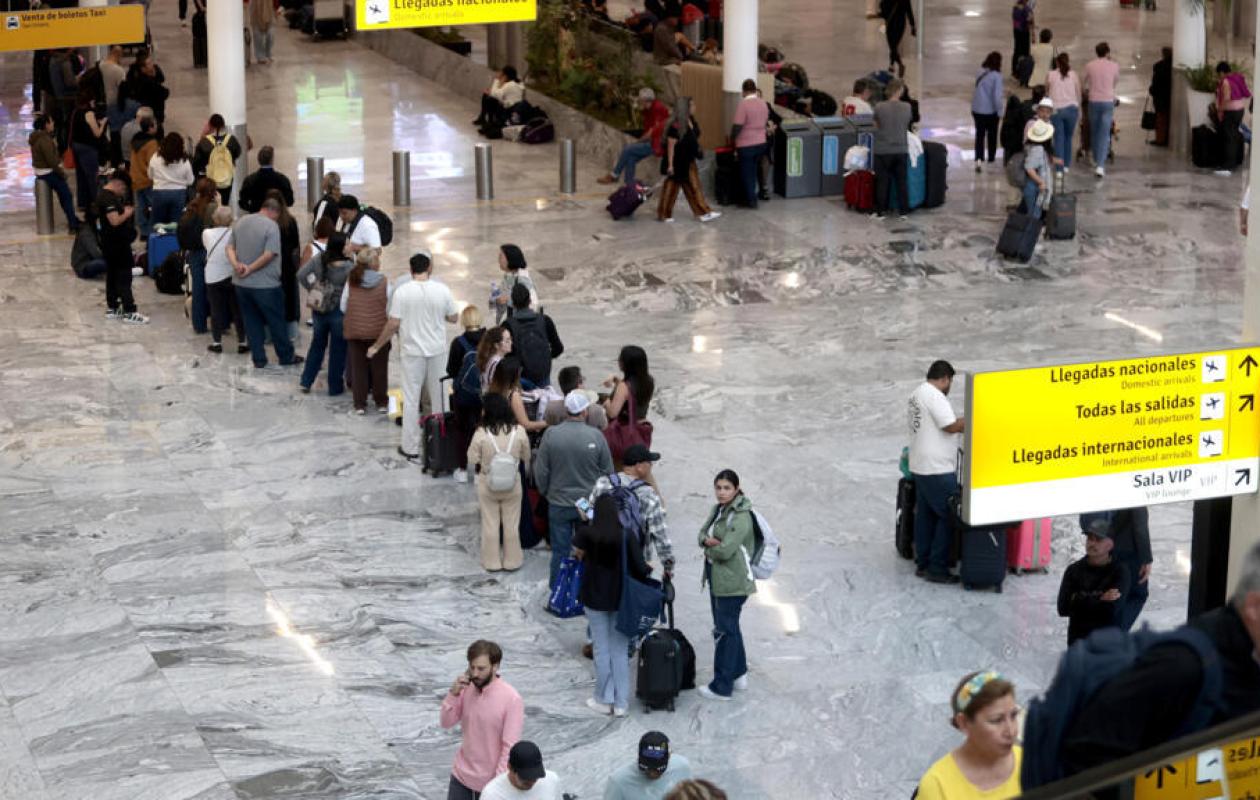
Troubles au Mexique après la mort du chef d'un des principaux cartels, tué par l'armée
Unrest broke out in Mexico on Sunday after the death of the leader of one of the world's largest drug cartels during a military operation, with the Mexican president calling for calm and the United States urging its citizens to stay "safe".
North American airlines have cancelled dozens of flights to several Mexican cities.
"We must remain informed and calm," President Claudia Sheinbaum told Network X, after armed men blocked several roads and set fire to businesses in the states of Jalisco, Michoacán, Guanajuato, Puebla and Sinaloa.
The United States has called on its citizens in several areas of Mexico, including tourist cities and regions such as Cancun, Guadalajara and Oaxaca, to "take shelter until further notice".
"Due to ongoing security operations, roadblocks and criminal activity, U.S. citizens in the aforementioned locations should seek shelter until further notice," the U.S. Embassy in Mexico said on its website.
Killed at the age of 59, Nemesio Oseguera, alias El Mencho, was considered the last of the great godfathers since the arrest of the founders of the Sinaloa cartel, Joaquín Guzmán "El Chapo" and Ismael "Mayo" Zambada, who are incarcerated in the United States.
He was one of the most wanted drug lords by Mexico and the United States, who offered up to $15 million for his capture.
"El Mencho" was wounded during an operation in the town of Tapalpa, in the state of Jalisco (west), and died "during his transfer by air to Mexico City," the army said in a statement.
She added that, in order to carry out the operation against the drug trafficker, "additional information" had been obtained from the American authorities.
After this operation, armed men blocked several roads in the state of Jalisco with burning cars and trucks.
The blockades have also spread to the neighbouring state of Michoacán, where Oseguera's group is present.
Local authorities have advised the population not to leave their homes.
- "Great victory" for Washington -
Christopher Landau, U.S. Under Secretary of State, called the drug trafficker's death "a great victory for Mexico, the United States, Latin America, and the entire world."
In total, seven criminals were killed and three soldiers wounded. Two members of the CJNG were arrested and various weapons were seized, including rocket launchers capable of shooting down aircraft and destroying armored vehicles, according to the same source.
The match between Querétaro and Juárez, counting towards the seventh day of the Mexican first division championship, was suspended due to the violence following the death of the drug trafficker.
The women's championship also suspended the clásico between Guadalajara and América, scheduled for the Akron stadium in Zapopan (Guadalajara), and the Liga Expansión (second division) postponed the match between Tapatío and Tlaxcala, which was to take place at the Gregorio "Tepa" Gómez stadium, also located in the state of Jalisco.
The CJNG, which Oseguera had formed in 2009, was designated a terrorist organization in 2025 by the United States, which accuses it of trafficking cocaine, heroin, methamphetamine and fentanyl.
- Violent cartel -
The CJNG is one of the most violent cartels in Mexico, according to the State Department, which describes it as a "transnational cartel, present in almost all of Mexico," that engages in extortion, migrant smuggling, oil and mineral theft, and arms trafficking.
Interviewed by AFP, José Reveles, a writer specializing in drug trafficking, described "El Mencho" as a man with a "violent nature", who was not afraid to confront the authorities head-on, when other cartels are more on the defensive.
Thus, on June 20, 2020, he launched an unprecedented attack against the current Federal Secretary of Public Security, Omar García Harfuch, then head of the capital's police force, who was injured. Three people died, including two bodyguards.
For a long time, "El Mencho" was unable to compete with the cartels that controlled the border with the United States. He then turned to other markets. "Europe, Asia, Africa, and even Australia were less contested by the Mexicans, and drugs fetch a higher price there," explains Mr. Reveles.
Oseguera "was very careful not to expose himself publicly, we know little about his life," observes Mr. Reveles.
On the State Department's wanted poster, he appears with an angular face, impeccably combed hair and a thin mustache, while on a 1989 US Drug Enforcement Administration (DEA) card, he is seen with curly hair and coarser features.
Cartel-related violence has left more than 450,000 dead and more than 100,000 missing since 2006 in Mexico, according to official figures.















Commentaires (1)
Participer à la Discussion
Règles de la communauté :
💡 Astuce : Utilisez des emojis depuis votre téléphone ou le module emoji ci-dessous. Cliquez sur GIF pour ajouter un GIF animé. Collez un lien X/Twitter, TikTok ou Instagram pour l'afficher automatiquement.