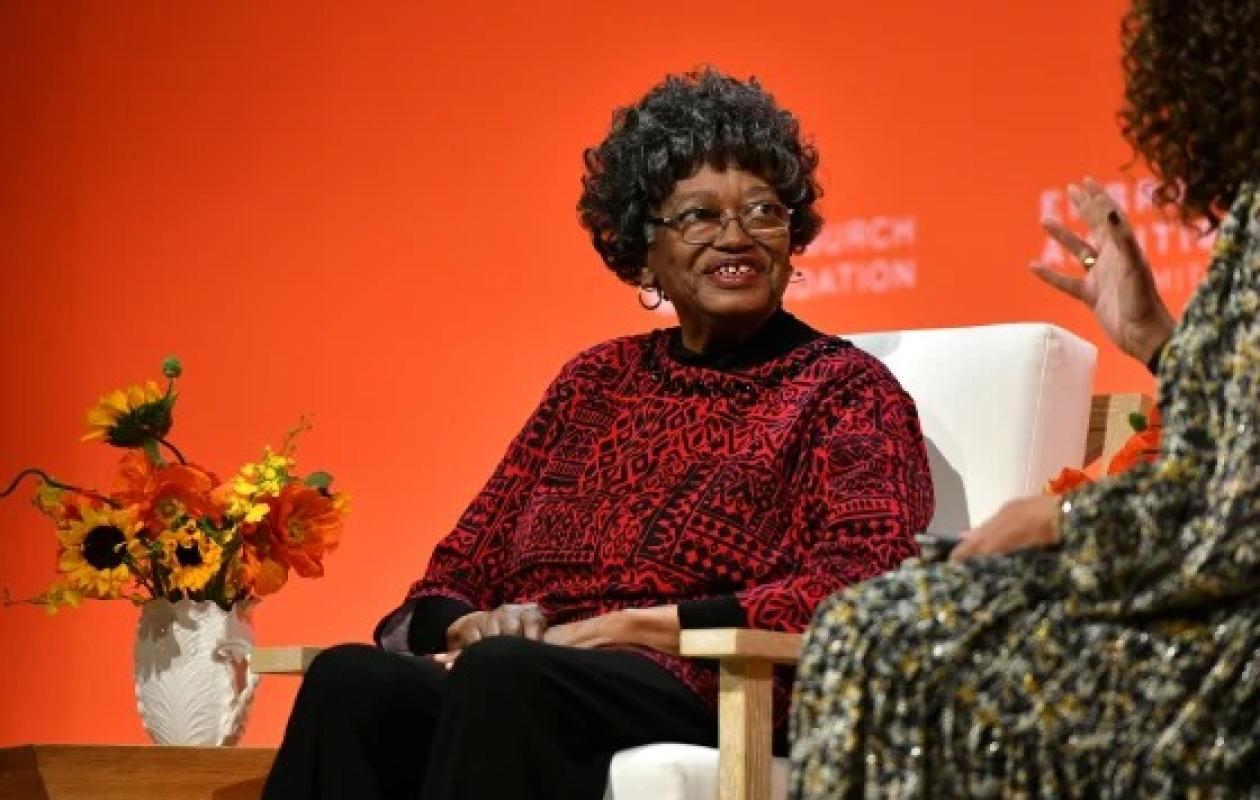
Décès de Claudette Colvin, figure des droits civiques aux États-Unis
Claudette Colvin, a black woman who made American history for refusing to give up her seat to a white woman on a bus in segregated Alabama, died Tuesday at the age of 86.
Claudette Colvin, who in 1955 became an African-American figure of civil rights for refusing at age 15 to give up her seat on a bus in segregated Alabama to a white woman, nine months before Rosa Parks, died at the age of 86, her foundation announced on Tuesday, January 13.
"For us, she was more than a historical figure. She was the heart of our family, wise, resilient and faith-based," the Claudette Colvin Foundation wrote in a statement.
History remembers Rosa Parks, the black seamstress from Montgomery who, by refusing on December 1, 1955 to give up her seat to a white passenger, triggered the first major movement of passive resistance against segregation.
As the local head of the NAACP, a major civil rights organization, Rosa Parks, along with Martin Luther King Jr., spearheaded the Montgomery bus boycott. The city buses remained out of service for 381 days.
The first to plead not guilty
Before her, however, in the same city and on the same bus line, a 15-year-old high school student, affiliated with the NAACP, defied racist laws. Other passengers had already done so, but she was the first to plead not guilty in court.
On March 2, 1955, she told AFP in 2023, "as the bus went down the main street, more and more white passengers boarded, and the driver asked everyone to free up their seats." "Two or three stops later, a policeman asked me what I was doing sitting there. I said I had paid for my ticket and that it was a constitutional right. I wanted more than anything to defy him, and I refused to get up." "History has me glued to my seat," she said at the time.
The police threw her, handcuffed, into their car. "I started crying, anguish overwhelmed me," she also told NPR. "I started praying." Lewd remarks were hurled at her. She was imprisoned.
She was quickly released after jointly paying her bail. Upon her return, the neighbors congratulated her and stood guard, fearing her house might be targeted.
After pleading not guilty, she was convicted of disturbing the peace, violating segregation laws, and assaulting a law enforcement officer. The young woman appealed, but to no avail: she was convicted again.
Accused of dissolute morals
At that time, she learned she was pregnant by an older man. Still a minor and unmarried, she was accused of dissolute morals and could no longer serve as a figurehead for civil rights organizations.
This is where Rosa Parks comes in. "She was an adult: she would be more reliable than a teenager," Claudette Colvin explained to NPR. "Her complexion made her seem middle-class. She had the right profile and possessed a natural authority."
In the midst of the boycott, the city of Montgomery convicted about a hundred organizers of the movement in February 1956, including Martin Luther King Jr. and Rosa Parks. Two of their appeals were rejected. Fired from her job, Rosa Parks was forced to flee the city.
With Rosa Parks' case stalled in local courts, the NAACP decided to take the case of Claudette Colvin and three other passengers to federal court.
On June 5, 1956, the first victory was achieved: two federal judges declared segregation on buses unconstitutional. Montgomery and Alabama appealed. But the Supreme Court ruled against them. On November 13, 1956, it ruled that segregation in public transportation in the South was unconstitutional.
Things didn't improve much for Claudette Colvin: because of her pregnancy out of wedlock, she was expelled from college and couldn't find work in Montgomery. In 1958, she moved to New York, became a nursing assistant, and wouldn't elaborate on her past for a long time.
In 2005, she told the local Montgomery newspaper: "I feel very, very proud. I feel like what I did was a spark."
"People should know that Rosa Parks was the right person for the boycott. But they should also know that lawyers took four other women to the Supreme Court to challenge the law that led to the end of segregation."























Commentaires (0)
Participer à la Discussion
Règles de la communauté :
💡 Astuce : Utilisez des emojis depuis votre téléphone ou le module emoji ci-dessous. Cliquez sur GIF pour ajouter un GIF animé. Collez un lien X/Twitter, TikTok ou Instagram pour l'afficher automatiquement.