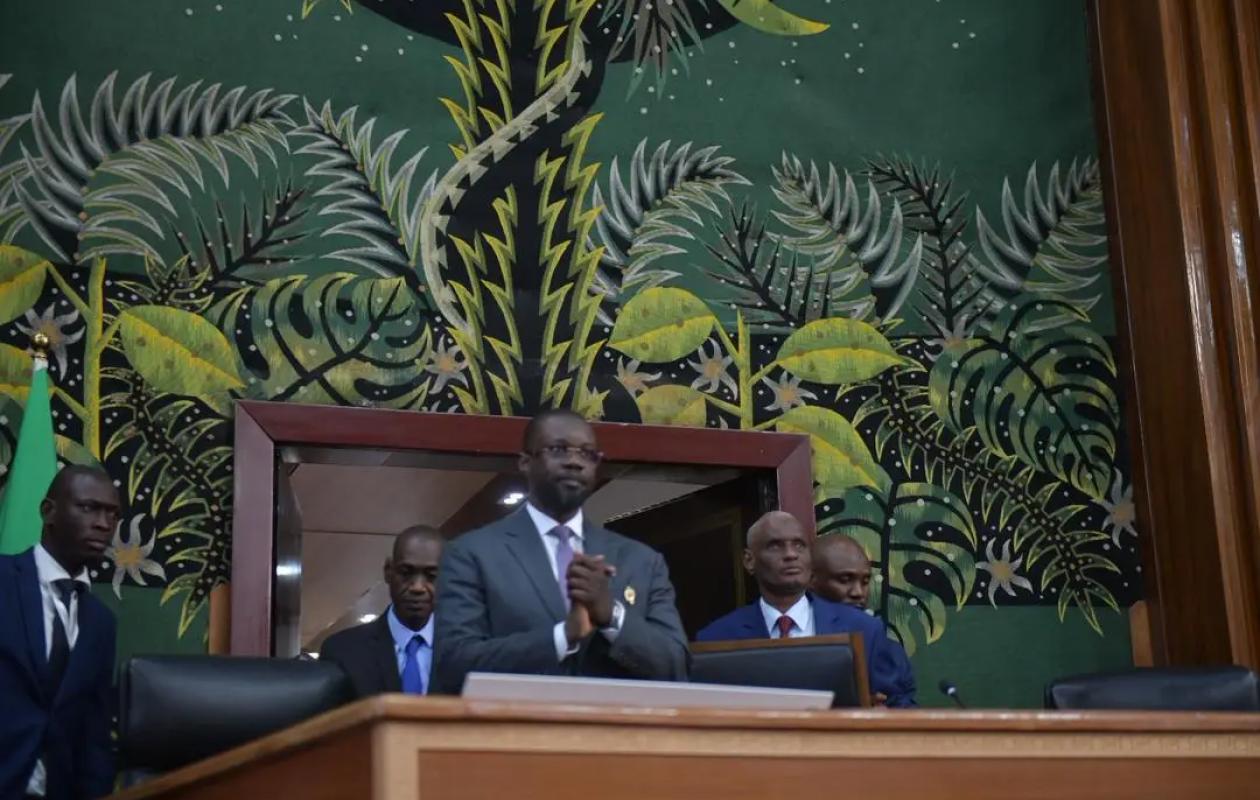
Assemblée : Ousmane Sonko transforme son discours d’installation en manifeste politique
Barely elected president of the National Assembly, Ousmane Sonko delivered, on Tuesday, May 26, 2026, a dense, solemn and profoundly political speech, mixing the assessment of his time at the Prime Minister's office, a strong institutional tribute, a philosophical reflection on power and a clear warning aimed at the executive.
Facing the members of parliament gathered in the chamber, the leader of Pastef first placed this historic day under a strong spiritual symbol, evoking "the day after Pentecost for Christians" and "a day of fasting and meditation for Muslims".
Reflecting on his recent departure from the Prime Minister's office, Ousmane Sonko offered what he considers a "very precise" assessment of his actions at the head of the government. He specifically cited transparency in public management, the renegotiation of Senegal's strategic interests, the moralization of public life, the relentless fight against corruption, the drastic reduction of government spending, economic and social reforms, as well as controlling the cost of living and achieving lasting social peace.
The new Speaker of the National Assembly also emphasized what he considers the strong ideological markers of his time at the Assembly building on Avenue Roume, mentioning "the demand for justice," "the protection of fundamental societal values," and structural reforms related to public governance. In the same vein, Ousmane Sonko paid a heartfelt tribute to his predecessor, El Malick Ndiaye, praising "his unwavering loyalty to patriotic ideals" and his remarkable work at the helm of the institution.
According to him, El Malick Ndiaye profoundly modernized the National Assembly, in terms of its facilities, personnel, finances, and technology. He highlighted, in particular, the building's renovation, the significant improvement in working conditions for parliamentary staff, budgetary discipline, and the advanced digitalization of legislative work.
But it was above all on the political and institutional front that the speech took a distinctly more offensive turn. Drawing on his past experience as an opposition MP for five years, then as mayor, and finally as Prime Minister, Ousmane Sonko affirmed his desire to transform the National Assembly into a genuine institutional counterweight.
"Some believed that the dismissal of a Prime Minister meant his political demise. Obviously, in a true democracy, no office exhausts popular legitimacy," he told his detractors.
In one of the most striking passages of his speech, he asserted that the National Assembly under his leadership "will not be a rubber-stamp chamber." "It will oversee government action. It will fully exercise its constitutional prerogatives of voting on laws, scrutinizing government action, and evaluating public policies," the Pastef leader emphasized. While promising not to exploit the institution for "personal vendettas" or to "create institutional chaos," he warned that the Assembly would use "all the checks and balances" provided for in the Constitution.
Public morality at the heart of the Republic
His speech was also peppered with numerous philosophical, historical, and religious references. Citing Aristotle, Saint Augustine, Mamadou Dia, Aline Sitoé Diatta, and even Caliph Omar Ibn Khattab, Ousmane Sonko developed a lengthy reflection on public morality, the dignity of peoples, and the ethical responsibility of leaders. According to him, "a nation can survive material poverty but rarely the collapse of its public morality."
In a direct address to the entire political class, he finally called for preserving the country's stability despite the current tensions perceptible at the highest levels of government. "Senegal must show Africa that a political crisis can be confronted without hatred, without violence, and without institutional collapse," he stated, before extending a hand to all parliamentarians, "from both the majority and the opposition."
Concluding on a solemn note, the new president of the National Assembly declared that he wanted to continue to "choose truth rather than comfort," in what already resembles a true political manifesto for the new institutional phase that is now opening at the top of the Senegalese state.









Commentaires (15)
Participer à la Discussion
Règles de la communauté
💡 Astuce : Utilisez des emojis depuis votre téléphone ou le module emoji ci-dessous. Cliquez sur GIF pour ajouter un GIF animé. Collez un lien X/Twitter, TikTok ou Instagram pour l'afficher automatiquement.
Se connecter
Commentez avec votre profil, votre photo, et soyez averti des réponses.