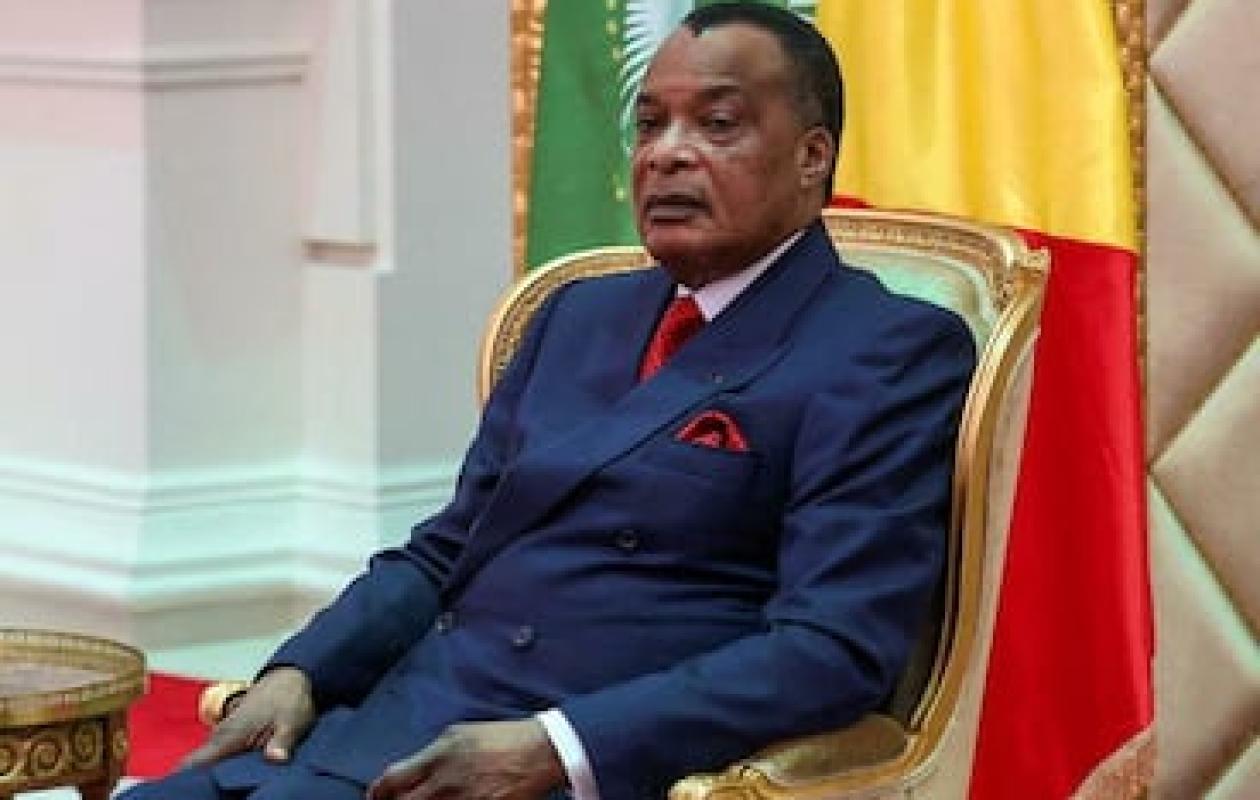
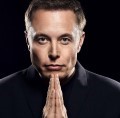
[Portrait] Sassou Nguesso, "l'Empereur" du Congo qui refuse de passer la main
At 82, Denis Sassou Nguesso, a career military man and candidate again in Sunday's presidential election in Congo-Brazzaville, has accumulated 40 years of rule at the head of this oil-rich Central African country.
In terms of longevity in power, he is surpassed on the continent only by his counterparts of Equatorial Guinea Teodoro Obiang Nguema and of Cameroon Paul Biya.
A strong ally of France, a former colonial power that has lost influence on the continent, it skillfully cultivates its ties with Russia and China.
President? Some have nicknamed him "the Emperor". Having come to power in 1979, during the era of the single party, dismissed in 1992 at the ballot box during the return of multi-party politics, returned by force of arms in 1997, he prefers the symbol of the elephant which he displays on his campaign clothes.
His age does not prevent the presidential candidate from holding a series of election rallies.
"He is a military man," emphasizes one of his close associates, admiring his longevity when his opponents see him as an autocrat worn down by time.
In an interview with AFP in early March, in one of his luxurious residences in Dolisie (south), Denis Sassou Nguesso appeared affable and responded without flinching to criticism.
"Before blaming us (...) for a lack of progress in the development of the country, it must first be said that at independence, in 1960, the Congo did not have a single kilometer of paved road outside the cities," he recalls.
At the time, Denis Sassou Nguesso, born in November 1943 in Edou, a town more than 400 km north of Brazzaville, was beginning the military career that would take him to the top of the state.
Between 1961 and 1963, he trained at the reserve officers' school in Cherchell, in an Algeria that was still French, then at the infantry application school in Saint-Maixent (western France).
As a young officer, in 1968 he participated in the movement that ousted President Alphonse Massamba-Débat in favor of Commander Marien Ngouabi, who wanted to build a "socialist" society in the tropics, and then the following year in the founding of the Congolese Labour Party (PCT), the single Marxist-Leninist party.
A key element of the security apparatus of a regime aligned with the Soviet bloc, he came to power in 1979, two years after the assassination of Ngouabi, and concentrated all the powers until 1992.
Defeated by Pascal Lissouba in the presidential election marking the return to multiparty politics, Denis Sassou Nguesso leaves for a short exile in France.
He returned to Congo in 1997, a country ravaged by violence from political militias, which plunged it into civil war.
His own "cobra" militia, supported by Angolan soldiers, prevailed after four months of fighting in Brazzaville, which left thousands dead.
Control of the army and the public treasury allows the victor of the civil war to establish a "climate of terror", while buying the loyalty of the party's bigwigs, says Clément Mierassa, a historical opponent and former minister.
According to him, these two "pillars" ensure his longevity, which he consolidates through successive triumphant re-elections and constitutional reform.
"He sets the rules of the game, the Constitution, he tramples on it," Mr. Mierassa protests.
Few dispute it. Defeated in the 2016 presidential election, General Jean-Marie Michel Mokoko, and former minister André Okombi Salissa, who reject his victory, have been serving 20-year sentences of forced labor for "undermining the internal security of the State".
His detractors denounce his lavish lifestyle, the omnipresent corruption, the grip of his family and his Mbochi ethnic group on the State, in a country where half the population lives in poverty, according to the World Bank.
Difficult to estimate, the fortune of the Sassou Nguesso family is the subject of several investigations, notably in the United States or France, where it is at the center of the "ill-gotten gains" case.
Norwegian authorities recently charged two individuals and a company suspected of paying $25 million to the Congolese president and his associates.
The British NGO Global Witness has accused one of his sons (and potential successors), Denis Christel Sassou Nguesso, of embezzling tens of millions of dollars.
Denis Sassou Nguesso, for his part, denies that the country's resources are "wasted", asserting that the oil windfall benefits the people and has allowed the country to reach "its current level".
Future generations "will find roads, railways, electricity, ports," universities and schools, he assures.
Stressing that he will "not remain in power forever", Denis Sassou Nguesso still refuses to comment on a possible successor.
In the event of another victory in Sunday's election, the "leap into the void" feared by his supporters should be postponed until 2031, as the Constitution in principle prevents him from running again.
![[ EXCLUSIF] Escroquerie au visa : Ass Dione passe aux aveux, le montant du préjudice dévoilé](https://image.seneweb.com/content/news/2026-21-21//thumb_1260x800_6a0e4fa45e2f9_JtdXe63zlf.jpg)






Commentaires (2)
Participer à la Discussion
Règles de la communauté :
💡 Astuce : Utilisez des emojis depuis votre téléphone ou le module emoji ci-dessous. Cliquez sur GIF pour ajouter un GIF animé. Collez un lien X/Twitter, TikTok ou Instagram pour l'afficher automatiquement.