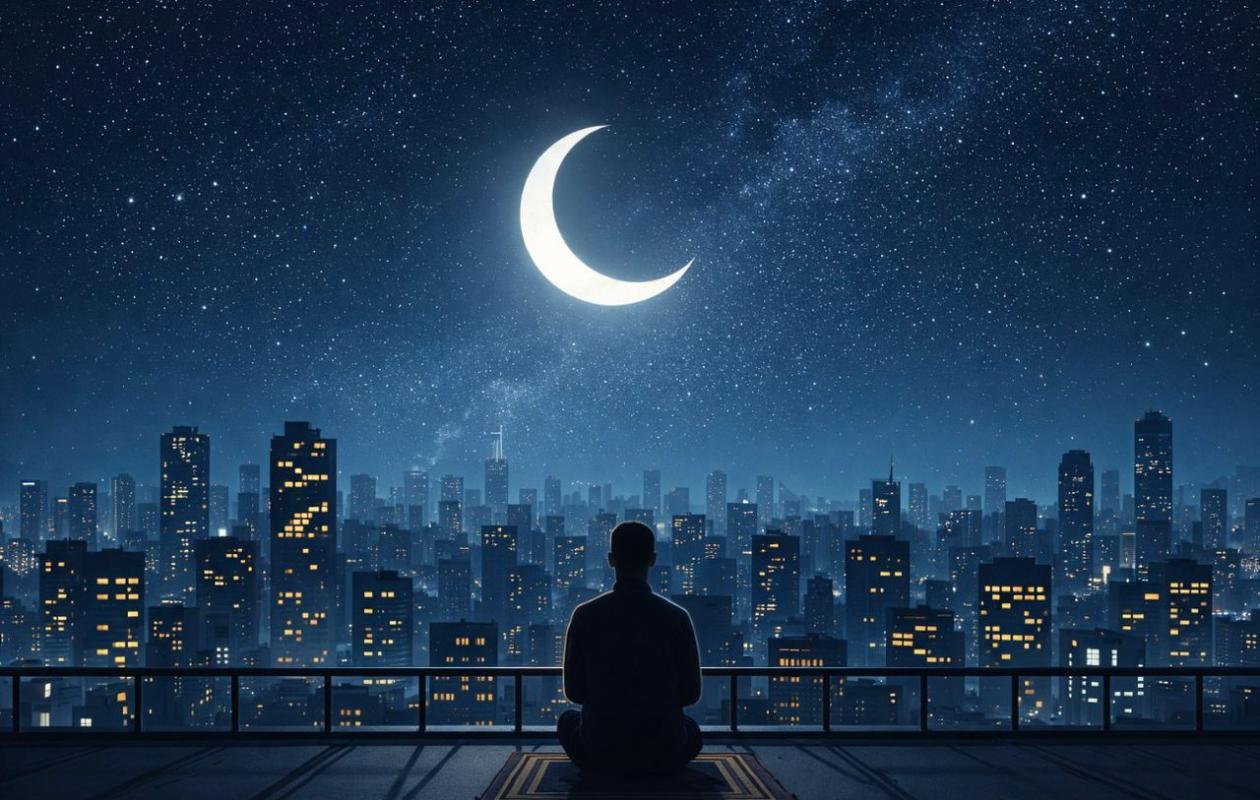
Entre la Lumière et les lumières : une humanité en quête de Vérité
One month. Forty days. Two traditions. One shared quest for spiritual elevation.
These are times when the body slows down and the mind seeks light, in mosques, in churches, or simply in inner silence. Yet, on a global scale, this doesn't occupy the major players, even though this movement concerns nearly 60% of humanity.
While the world is in turmoil, divided, and ablaze, a majority of human beings fast, pray, meditate, and try to connect with the deeper meaning of existence. But our modern era tends to relegate spirituality to the private sphere, making it almost invisible. The priority seems to lie elsewhere: in materialism, immediacy, and consumerism. The world believes itself to be driven by scientific advances, overproduction, social media hype, and virality.
Today, how many people actually take the time to question the truth? 24-hour news channels and social media bombard us daily with a flood of information that affects our moods more than our governance. Falsehood is all too often a public policy strategy. In this constant noise, truth seems to have become fluid, influenced by persuasion, the dominant narrative, or popularity. And yet, the quest for spirituality remains very real. So let's ask the question simply: What is Truth? Where is it? What are its limits?
As history shows, scientific truth evolves. It corrects itself, becomes more precise, and transforms. Religious truth, on the other hand, claims to be permanent. Yet both claim to speak the Truth. So how can we recognize a universal Truth?
Let's consider a natural truth. Saying that the sky is blue is a truth. Saying that the Earth is round is also a truth. The lunar cycle, the solar orbit, the certainty of death: these are realities that no one can alter. These universal truths have four characteristics: They are constant; They are invariable; They are inviolable; And they always retain an element of mystery.
Faced with these criteria, scientific theories are often valid truths under certain conditions, until a new discovery leads to their revision. Despite the blind faith many place in it, science, through its very process, is actually telling us: I am searching, I am in a perpetual quest for Truth. Can we then say that science is not truth itself, but a sincere quest for Truth?
Let us now try to apply this framework to religious truth. Let us take the Quran. Approximately six centuries after Jesus Christ, the angel Gabriel revealed these first words to the Prophet Muhammad (peace be upon him): “Read in the name of your Lord who created. He created man from a clinging substance. Read! Indeed, your Lord is the Most Generous, who taught man by the pen and taught him that which he did not know.” (Surah 96, verses 1-5)
Thus began the revelation of the Quran, which spanned 23 years. For over 1460 years, the Quranic text has remained unchanged. No additions. No revisions. No competing versions. Why?
Because its transmission relies on a unique phenomenon: collective human memory. Since its revelation, the Quran has been memorized, generation after generation, on every continent. Even today, millions of people know it in its entirety. On a historical scale, billions of human memories have carried it. Modifying the Quran would be, in practice, impossible. It would require simultaneously erasing this text from the living memories of millions of people, everywhere on Earth, at the same instant. An unrealizable condition. One could almost speak of a modern analogy: the Quran as a human blockchain over 1460 years old—a text engraved in the hearts of humankind and replicated identically, forming an interconnected network where the heart of each believer is a node.
But beyond its preservation, one fact is intriguing. Despite centuries of study, the Quran continues to be explored, interpreted, and discovered. Like the universe itself, it seems inexhaustible. Thus, like the great truths of nature, it seems to meet the criteria of a universal truth: constant, unchanging, inviolable, and imbued with mystery. Ultimately, what if the true Light of Truth were that which shines through time without fading?
So, science and religion: where does the Truth lie? I would say: in both, but in different dimensions. Whatever the scientific truth, its effects on you end with death. Religious truth, however, impacts you here on Earth and its effects will follow you after death: for better in Paradise for eternity, or for worse in Hell for eternity, according to the will of Allah Subhanahu wa Ta'ala.
Bilal At-Tawbah
Note: Since 2020, I have been personally immersed in profound spiritual reflection. A form of inner dialogue with the unseen, made up of questions, meanings, and visions. This journey led to the writing of a book: "13.7 – The Code of the Universe Encrypted in Muslim Prayer: Salat." A revelation of the scientific and historical miracles of the Salat ritual. Available here: https://www.at-tawbah.org
















Commentaires (1)
Participer à la Discussion
Règles de la communauté :
💡 Astuce : Utilisez des emojis depuis votre téléphone ou le module emoji ci-dessous. Cliquez sur GIF pour ajouter un GIF animé. Collez un lien X/Twitter, TikTok ou Instagram pour l'afficher automatiquement.