LA SALĀT, CODE DU TEMPS : Les cinq grands prophètes comme cycles de l’humanité
What if daily prayer revealed a hidden interpretation of human history? For centuries, Salat has been seen as a spiritual pillar of Islam. But beyond the ritual, one can perceive a deeper structure: an organization of time, a symbolic language, even a map of human history.
The U'l-'Azm, the pillars of revelation: Allah says in Surah 46, verse 35: "So be patient, as were the steadfast messengers (U'l-'Azm)... " Scholars generally identify the U'l-'Azm as: Noah, Abraham, Moses, Jesus, and Muhammad (peace be upon him) .
These prophets appear at times when pure monotheism had disappeared or slipped towards a form of idolatry. They mark ruptures, new beginnings, spiritual dawns .
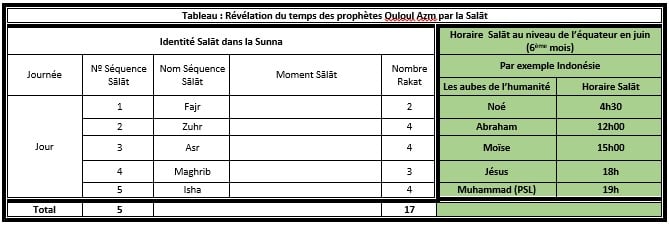
If we consider that Dawn corresponds to Salat al-Fajr—composed of two rakats, or 13 genuflections—then this structure becomes a key to understanding the list of the Prophets Ullul Azm minal Rasul. Let us therefore return to the table of the daily Salat:
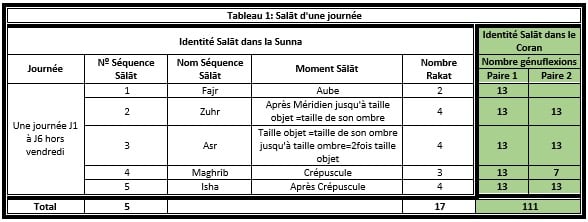
Let us count the number of pairs of rak'ahs before the interruption of the Maghrib prayer. As we have seen, this prayer marks the entry into the night and the return to Allah. It also introduces a break in the sequence of pairs of rak'ahs, since it is exceptionally composed of a pair followed by a single rak'ah. Thus, the number of consecutive pairs amounts to six—representing six "dawns" of humanity, as we will see later .
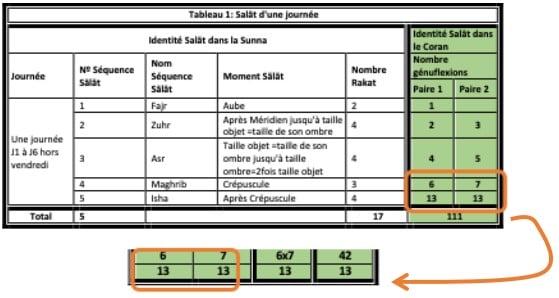
Salat refers us to Surah 42, Ash-Shura (The Consultation), verse 13 : “He has ordained for you of religion that which He enjoined upon Noah and which We have revealed to you, [O Muhammad], and that which We enjoined upon Abraham, Moses, and Jesus - to establish the religion and not be divided therein. But that to which you invite the polytheists seems great to them. Allah chooses and brings near to Himself whom He wills and guides to Himself whoever repents.” This verse clearly reveals the five prophets, Ullul Azm.
Let us not forget that originally, during the Meccan phase, prayer sequences consisted of only two (2) rakats, or 13 genuflections corresponding to the first pair. This excludes the Maghrib prayer. Let us then replace these values (13), associated with dawn, with their spiritual equivalent: the prophets, according to their order of appearance in the days of humanity, starting with Noah.
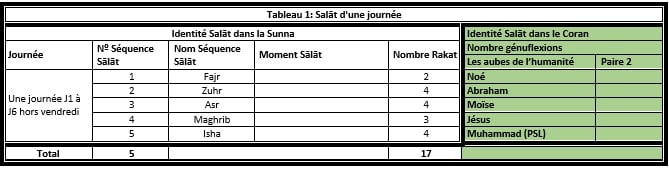
We observe that Jesus corresponds to the Maghrib prayer. Recall that, in our previous articles, we demonstrated that all the sequences of prayer refer directly to verses in the Quran that mention prayer, with the exception of the Maghrib prayer, which, in a certain reading order, refers to a miracle and only represents the prayer in a reversed reading. This correspondence with Jesus highlights the unique nature of his advent: a miraculous birth, followed by an exceptional return to the Ummah of the Prophet Muhammad (peace be upon him).
The Prophets (Ulul Azm minal Rasul) thus appear as the “six new dawns” of humanity. Jesus, at his first coming, is a dawn like any other; but he is distinguished by a dawn of return—like a sun returning to its course—a western dawn. Several authentic hadiths narrated by Bukhari and Muslim indicate that one of the major signs of the end times will be the rising of the sun in the west, after which the doors of repentance will close for those who had not previously believed. In this interpretation, the return of Jesus to the Ummah of the Prophet (peace and blessings be upon him) is, on a spiritual level, “The Sun of the West.”
Having established the correspondences between the sequences of Salāt and the prophets, it then becomes consistent to examine the intervals between the times of prayers as being proportional to the periods separating their advents.
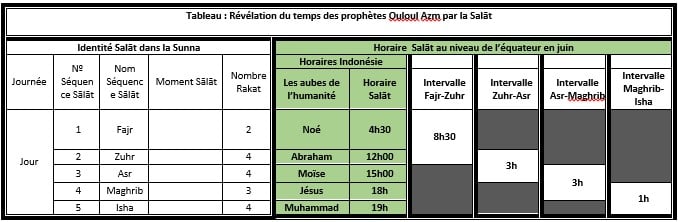

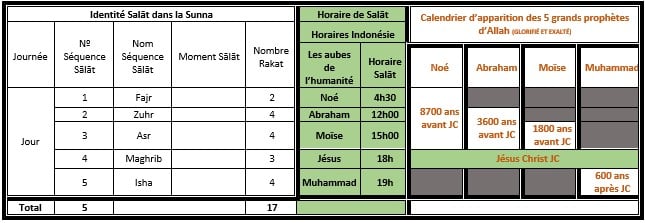
Thus, the interval between Maghrib and Isha prayers (approximately one hour) can be compared to the time separating Muhammad (peace be upon him) from Jesus, son of Mary. This interval is known in Islamic tradition as fatrah min ar-rusul , meaning a period of interruption between two messengers, estimated at approximately 600 years.
Therefore, if one hour in the Salat cycle symbolically corresponds to 600 years in prophetic history, it becomes possible to outline a calendar of the appearance of the prophets based on the reference point of the advent of Jesus.
The Quran tells us: “The Day the Trumpet is blown, on that Day We will gather the criminals, trembling with fear.” (20:102) “They will whisper among themselves, ‘You were only here ten days.’” (20:103) “We know perfectly well what they will say when the most righteous among them says, ‘You were only here one day.’” (20:104) “The angels and the Spirit ascend to Him (Allah) in a Day the measure of which is fifty thousand years.” (70:4)
Thus, the entire odyssey of humanity — fifty thousand earthly years — is reduced, on the scale of the Last Judgment, to a single day.
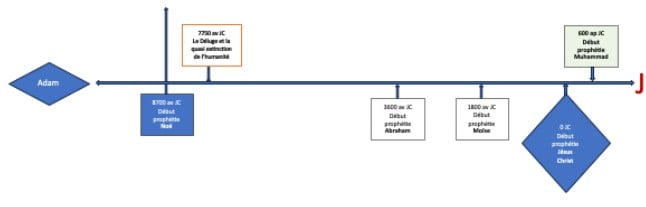
Noah called his people for 950 years, as indicated in Surah 29, Al-Ankabut (The Spider), verse 14: “And We certainly sent Noah to his people, and he remained among them a thousand years less fifty years. Then the flood overtook them while they were wrongdoers.” According to this interpretation, the Flood occurred around 7750 BCE. We find an echo of this reference in Surah 77, Al-Mursalat, which contains exactly 50 verses.
In our next article, God willing, we will present the identity of Moses' pharaoh as well as the archaeological and scientific elements that support this chronological reading.
Bilal At-Tawbah
Bakary Boloba COLY
Find us at www.at-tawbah.org























Commentaires (7)
Participer à la Discussion
Règles de la communauté :
💡 Astuce : Utilisez des emojis depuis votre téléphone ou le module emoji ci-dessous. Cliquez sur GIF pour ajouter un GIF animé. Collez un lien X/Twitter, TikTok ou Instagram pour l'afficher automatiquement.