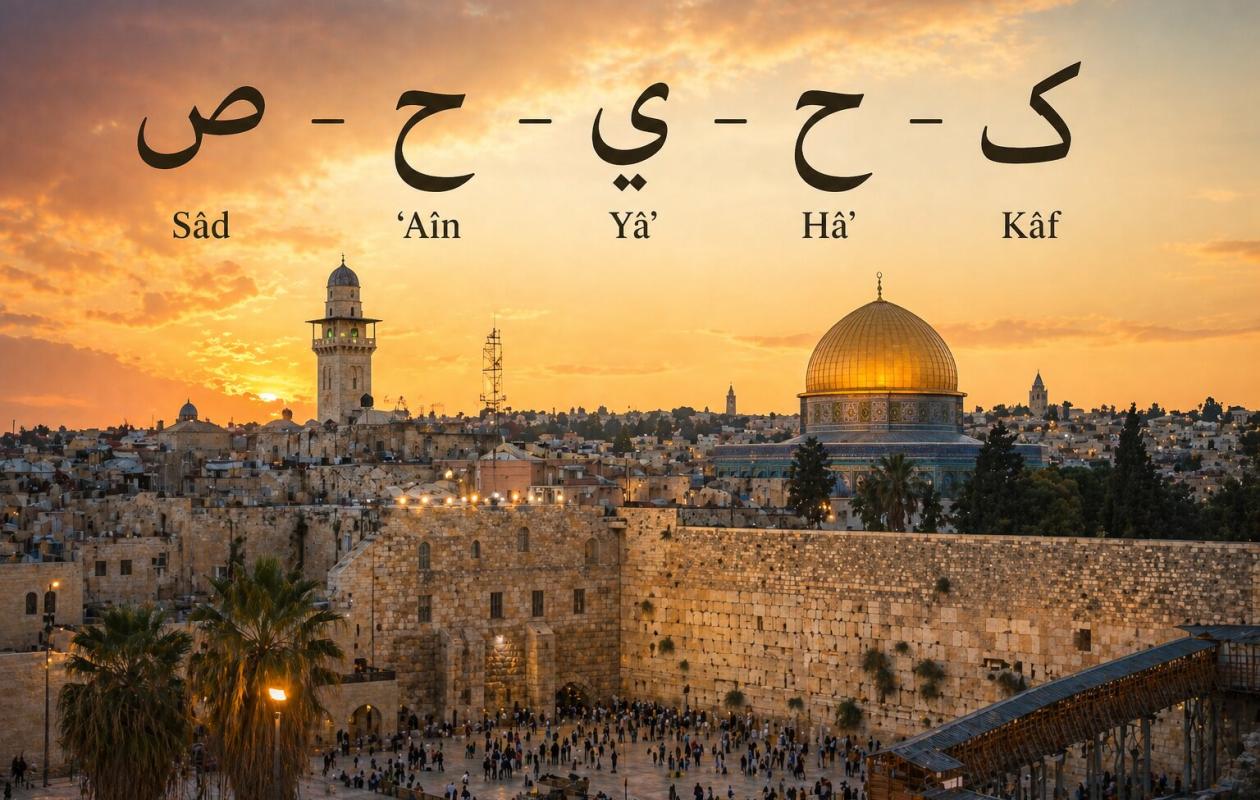
Qui est « Kâf - Hâ' - Yâ' - 'Aïn - Sâd » ?
Dear readers, this is the third article in our series on the ḥurūf al-muqaṭṭaʿāt , the mysterious separate letters that begin twenty-nine surahs of the Quran. We have seen the opinions of scholars who interpret them as epithets of the Names of Allah, as well as those of the majority who attribute them to divine mysteries. We have seen why these letters were primarily addressed, at the time, to the literate, identified as the "People of the Book"—a designation that refers to Jews and Christians. This observation led us to seek their meaning in the language of the original Torah of Moses, which is Proto-Sinaitic (or Paleo-Hebrew), the common ancestor of the Semitic languages (Arabic and Hebrew), and which we maintain traces back to Abraham, the ancestor of both peoples.
By the grace of Allah, this process reveals their meaning and sheds light on their role. Indeed, we have seen that a single symbol can fulfill several functions simultaneously. It can represent a sound (like a letter), but also a word or an idea directly, as a meaningful image. Thus, letters simultaneously combine phonetic and symbolic value, making it a writing system that is at once sonic, visual, and conceptual.
It is a miraculous call addressed to the "People of the Book" to recognize the prophethood of Muhammad (peace and blessings be upon him), which comes with the Book in Arabic and is linked to the original form of the ancient messages—resurrecting, correcting, and completing them for all humanity until the end of time. It is also a test for the Jewish scholars who, for the most part, erred by ordering those who had recognized the message to reveal nothing to the Muslims. For the Muslims of that time, not understanding these letters, it is a test of faith, an unquestioning acceptance of the divine mystery. For us, contemporary Muslims, it is a grace that recalls the miracle that is the Quran—its transcendence and completeness as a resurrection of the ancient revelations and an expansion of the knowledge necessary to guide humankind until the end of time. Today, I invite you to explore together the teachings of the letters Kaf , Ha , Ya , Ain , and Sad , which begin Surah 19, Maryam . As a reminder, the 22 letters of the Proto-Sinaitic (Paleo-Hebrew) alphabet are as follows:
With Kâf - Hâ' - Yâ' - 'Aïn - Sâd , we literally read:
"The foot that crushes—the revelation—that Yisrael (Israel) carries out—who followed his passion—for the land." In other words: "He who puts an end to the prophetic mission of the children of Israel, because they followed their passion for the land."
This deciphering is striking. The ḥurūf al-muqaṭṭaʿāt are not mere mysterious ornaments: they constitute a message addressed precisely to the "People of the Book," in their own native language, that of the original Torah. In a few letters, the Quran states the diagnosis of the prophetic rupture: the Children of Israel, custodians of divine revelation, allowed their attachment to the land—in the material, political, and tribal sense—to override their spiritual mission. Allah then sends the One who closes this cycle. This is the full power of the Quranic miracle: to say in five letters what volumes of theology struggle to express, and to say it in the very language of those to whom the message is addressed. Surah 19, Maryam , explains Allah's decision in detail. Let us look at an excerpt:
In the Name of Allah, the Most Gracious, the Most Merciful
(1) Kaf, Ha', Ya', 'Ayn, Sad. (2) This is a mention of the mercy of your Lord to His servant Zechariah. (3) When he called upon his Lord in a private supplication, (4) and said, "My Lord, indeed my bones have weakened and my head has turned white with age. Yet I have never been disappointed in my supplication to You, my Lord. (5) Indeed, I fear my descendants after me, and my wife has been barren. So grant me from Yourself an heir (6) who will inherit from me and inherit from the family of Jacob and make him pleasing to You, my Lord." (7) "O Zechariah, We give you good tidings of a son. His name will be Yahya [John]." We have not given him a namesake before.” (8) And [Zechariah] said, “My Lord, how can I have a son when my wife is barren and I have reached extreme old age?” (9) [Allah] said, “Thus it will be. Your Lord has said, ‘That is easy for Me. And before that, I created you when you were nothing.’” (10) [Zechariah] said, “My Lord, grant me a sign.” [Allah] said, “Your sign will be that you will not be able to speak to people for three nights while you are healthy.” (11) So he went out from the sanctuary to his people and signaled to them to pray morning and evening. (12) … “O John, hold fast to the Scripture (the Torah)!” And We gave him wisdom while he was a child, (13) and tenderness from Us and purity. He was pious, (14) and devoted to his father and mother; and was neither violent nor disobedient. (15) Peace be upon him the day he was born, the day he dies, and the day he is raised alive!
(16) And mention in the Book (the Quran) Mary, when she withdrew from her family to a place toward the east. (17) She placed a veil between herself and them. Then We sent to her Our Spirit (Gabriel), who appeared to her in the form of a perfect man. (18) She said, "I seek refuge in the Most Merciful from you. If you should be righteous, [do not approach me]." (19) He said, "I am only a messenger from your Lord to give you the gift of a pure son." (20) She said, "How can I have a son when no man has touched me and I am not unchaste?" (21) He said, "Thus it will be. Your Lord says, 'That is easy for Me. And We will make him a sign for mankind and a mercy from Us.'" "It is a matter already decided." (22) So she conceived [the child], and she withdrew with him to a remote place. (23) Then the pains of childbirth drove her to the trunk of a palm tree, and she said, "Oh, would that I had died before this and been forgotten!" (24) Then he called to her from below her, [saying], "Do not grieve. Your Lord has placed beneath you a stream. (25) Shake toward yourself the trunk of the palm tree; it will drop upon you ripe, fresh dates. (26) So eat and drink and be content. And if you see any human being, say, 'Indeed, I have vowed a fast to the Most Merciful, so I will not speak today to any human being.'"
(27) Then she came to her people, carrying him [the baby]. They said, “O Mary, you have certainly done a monstrous thing!” (28) “O sister of Aaron, your father was not a wicked man, nor was your mother unchaste.” (29) So she pointed to him [the baby]. They said, “How can we speak to one who is in the cradle?” (30) But he said, “Indeed, I am the servant of Allah. He has given me the Scripture and made me a prophet. (31) And He has made me blessed wherever I am and has enjoined upon me prayer and zakah as long as I live, (32) and kindness to my mother. He has not made me violent or wretched.” (33) And peace be upon me the day I was born, the day I die, and the day I am raised alive.
(34) Such is Jesus, son of Mary: a word of truth about which they doubt. (35) It is not befitting for Allah to have a son. Glory be to Him! When He decrees a matter, He only says to it, "Be," and it is. (36) Indeed, Allah is my Lord and your Lord, so worship Him. This is a straight path. (37) [Then] the sects differed among themselves. So woe to the disbelievers from the sight of a terrible Day! (38) How clearly they will hear and see the Day they come to Us! But today the wrongdoers are in manifest error.
We see, therefore, that the advent of the prophet Yahya (John the Baptist), son of the prophet Zechariah, did not create any divergence: it is in the usual order of prophetic succession among the children of Israel. Arriving in the world at the same time as Issa (Jesus), son of Mary, Yahya (John) was also born miraculously—to an elderly father and an elderly, barren mother. This miraculous birth has two effects: firstly, it recalls the miracle of divine creation and thus testifies to the miraculous birth of Jesus. Secondly, by the grace of Allah, we can observe that the birth of Yahya is a repetition of that of Isaac, recounted in the following excerpts:
The birth of Yahya (John) concludes the cycle of the prophetic succession of the children of Israel, which began with Isaac, Abraham's son. Indeed, unlike the announcement of Isaac's miraculous birth—where Allah simultaneously announces the birth of his grandson Jacob, thus outlining the lineage—Yahya is announced alone. This marks the culmination of the Abrahamic covenant through Isaac and Jacob (Israel).
As for Issa (Jesus), son of Mary, the absence of a father breaks the patrilineal prophetic succession and, to some extent, ethnic affiliation. After the advent of Jesus and the revelation of the Gospel, there was divergence: the Jews—Muslims of the time—who did not believe in him became disbelievers, as specified in Surah 3, Al Imran :
Then, when Jesus sensed disbelief from them, he said, "Who are my allies in the cause of Allah?" The apostles said, "We are the allies of Allah. We believe in Allah. And bear witness that we are submissive to Him." (53) Our Lord! We have believed in what You have revealed and followed the Messenger. So register us among the witnesses. (54) And they [the others] plotted, but Allah thwarted their plot. And Allah is most knowing of their schemes.
(55) (Remember) when Allah said, “O Jesus, indeed I will take you up to Myself and raise you to Me and purify you from those who disbelieve and make those who follow you superior to those who disbelieve until the Day of Resurrection. Then to Me will be your return, and I will judge between you concerning that in which you used to differ. (56) As for those who disbelieve, I will punish them with a severe punishment in this world and the Hereafter, and for them there will be no helpers. (57) But as for those who believe and do righteous deeds, He will give them their rewards. And Allah does not like the wrongdoers. (58) This is what We recite to you of the verses and the precise revelation.” (59) For Allah, Jesus is like Adam, whom He created from dust, then He said to him, "Be": and he was.
In conclusion, Jesus, son of Mary, is Kâf - Hâ' - Yâ' - 'Aîn – Sâd: The Messenger who crushes – the revelatory mission – with which Israel (Jerusalem) was charged – because it followed his passion – for the earth.














Commentaires (14)
Participer à la Discussion
Règles de la communauté :
💡 Astuce : Utilisez des emojis depuis votre téléphone ou le module emoji ci-dessous. Cliquez sur GIF pour ajouter un GIF animé. Collez un lien X/Twitter, TikTok ou Instagram pour l'afficher automatiquement.