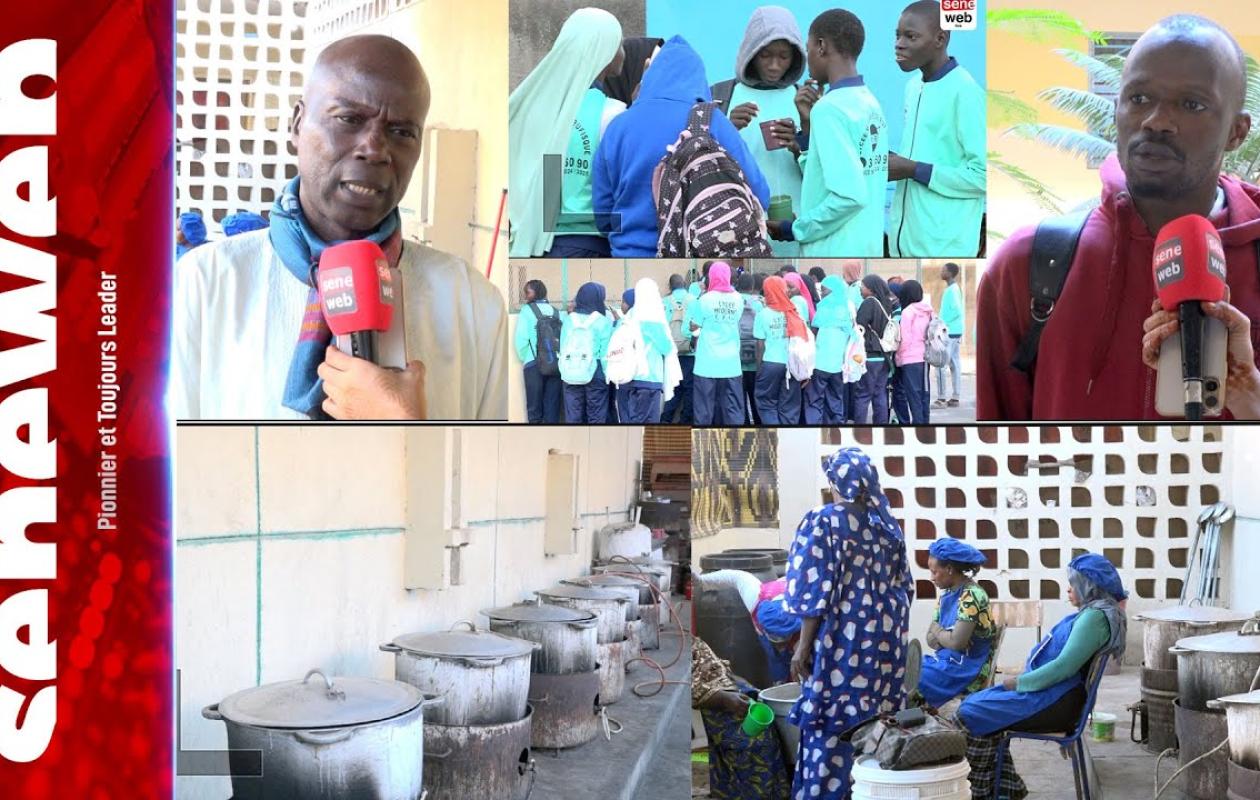
Rufisque : La cantine scolaire, ce "plat de survie" qui sauve l'école et l'avenir
In Senegal, school canteens are much more than just a midday meal. They often represent the only answer to hunger, the driving force behind academic success, and the last line of defense against dropping out of school. Yet, this life-saving reality remains an exception: less than 15% of the country's schools have them. Elsewhere, thousands of students study on an empty stomach, weakened and forced to abandon their studies.
At the Lycée Moderne de Rufisque, this model has transformed the destiny of thousands of students. Here, eating at school is not a privilege, but an essential condition for learning and having hope.
8 a.m.: A vital ritual to start the day off right
The day begins with an unchanging ritual. Before the first class, students line up to receive a cup of "Fondé," a hot porridge made from millet or corn. This breakfast, costing only 50 FCFA, is a lifeline that allows students to get through the morning without feeling dizzy or tired. For families struggling with the high cost of living, it's an invaluable daily relief.
The central kitchen: The beating heart of solidarity
Just steps from the classrooms, the central kitchen is bustling with activity. In large, bubbling pots, rigorously trained and medically supervised women are transforming local produce. Millet, corn, fish, and vegetables come directly from local producers, creating a virtuous economic cycle.
“Here, we prepare healthy and balanced meals. We feed children, but above all, the future of the country,” says Marème Coumba, president of the cooks.
At lunchtime, for 100 FCFA, students share a complete, hot meal. Beyond nutrition, this moment breaks down social barriers. "The canteen helps us enormously. We eat together, we share, and we save money. It eases the burden on our parents and saves us from having to walk home at midday," testifies one student. This space thus becomes a place for learning about living together and solidarity.
Academic results showing significant improvement
The benefits are not only health-related, but also educational. The administration and teachers have noted a drastic decrease in absenteeism and a significant improvement in concentration. Henry Diouf, head of canteens at the Research and Implementation Group for Rural Development (GRDR), is categorical: "A child who eats properly is more attentive, calmer, and performs better. The canteen is a real driver of success."
Ms. Kandé, the school's headmistress, confirms this positive dynamic which is restoring ambition to the students.
A major challenge: Feeding 3,500 students every day
The logistical challenge is immense. Mamoune Ovense Ndiaye, president of the Parents' Association (APE) and manager of the facility, explains that the central kitchen serves 10 schools and prepares ten giant pots of food daily. This success relies on a synergy between parents, local authorities, and technical partners such as GRDR.
However, this model remains fragile. While similar initiatives exist in Saint-Louis and Kolda, often with support from the World Food Programme (WFP) or Counterpart International, the question of sustainability after the donors' departure is a concern. Henry Diouf is therefore calling on other institutions to draw inspiration from Rufisque's financial autonomy.
Despite these local successes, the need remains urgent. Insufficient funding, inadequate kitchen equipment, and a lack of suitable dining facilities are hindering the widespread adoption of the model. Yet, the equation is simple: schools without cafeterias have lower success rates.
Making school canteens accessible throughout Senegal is not a luxury, it is an act of social justice. In Rufisque, a plate of food has restored dignity to children. Because a child who eats is a child who learns; a child who learns is a country that builds its future.







![[Grain de Sel] - Macky Sall : crédit épuisé ?](https://image.seneweb.com/content/news/2026-17-25//thumb_1260x800_69ec75b20a303_UosfM3UoCK.jpg)











Commentaires (2)
Yalla nalèèn Yalla Takhawou!
Merci à l'ong counterpart Sénégal qui jouent un rôle important dans les régions de kolda et sedhiou
Participer à la Discussion
Règles de la communauté :
💡 Astuce : Utilisez des emojis depuis votre téléphone ou le module emoji ci-dessous. Cliquez sur GIF pour ajouter un GIF animé. Collez un lien X/Twitter, TikTok ou Instagram pour l'afficher automatiquement.