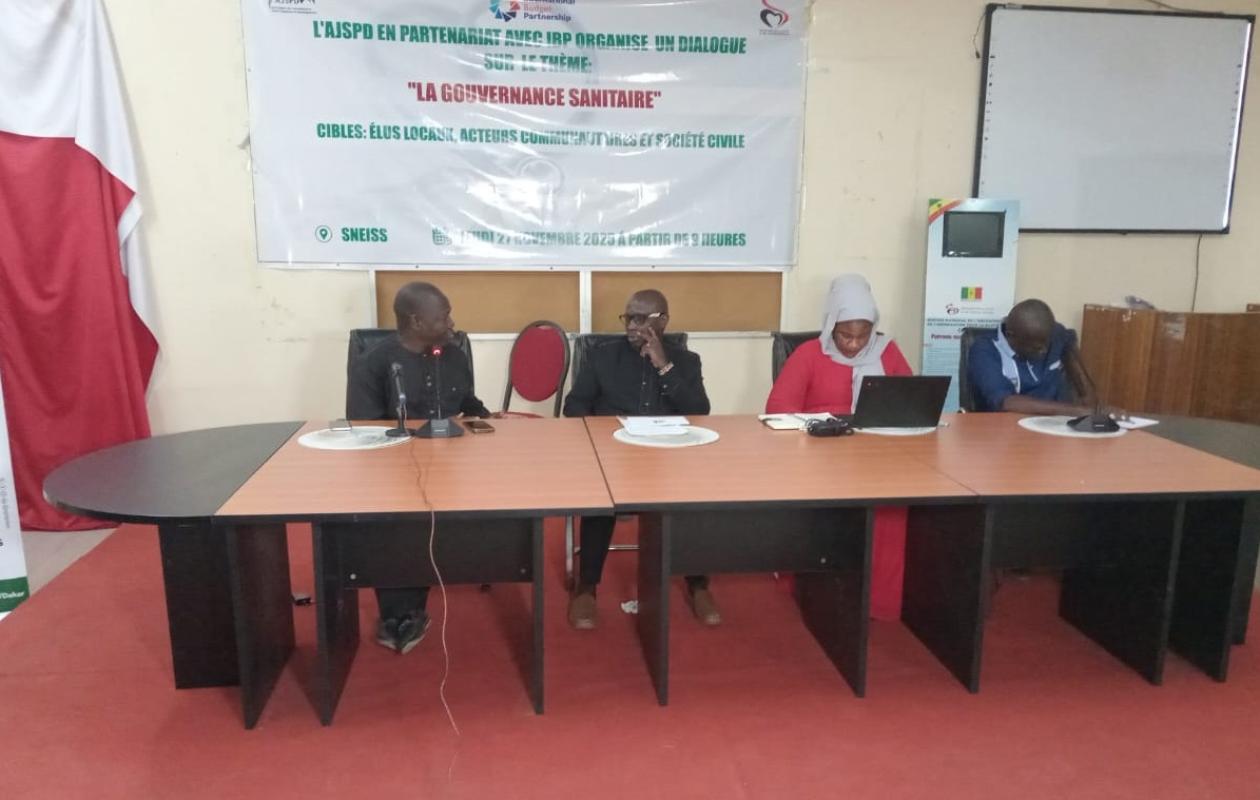
Gouvernance sanitaire : Un système de santé fragilisé par une "coordination insuffisante"
Health governance in Senegal is going through a critical phase, marked by a growing need for coordination between the various institutional actors. This was the main conclusion of the workshop organized on Thursday, November 27, by the Association of Journalists in Health, Population and Development (AJSPD), in partnership with the International Budget Partnership (IBP). The meeting, which brought together journalists, representatives of local authorities, community actors and technical partners, aimed to create a forum for discussion on the challenges hindering the effectiveness of health policies and the transparency of their implementation.
According to analyses by Matel Sow, Health Program Officer at IBP, "the difficulties in the health system are no longer solely related to funding or the quality of infrastructure, but rather to a governance problem." "Research conducted in the red and orange zones of the health map shows that coordination between stakeholders remains largely insufficient," she says.
It indicates that "irregularity in governance bodies, the absence of concerted planning and difficulties in coordination between the Ministry of Health, local authorities and communities have been identified as major factors of dysfunction."
Furthermore, it should be noted that "local elected officials, now holding health-related responsibilities, should play a more assertive role in the supervision and control of interventions."
Furthermore, Matel Sow emphasizes that "health decentralization, although enshrined in law, is struggling to produce the expected results. On the ground, several local authorities are experiencing difficulties in fully assuming their responsibilities due to a lack of resources, training, or coordination with the decentralized services of the State."
This disarticulation results in weak community involvement in decision-making and delays in the implementation of local action plans.
Journalists, an essential link in accountability
On behalf of the National Service for Health and Social Education and Information (SNEISS), Dr. Ibou Guissé emphasized the crucial role of journalists in raising public awareness and disseminating information about health issues. He commended the partnership with the AJSPD, stating that media professionals are an essential channel for informing citizens and documenting systemic shortcomings.
Health expert Tamba Danfakha mentioned another structural factor: the rigidity of the budgetary circuit.
According to him, the actual capacity of the Ministry of Health remains limited by financial procedures that are heavily dependent on the Ministry of Finance.
He believes that this mechanism reduces the operational scope, to the point that "the Ministry of Health only really works six months a year".
This constraint, he points out, slows down programs, weakens planning and impacts the quality of services offered to the population.
The workshop concluded with a general call to strengthen collaboration between different levels of stakeholders. Participants emphasized the need to institutionalize regular spaces for dialogue, improve local accountability, and better involve communities in decision-making.























Commentaires (1)
Participer à la Discussion
Règles de la communauté :
💡 Astuce : Utilisez des emojis depuis votre téléphone ou le module emoji ci-dessous. Cliquez sur GIF pour ajouter un GIF animé. Collez un lien X/Twitter, TikTok ou Instagram pour l'afficher automatiquement.