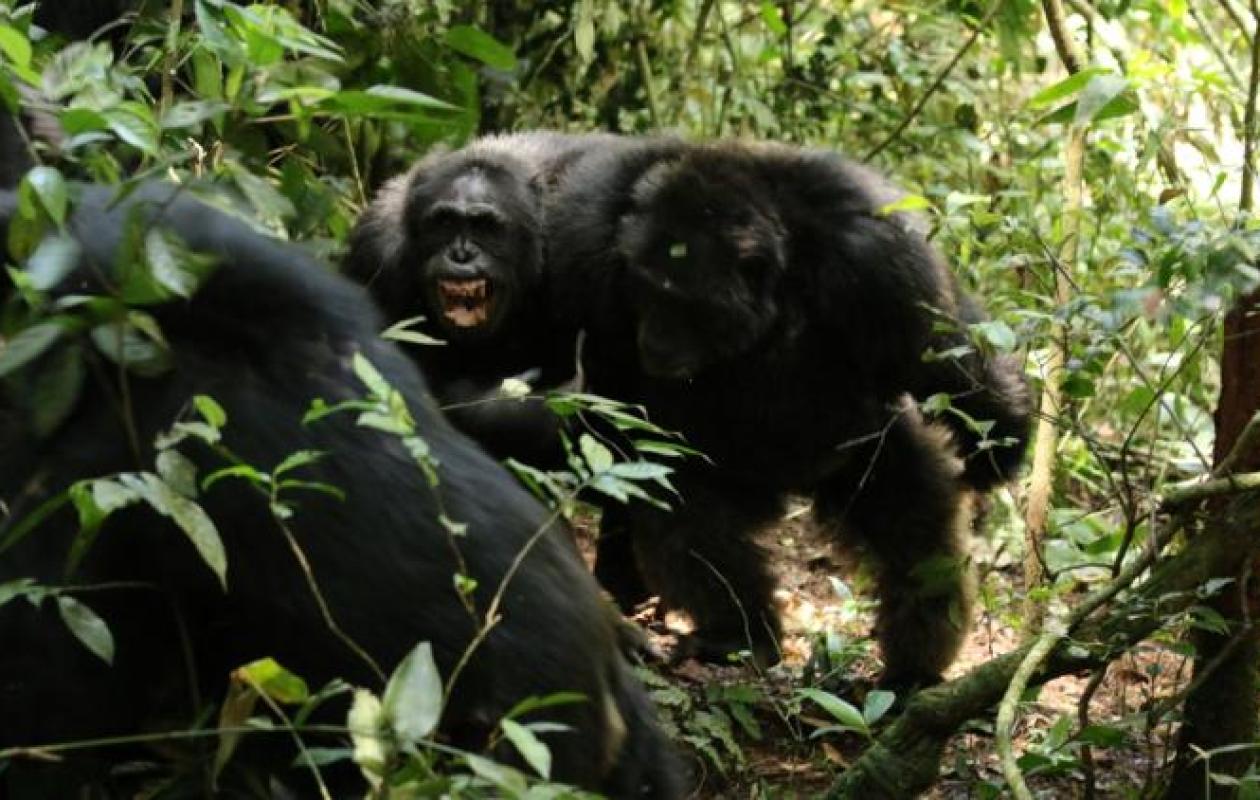
«UN CONFLIT SANGLANT DE PLUSIEURS ANNÉES» : DES CHIMPANZÉS SAUVAGES ENGAGÉS DANS UNE VÉRITABLE «GUERRE CIVILE»
In a Ugandan forest, a once-united chimpanzee community has torn itself apart, descending into extreme violence. A recent study sheds light on what could be the first case of "civil war" among these primates, revealing disturbing behaviors.
Let's head to Kibale National Park in Uganda. In 2015, primatologist Aaron Sandel observed unusual behavior in a small group of chimpanzees from the Ngogo community. As other members approached, the observed individuals tensed up, exchanging reassuring gestures and displaying signs of anxiety. A strange scene, almost incomprehensible at the time.
This event marked the beginning of a profound rift, even though for over twenty years this community had been united. Between 2015 and 2018, social bonds weakened, eventually forming two distinct clans: the western chimpanzees and those of the central group. This split led to a series of coordinated attacks of rare violence. In seven years, the western group launched 24 raids against its former kin, resulting in the deaths of at least seven adult males and seventeen infants.
UNPRECEDENTED VIOLENCE
Chimpanzees are known for their territorial conflicts with neighboring groups. But seeing a community turn against itself is an unprecedented phenomenon. To explain this shift, researchers have proposed several factors. First, a disruption of social hierarchies: the dominant male is thought to have shown unusual signs of submission, weakening the established order. Added to this is the gradual disappearance of older individuals, pillars of social relations, whose deaths are believed to have weakened group cohesion.
An epidemic that occurred in 2017 also accelerated the division, making the separation inevitable. Deprived of its points of reference and stabilizing figures, the group gradually became polarized.
A LESSON FOR UNDERSTANDING LIFE
Beyond the observed violence, this study, published in the journal Science, raises fundamental questions about the social mechanisms of these animals. It shows that even without a structured culture or institutions, social bonds play a crucial role in group stability. These attacks can be explained by the pursuit of a reproductive advantage: eliminating rivals increases one's own chances of survival and genetic transmission.
These observations worry scientists about the future of chimpanzees, which are already threatened with extinction. While such conflicts remain extremely rare in the wild, disturbances caused by human activity (deforestation, disease, climate change) could increase their frequency.





















Commentaires (5)
Participer à la Discussion
Règles de la communauté :
💡 Astuce : Utilisez des emojis depuis votre téléphone ou le module emoji ci-dessous. Cliquez sur GIF pour ajouter un GIF animé. Collez un lien X/Twitter, TikTok ou Instagram pour l'afficher automatiquement.