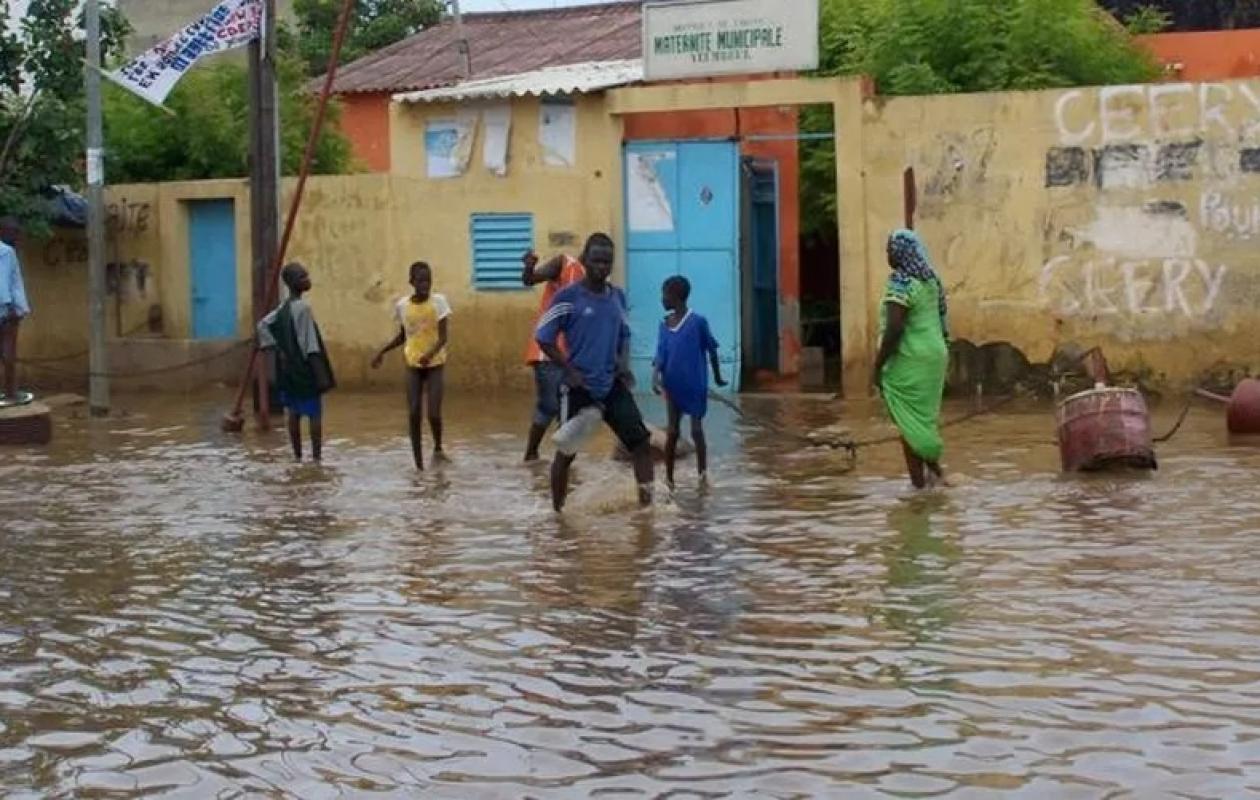
Amplification des inondations à Thiès : une analyse scientifique liste les causes
Strengthening community resilience to flood risks through an ecosystem-based approach (EBA) in Thiès is the objective of a three-day workshop in Thiès focused on the co-creation and adoption of nature-based solutions. The workshop, held in Thiès, will cover three days of diagnosis, planning, and practical implementation for flood risk mitigation.
Over the past few decades, it has emerged that floods are responsible for a very large proportion of the disasters recorded internationally: nearly four out of ten between 1900 and 2022.
Global data also shows that between 1992 and 2021, their average frequency was around one hundred events per year. Since the beginning of the 2000s, the scale of the phenomenon has increased significantly: the number of events has more than doubled (an increase of approximately 134%), and nearly 1.6 billion people have been affected, according to the WMO.
This increase is consistent with the IPCC's climate projections, which predict a rise in extreme weather events, particularly damaging to countries with fewer resources to cope with them. Urban areas, with their high population density and numerous infrastructures, are among the most exposed.
Senegal, notes the Executive Director of GIPS/WAR, Ms. Julie Cissé, "clearly illustrates this situation: it is among the West African countries most affected by flooding. Despite this, some rapidly expanding cities, notably Thiès, do not benefit from systems comparable to those put in place in the capital, Dakar."
Thiès, in fact, is experiencing significant population growth and sustained urbanization, therefore a development that exerts increasing pressure on natural environments: decline of vegetation cover, installation of housing in vulnerable areas, and progressive deforestation of the plateau overlooking the city.
"Since the return of a more intense rainfall pattern and the weakening of the forest cover, flooding episodes have become more frequent there," Ms. Cissé points out.
The particular sensitivity of Thiès, he says, is also explained by its physical characteristics; a relief marked by a plateau culminating at about 133 m, generating rapid flows towards the low-lying areas; soils that are predominantly ferruginous, sandy, easily eroded and not very able to absorb water; a great variability of rainfall during the wet season.
The lower-lying neighborhoods are often occupied by low-income households, which further increases their vulnerability when water accumulates.
Regarding the institutional response, national flood management relies primarily on large-scale engineering structures, or grey infrastructure. While these have helped alleviate pressure in some areas, they have limitations: very high cost, difficulty in monitoring future risk developments, and sometimes the displacement of problems to other urban areas.
Furthermore, the spread of concrete in cities reduces the natural infiltration capacity of the soil, which intensifies water stagnation. For this reason, notes Julie Cissé, "purely technical solutions are no longer sufficient to ensure lasting protection."
The practitioner argues that Nature-based Solutions (NbS) are an essential complement: they reduce risks while preserving ecological processes, providing socio-economic benefits, and addressing the factors that make populations vulnerable. They are an effective way to improve climate adaptation, maintain hydrological services, and foster a less resource-dependent economy.
Given the scale of the losses caused by the floods, it is imperative to strengthen flood risk management. It is with this in mind that the project entitled "Strengthening community resilience to flood risks through the Ecosystem-based Adaptation approach in Thiès, Senegal" was launched, implemented by the Practical Action, EPT and GIPSWAR consortium, and funded by the Global EbA Fund for a period of two years.
The overall objective of this workshop is to ensure sustainable ownership of the flood risk diagnosis and full participation of communities in the implementation, management and sustainability of Nature-based Solutions (NBS) in Thiès.























Commentaires (3)
A Thiès le problème est connu d'avance les eaux en provenance du nord ruissellent vers le sud (Hôpital Régional,Maire de ville,Chambre de commerce, centre ville, médina Fall, Kaosara etc). Jadis il y'avait des caniveaux et un passage sous les rails qui permettait à l'eau de s'évacuer naturellement. Maintenant avec l’ensablement, la fermeture de ces caniveaux et une urbanisation anarchique le problème s'aggrave. Ce qu'il faut faire, c'est construire des voies de contournement ceinturant la ville pour dévier l'eau et construire des bassins de rétention pour l'agriculture.
Participer à la Discussion
Règles de la communauté
💡 Astuce : Utilisez des emojis depuis votre téléphone ou le module emoji ci-dessous. Cliquez sur GIF pour ajouter un GIF animé. Collez un lien X/Twitter, TikTok ou Instagram pour l'afficher automatiquement.
Se connecter
Commentez avec votre profil, votre photo, et soyez averti des réponses.