Fouta : Les repas collectifs du « Feeddé », un patrimoine social et intergénérationnel préservé
In Fouta, the celebration of Tabaski transcends its strictly religious aspect to become a true moment of community communion. This festival brings together all generations, organized into age groups called "Feeddé," around generous communal meals. Much more than a simple festive event, it carries profound socio-cultural value, marking a significant time for reunions and sharing that strengthens social bonds. These intergenerational gatherings—between children, adults, and elders—act as a precious repository of traditions, resisting the changes brought about by the contemporary world.
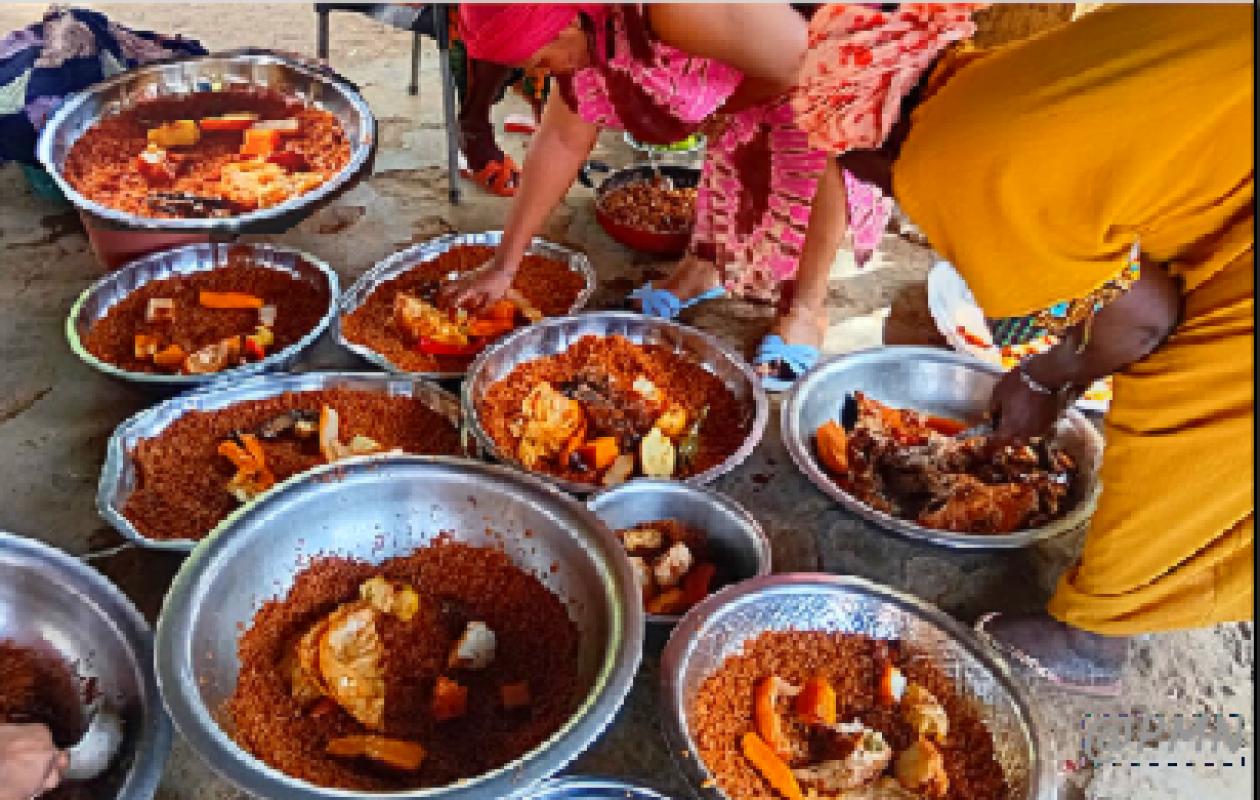
The age-grade system, a true community glue, structures the collective life of the various villages in Fouta. In the commune of Sinthiou Bamambé, this practice holds particular importance for young people, both girls and boys, who actively participate in the festivities. Often dressed in the same clothes, they can be seen walking through the alleyways, carrying bowls of food on their heads, on their way to the home of the day's designated host. The meals are then gathered and enjoyed together in an atmosphere of unity and conviviality.
Three days of uninterrupted sharing from Ndouloumadji to Ourossogui
In the village of Ndouloumadji, the festivities last for three full days. Three rotating host locations are chosen in advance by the members of the Feeddé (a local cultural association). From the first day of the celebration until the third day, every villager—man or woman, young or old—prepares a traditional dish called "Lahal" which they bring to the home of the day's host. Saidou Sarr, a member of a generational group representing those born between 1984 and 1986, emphasizes that this organization fosters the creation and maintenance of social bonds. What particularly pleases him is the involvement of people of all ages in this collective endeavor, including religious leaders, village elders, and other dignitaries. He explains that "before major occasions such as religious holidays, but also weddings and baptisms, each group contributes funds to prepare the festivities together." During these events, scenes of intense sharing unfold: the women, each adorned in her finest boubous, bring meals, drinks, and "thiakry" (a traditional dessert) to their husbands. The festivities continue in a celebratory atmosphere until late into the night, leaving behind an indelible mark of unity and conviviality.
In the commune of Ourossogui, despite the rapidly growing population of the town and its surrounding areas, the Lahal Feeddé is still seen as a convivial occasion, fostering a space for sharing that bridges socio-economic divides. As journalist Mamadou Adama Ba explains, "This event allows childhood friends, often separated by emigration or work, to reunite, reminisce, and discuss joint projects, all in a warm and welcoming atmosphere." He adds that over traditional dishes, participants celebrate a shared identity and cultural heritage, often accompanied by Pulaar folk music, such as the songs of Baaba Maal, adding a festive dimension to the event. "For many people from Fouta Djallon, this gathering is essential, even with social changes and migration. Although some areas have seen this tradition decline, many villages continue to preserve it, making the Lahal Feeddé a symbol of collective memory, social bonds, and solidarity."
The mobilization of neighborhoods in Matam and Karim's table in Tantadji
In the Matam district, this tradition is observed by numerous associations that bring together people of the same age group or, more simply, neighbors from the same area. Among these is the women's association of the newer Alwar neighborhood, which has mobilized to contribute to the community well-being of its residents. However, in some cases, several groups simply designate one of their members to host the gathering. This person is then responsible for organizing a meal for all the participants.
This year, Karim, an active member of his "Feeddé" (group), had the honor of hosting this special occasion, held in the town of Tantadji. In keeping with the culinary theme, he chose to prepare Thiebou Diene – the emblematic fish and rice dish of Senegal – to offer his guests a welcome break after the abundance of meat consumed the previous day: grilled meats, yassa, kebabs…
Today's dish features a prized fish, the escolar (a type of flatfish), accompanied by a flavorful dumpling sauce and carefully selected vegetables. For this is not simply about preparing a meal, but about achieving a perfect balance between lightness and flavor: carrots for crunch, cabbage that melts in your mouth without becoming mushy, eggplant infused with the fish's flavor, and cassava and sweet potato for a firm yet light texture. Even okra, used sparingly, plays its discreet role in thickening the sauce. The task undertaken by the sisters and cousins who rallied together was no simple one. While Aïcha tasted and refined the sauce, Néné, Mariame, Khairy, Touty, and Fatima methodically chopped the vegetables, which were then added to the pot at just the right moment under the watchful eye of Aunt Adja. Each ingredient has its precise moment: the cassava first, since it's harder, and the cabbage at the very end to prevent it from falling apart. Once the vegetables are cooked to perfection, attention turns to the rice. Ndoumbé and Bintou patiently watch over each grain to ensure it's just right: neither sticky nor dry, but well-aerated and fully infused with the succulent red sauce.
A welcome culinary transition and the Ataya ritual
After a whole day dedicated to meat, preparing the Thiebou Diene was a major undertaking. Finally, after two hours of hard work in the kitchen, when the long-awaited mealtime arrived and Karim and his friends from Feeddé plunged their spoons into the steaming dish, their satisfaction was immediate. It was exactly what they had been looking for: a perfect balance between richness and lightness. Samba, with a contented sigh after his first bite, exclaimed, "Alhamdulillah, finally some fish! My teeth couldn't take any more of that meat!" Everyone agreed: this change was welcome after the meaty abundance of the previous day. Hassim, one of the family elders, confirmed with a laugh, "It's exactly what we needed," after a few more indulgent bites.
But the day doesn't end with the meal. Once the plates are empty and stomachs are full, it's time for ataya: the traditional mint tea. Young boys set up the tray with a steaming teapot, sparkling glasses, and fresh mint bought the day before. The usual three rounds follow: a first strong and bitter one to awaken the senses, a second milder and sweeter one to delight the palate, and then a third where the mint reveals its full, soothing freshness. Between sips of frothy tea, conversations flow: childhood anecdotes, personal or group projects, sharing news… Laughter erupts, further enhancing the convivial atmosphere.
To cap off this festive interlude, the women prepared juices using local produce. Deep red bissap, chilled and perfectly balanced; creamy, lump-free white bouye—just sweet enough, garnished with mint leaves for a touch of freshness to temper the spiciness of the fish. The menu also included other cocktails, ideal for those who appreciate a touch of acidity. Everything came directly from the neighborhood market, nothing but local fruits, carefully transformed by the women. Between the light fish rice, the expertly frothy mint tea, and these refreshing drinks bursting with local flavors, this gathering was a truly special moment for the group. Many, preoccupied with work, family, or the vagaries of daily life, and often affected by distance, barely saw each other throughout the year. On this special day, they put everything aside. These connections, after all, are infinitely precious to them.























Commentaires (4)
Participer à la Discussion
Règles de la communauté :
💡 Astuce : Utilisez des emojis depuis votre téléphone ou le module emoji ci-dessous. Cliquez sur GIF pour ajouter un GIF animé. Collez un lien X/Twitter, TikTok ou Instagram pour l'afficher automatiquement.