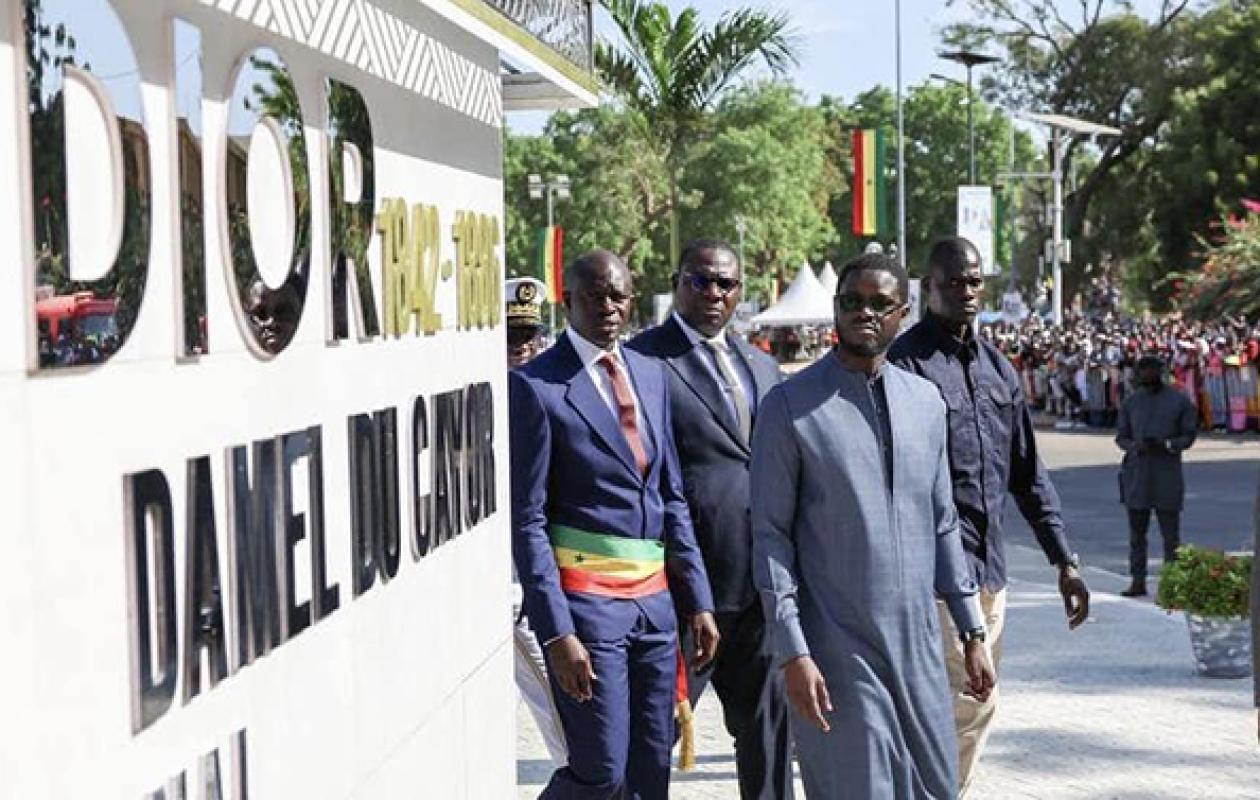
[Spécial Indépendance] Thiès : Les secrets d'une « ville rebelle » qui n'a jamais plié le genou !
The protests by the people of Thiès against the arrest of their former mayor, Idrissa Seck, bring back many memories in this city whose history remains marked by a tradition of resistance and protest, to the point of earning it the label of "Rebel City."
The residents of Cité du Rail had once again taken to the streets, protesting what they called the "unjust and arbitrary arrest" of their mayor, Idrissa Seck. Burning tires blocked the city's main thoroughfares, and a horde of young people, including women, armed only with stones, confronted the police, creating a scene that brought back many memories.
Memories of a certain February 26th in 1988. A year of electoral frenzy, when, in addition to the youth, the entire population of Thiès mobilized and stood as one to forcefully and vigorously defend the right to assembly. This was in the lead-up to the 1988 presidential election, and the then-President of the Republic, Abdou Diouf, had forbidden his most serious opponent, Abdoulaye Wade, who later became President of the Republic, from holding a campaign rally in the symbolic "Place de France" (Thies Promenade). Abdou Diouf, for his part, was to occupy this very spot for his own rally.
The rest of these events are well known. The "unruly youth" of Thiès had succeeded in provoking President Diouf into a rage. In short, the Senegalese youth rebellion had indeed begun in Thiès, even before the urban guerrilla warfare that followed the 1988 elections, after the results were announced. A city of refusal, and therefore of protest, as was also the case in 1947 with the famous railway workers' strike. This strike was to last for five months and mark the birth of the labor movement in West Africa. A heroic struggle that was a decisive step in the awakening of consciences and the assertion of political rights.
Initially, it was the workers living in this city, known as the railway capital (because it was the headquarters of the railway company during the colonial era), who were demanding a wage increase and better social conditions. Especially since Thiès was not one of the four communes, its inhabitants were not citizens but lived under the system of native status, like mere French subjects. They thus easily found fault with their relationship with the colonists. Later, it was these sons and grandsons of railway workers who, at the Lycée Malick Sy, through a tradition of strikes, distinguished themselves in the widespread student protest movements of Senegal.
But since March 2004, with the president's decision to move the military parade commemorating Independence Day from Thiès to Dakar, the bond between President Wade and the city's inhabitants abruptly severed. The break was complete following accusations in the Thiès construction projects scandal and the subsequent arrest of their idol, Mayor Idrissa Seck.
The temperament of this city, which displays the characteristics of a people of resistance, is linked, according to Penda Mbow, Professor of History, to the history of Cayor and colonization. Thiès, she says, is part of the Cayor region where the "ceddo" ethic, an ethic of resistance, is highly developed. This is Cayor, with symbolic places like Thilmakha and Pékesse, which, since the 17th and 18th centuries, have been the stage for the historical events we know: political intrigues, clan warfare, and conflicts against Europeans.
In Thiès, Diéry Dior Ndella openly defied the colonizer. Furthermore, according to Ms. Mbow's insights, this city became a focal point for Bambara people who migrated from the interior of the former French West Africa (AOF), including Sudan, following the arrival of the railway. Throughout the sub-region's history, the Bambara have consistently represented a force of resistance, not only against colonization but also against the Omarian jihad in general and against Islamization.
This is what we find in Sembène Ousmane's work, "God's Bits of Wood." It concerns the Bambara people and all the other foreigners who came to settle in the city known as the "City of Two Stations." They are workers primarily linked to the history of the railway during the colonial conquest. And this culture of resistance, which has accumulated over time, can still be found in the city of Thiès today.
The other aspect is the city's population, comprised of well-established locals with strong family traditions, in addition to the Bambara families who all live in a town not far from Dakar. So, it's a modern city very much in touch with politics. As a result, the population, not too affected by rural exodus, is deeply attached to its land and its historical landmarks. It feels like Thiès, a large modern village where the inhabitants, as has been seen in the past, are involved in the organization of their city and in political battles.
All political battles have been, first and foremost, battles fought by the people, even when they identify with a political leader as a guide. This was the case with the late Boubacar Sall, nicknamed the "Lion of Cayor" for his courage. The defense of Idrissa Seck, also known by the warlike name "Ndamal Kadior," who, in their understanding, built the "New City" of which the people of Thiès are so proud, is the most widely shared sentiment. It is not only the young who fight in the streets for their political leader, but also women and children. In fact, everyone. And this has always been the case.
One figure hides another
In the railway city, political figures often fought tooth and nail to preserve their gains. It's fair to say that these political actors contributed to making Thiès a city often described as rebellious. Jean Colin was the most prominent politician in Thiès for a very long time. He was the strongman of Thiès, serving as Governor and political leader who made and broke careers, before becoming an all-powerful national figure at the presidential level. Boubacar Sall, also known as the "Lion of Cayor," was a liberal activist and a trusted confidant of Abdoulaye Wade. In the railway city, he symbolized resistance. He frequently clashed with high-profile socialist opponents of Colin's caliber.
Idrissa Seck, nicknamed "Ndamal Cadior," the former mayor of Thiès, served time in prison. Yet, from March 2000 until his removal as head of government, Mr. Seck played a leading role both at the national level and within the PDS party. He served successively as Minister of State, Chief of Staff to the President of the Republic, and Prime Minister. Talla Sylla, a fiery political leader who first gained experience in the student movement at the Malick Sy High School in Thiès, was the subject of an attack on himself in October 2003 for his scathing criticism of Wade, which he recorded on a cassette tape.
Léopold Sédar Senghor was mayor of Thiès. Originally from this region, he celebrated his last Independence Day in Thiès by investing 12 billion FCFA there, before proceeding with a series of inaugurations on April 4, 1979.
Mantoulaye Guène was one of the few women from Thiès who quickly rose through the ranks of the Socialist Party. She served as a member of parliament and a minister under Diouf before being forced out by Colin. Ousmane Ngom, also from Thiès, was a prominent trade unionist and political figure in the Socialist Party. He was a member of parliament and a minister under Senghor. Before the construction projects in Thiès, the residents of the railway city liked to point out that all the infrastructure in their city was the work of Ousmane Ngom.
Souleymane Ndiaye Brin, a left-wing politician and trade unionist, was among the young people who stood up to Diouf in 1988. Mbaye Diouf, a powerful socialist leader in Thiès until the eve of the political transition, was completely destroyed by his imprisonment following the audits. Some saw Idy's hand in the arrest of the man who was the only one capable of challenging him in Thiès because he was so financially powerful at the time.











Commentaires (6)
Participer à la Discussion
Règles de la communauté :
💡 Astuce : Utilisez des emojis depuis votre téléphone ou le module emoji ci-dessous. Cliquez sur GIF pour ajouter un GIF animé. Collez un lien X/Twitter, TikTok ou Instagram pour l'afficher automatiquement.