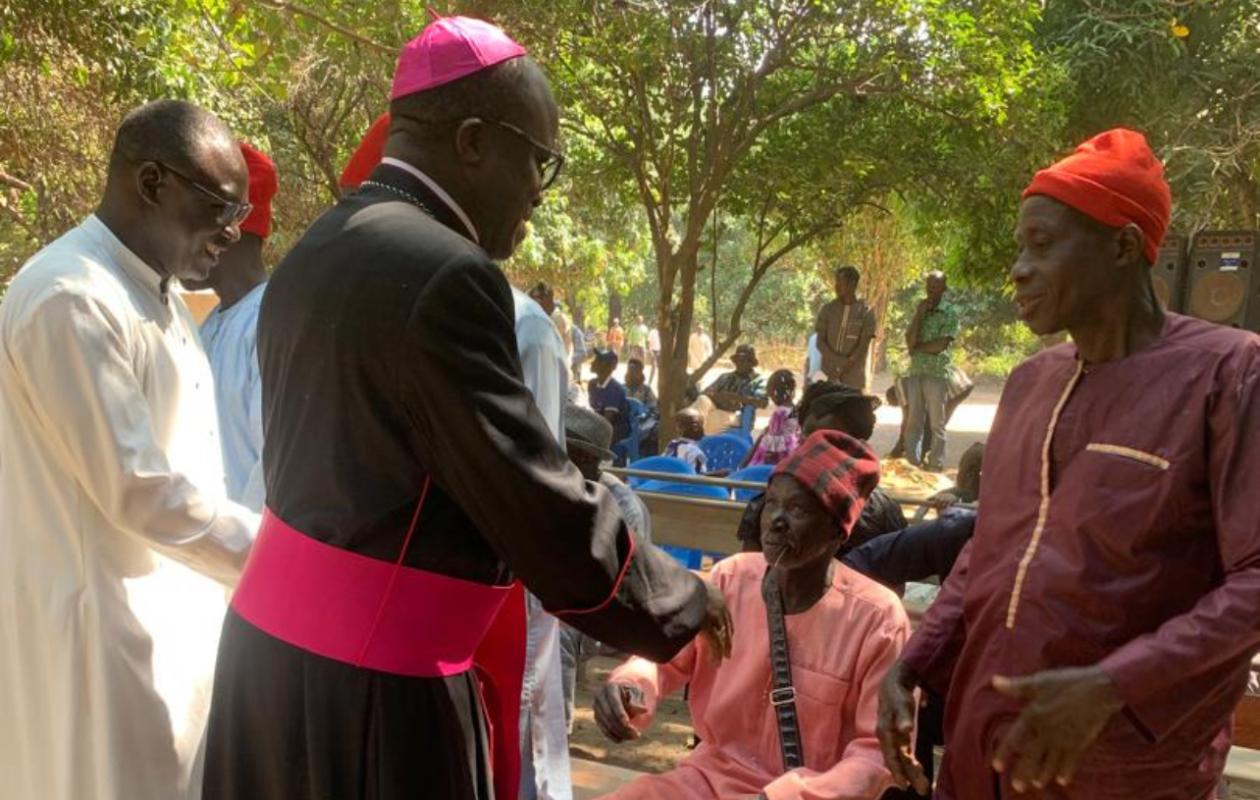
Journée mondiale de la paix célébrée à Youtou : L'évêque de Ziguinchor réitère ses appels pour le pardon et la réconciliation en Casamance
New Year's Day, which coincides with the Feast of the Blessed Virgin Mary in the liturgical calendar, is also World Peace Day, celebrated for the past 58 years. It is a day of prayer and action for the return of peace to all places affected by conflict and war.
In the diocese of Ziguinchor, since his episcopal ordination, Bishop Jean-Baptiste Valter Manga has been making numerous appeals and public appearances for the return of peace to Casamance, which requires forgiveness, reconciliation and celebrations in areas formerly shaken by the crisis.
After Diongol, in the far north of the Bignona department, Bishop Manga was in Youtou, a border village with Guinea-Bissau, in the south of Lower Casamance in the commune of Sanhiaba Manjack, to celebrate World Peace Day yesterday, January 1, 2026.
Historical reminder of World Peace Day and the scope of Pope Leo XIV's message
In Youtou, the bishop recalled that it was at the initiative of Pope Paul VI that the Church celebrated the first World Day of Peace in 1968. Since then, the first day of each year has been an opportunity for the Pope to address a message of peace to Christians and to all men and women of goodwill.
Monsignor Manga also referred to Pope Leo XIV's message entitled "Peace Be With You, Towards a Disarmed and Disarming Peace." "We remember that Pope Leo's first words, immediately after his election, were: 'Peace be with you.' These are the first words of Jesus himself to his apostles on the day of his resurrection. The apostles had locked themselves in their church out of fear after the violence that led their master to his death on the cross. The risen Jesus comes to restore their confidence by saying to them: 'Peace be with you.'"
"By addressing these words to us at the beginning of his pontificate and on the occasion of his first message for the World Day of Peace, Pope Leo invites us to have confidence despite all the distressing situations in our world," recalled the prelate of Ziguinchor.
Continuing, Bishop Manga explains that the Pope compares "peace to light and war to darkness." Pope Leo XIV thus invites us to forge an indissoluble friendship with peace throughout the world and calls for an openness to peace, to welcome and recognize it rather than considering it distant and impossible.
For a generation of peace
The Bishop of Ziguinchor also called for working together to build a generation of peace after more than forty years of conflict. Nothing should discourage or undermine the will to achieve a lasting and definitive peace in Casamance.
Bishop Jean-Baptiste Manga, reflecting on the choice of Youtou after Diongol last year, explains: "We went from the far north to the far south of our Lower Casamance to convey the same message: that of peace. The same message as on the day of my ordination."
"We were the generation of war. Now the generation of peace must rise," he said, recalling that he was 10 years old when the Casamance conflict erupted in 1982. And this experience resonates with thousands of his compatriots: "Many are far away, living elsewhere, and have children who may never know their homeland. Now a generation of peace must rise."
"The length of the Casamance conflict may wear us down, we may tire of calling for peace (but) the Pope invites us to persevere, to continue to seek peace," he continued in his address.
Like the Pope, the bishop invites us to adopt a different path to imitate the disarmed and disarming peace of the risen Christ. The one who said to Peter at his arrest: "Put your sword back in its sheath."
Jesus disarmed Peter, said Bishop Manga, to show that peace will not come through weapons. It will come through forgiveness. Peace is not about frightening others.
A clear commitment from the Church to peace, reconciliation of hearts, and forgiveness
Historian Nouha Cissé, a member of the Reflection Group for Peace in Casamance (GRPC), whose president is Robert Sagna, praised the Church's commitment to the peace process.
Recalling the global context marked by crises and extreme violence which undermine the will for world peace, and that the great powers which were supposed to be the guardians and guarantors of this world peace, by the main role which was assigned to them at the San Francisco Conference in 1945, are now the great troublemakers.
Ukraine, a victim of Russian expansionism. President Trump's America, flexing its muscles in the Caribbean Sea and the Panama Strait after a shocking punitive expedition against Iran, tacitly condoning the near-destruction of Gaza and the suffering of the Palestinian people. China, increasing its threat to Taiwan through repeated military exercises around the island. Africa, scarred by wars of unprecedented violence in Sudan and the Democratic Republic of Congo. Violent extremism, leaving its mark on the Sahel and at Senegal's doorstep. These are just some of the examples cited by Nouha Cissé.
It is in this context that Senegal is emerging from a long conflict which, although low-intensity, had become increasingly exhausting and agonizing. This is the Casamance conflict, which some refer to as the "Senegal conflict in Casamance," according to Professor Nouha Cissé.
For him, "Since the outbreak of this conflict, the Church of Casamance has tirelessly invested itself fully through its various resources, but above all through its sermons aimed at pacifying hearts and minds. The unique genius of the communities in our region, under your enlightened guidance, has responded to the fervent prayers offered everywhere. Thanks to your benevolent wisdom and the attentive listening of the communities, peace is gradually taking hold in our country, and with it, the efforts of integration and reintegration, both for returning refugees and for combatants and men who have agreed to lay down their arms."
However, some areas of uncertainty remain. "The existence of areas that have not yet been decontaminated is a major concern for communities still haunted by the threat of mines, this formidable weapon known as the weapon of cowards. There is also a toxic political climate in our country, a climate that is a source of great concern, to the point that the country seems fractured," Professor Cissé emphasized.
As a sign of the restored peace in Youtou and elsewhere in the South, a release of doves by children symbolized the day. "Children are our future and our hope," said Bishop Manga, who urged everyone to allow them to develop the full potential God has placed within each of them. "A potential that belongs to all of humanity and that insecurity and war prevent from being realized."












Commentaires (3)
Maudits soient tous les militants du MFDC!
Vous n'êtes pas des enfants de cette terre généreuse que vous avez souillée avec des mines!
Nous ne vous pardonnerons jamais vos crimes, vos pillages et vos destructions!
Reposez en paix, toutes les victimes de la barbarie du MFDC, Amen!
Participer à la Discussion
Règles de la communauté :
💡 Astuce : Utilisez des emojis depuis votre téléphone ou le module emoji ci-dessous. Cliquez sur GIF pour ajouter un GIF animé. Collez un lien X/Twitter, TikTok ou Instagram pour l'afficher automatiquement.