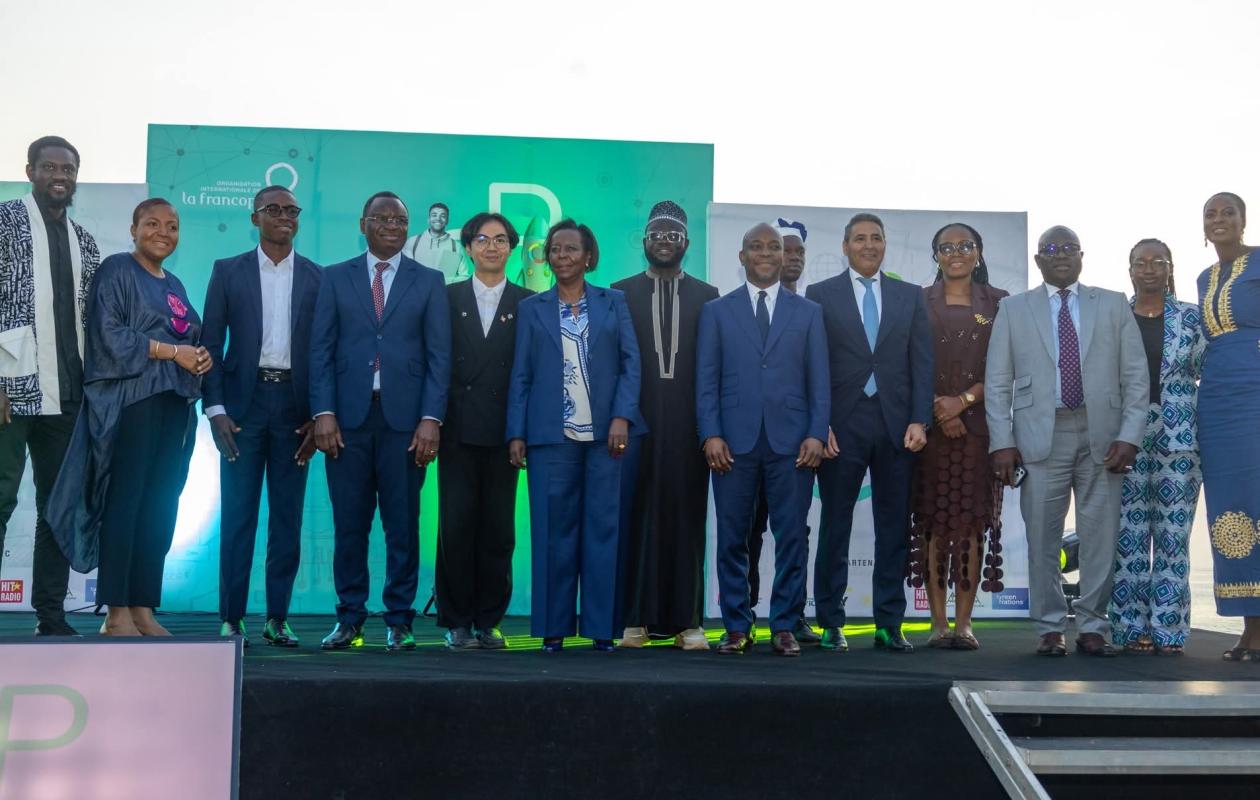
Louise Mushikiwabo, Secrétaire générale de la Francophonie, lors de la Journée mondiale de la créativité et de l'innovation à Dakar
Nearly 70% of the Francophone population is under 35, according to the International Organization of La Francophonie (OIF). This major demographic potential directly challenges the ability of states and institutions to turn innovation into sustainable jobs.
It was in this context that the World Creativity and Innovation Day, organized by the OIF, took place in Dakar. The event brought together young entrepreneurs, experts, and institutions to highlight projects from the Francophone world.
The 2025 call for applications received over 3,100 submissions from 49 countries, confirming the scale of youth engagement in innovation. At the end of the process, eight winners were selected, including four grand prize winners (€10,000 each) and four runners-up (€5,000). The program also trained 100 young entrepreneurs and supported 20 high-potential projects.
The winners come from Senegal, Benin, Burundi, the Democratic Republic of Congo, Cambodia, and Togo. Six of them were present in Dakar to present their projects and exchange with jury members, fostering experience sharing and networking.
On the ground, discussions quickly highlighted a central challenge: the difficulty of turning an innovation into a viable, structured business. "Inventing, creating, structuring a business model, and building an ecosystem around an idea is an extremely demanding journey," recalled Senegal's Minister of Industry and Commerce, himself a researcher and inventor.
Among the standout projects, Moustapha Diop's illustrates this ambition to scale up. His educational platform, Djangalma, already claims over 200,000 learners impacted and 700 teachers recruited and trained. The goal now is to reach one million learners and create 2,000 jobs in the coming years.
Beyond the numbers, the projects presented underscore a structural reality: innovation is advancing rapidly, but its industrialization remains limited. Access to funding, mentorship, and structuring business models emerge as recurring obstacles.
Present in Dakar, Louise Mushikiwabo, Secretary-General of La Francophonie, emphasized that youth make up the majority of the Francophone space and must be at the center of public policies, particularly through initiatives like CAP Innovation, designed to support project leaders.
But beyond showcasing these talents, the event raises a central question: how to transform thousands of innovative ideas into a significant number of viable, job-creating businesses? Because while the eight winners from 3,100 applications illustrate a rich pool of creativity across 49 countries, they also highlight the difficulty of moving from innovation to lasting economic impact.
"The challenge now is to scale up," insisted Dr. Serigne Gueye Diop, Minister of Industry and Commerce, calling for stronger funding mechanisms, mentorship, and integration of projects into national economies.
In Dakar, this edition highlighted a dual reality: a highly creative Francophone youth, still facing the major challenge of turning their ideas into structural economic engines.
Laïka NZANGUILA BA

![[EXCLUSIF] Expulsion de la famille Srour : L'accusée Khady Diagne se prononce, documents à l'appui](https://image.seneweb.com/content/news/2026-20-14//thumb_1260x800_6a05cc2715573_a9nMMiStMC.jpg)










Commentaires (0)
Participer à la Discussion
Règles de la communauté :
💡 Astuce : Utilisez des emojis depuis votre téléphone ou le module emoji ci-dessous. Cliquez sur GIF pour ajouter un GIF animé. Collez un lien X/Twitter, TikTok ou Instagram pour l'afficher automatiquement.