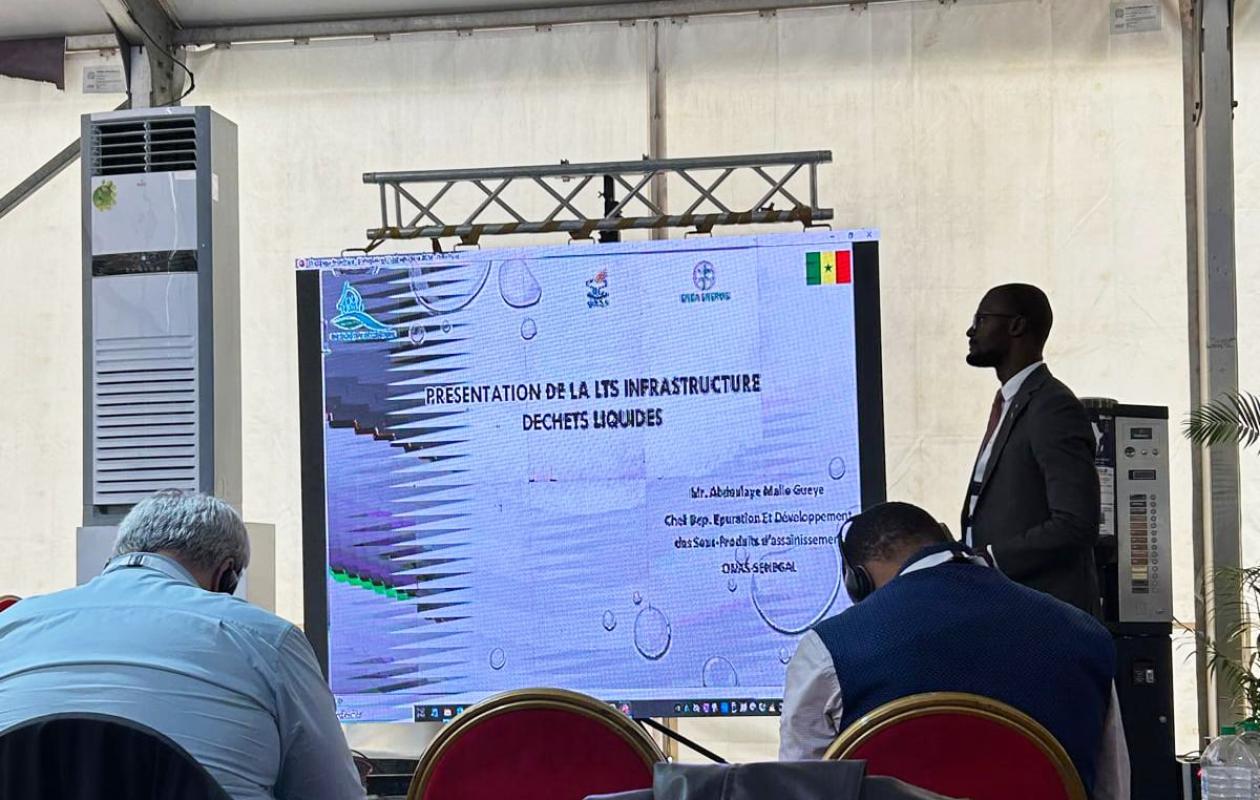
Réduction des émissions de gaz à effet de serre en assainissement : l’ONAS dévoile ses 4 scénarios et 4 options d’atténuation au 23ème Congrès de AAEA
Reducing greenhouse gas emissions is an emerging issue. In Africa, Senegal, through its National Sanitation Office (ONAS), is among the leaders in this field. At the 23rd Congress of the African Water and Sanitation Association (AWSA), held in Yaoundé, Cameroon, the topic was a central focus of participants during one of the panels last Wednesday. ONAS, along with Enda Energie and the Global Green Growth Institute (GGGI), began exploring the largely uncharted territory of the links between sanitation and climate change.
The stakeholders began by identifying the sources of greenhouse gas emissions. “We conducted a study with Enda and GGGI to contribute to the Nationally Determined Contribution (NDC). The goal is to inventory the greenhouse effects. To do this, we need to diagnose both systems, collective and individual. And with regard to these two systems, we noticed that the three links that could generate greenhouse gases are septic tanks, the structure that allows for the retention of wastewater produced at the household level, the treatment link, whether it be Sludge Treatment Plants (STB) or Wastewater Treatment Plants, and the third and final link is the receiving environment,” explains Abdoulaye Mallo Guèye, Head of the Department of Wastewater Treatment and Development of Sanitation By-products.
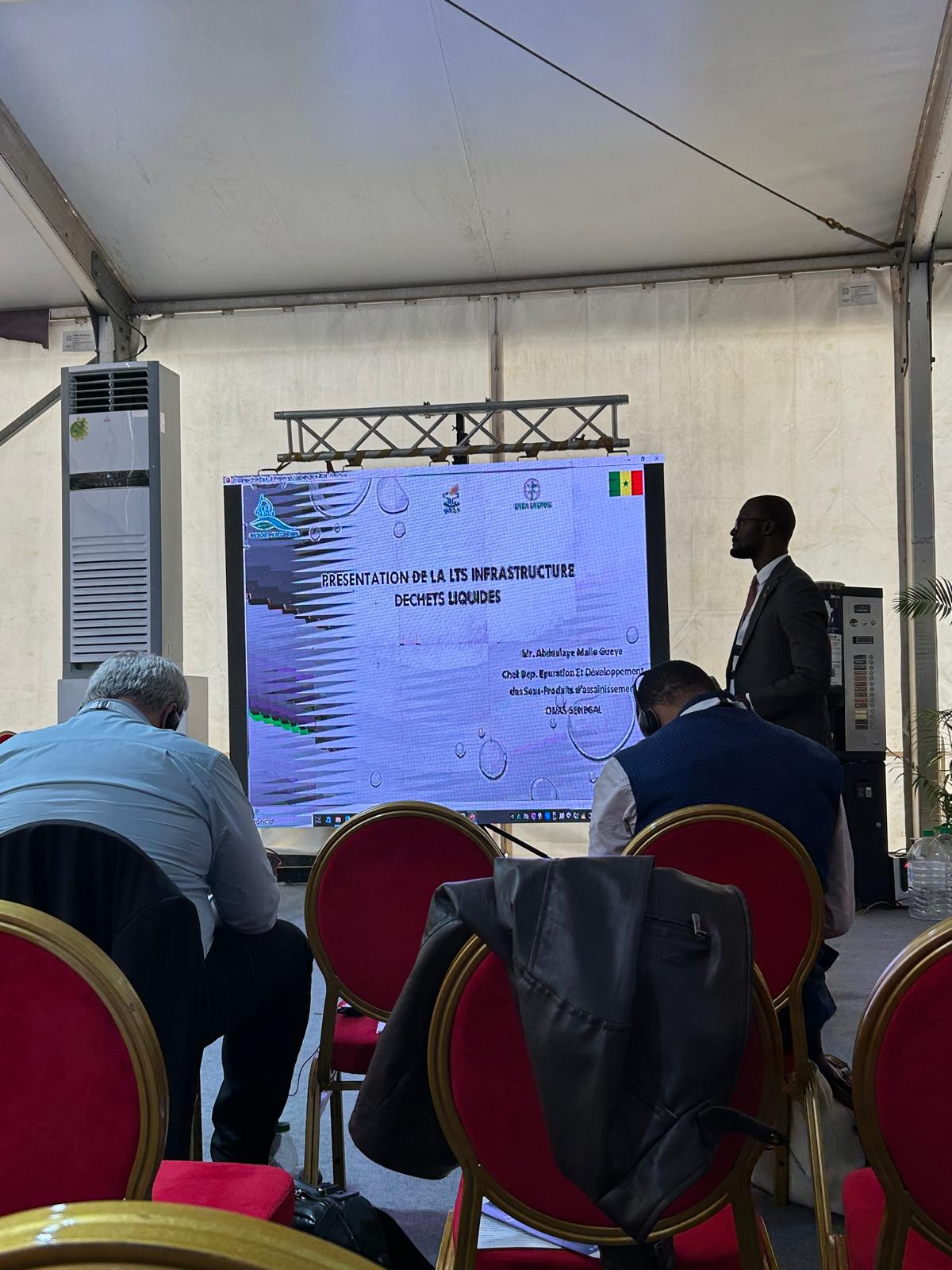
Emission of gas into the receiving environment
Experience has shown that effluent that has not been fully treated continues to emit gases, even into the receiving environment. "The effluent continues to degrade even in the receiving environment. That's why it's necessary to integrate all the data from the three stages of the process to create a comprehensive inventory. After this inventory, an IPCC platform had to be used." to generate emission values. And two gases are taken into account, namely nitrous oxide and methane. As you know, methane is 28 times more potent as a greenhouse gas than CO2. But for nitrous oxide, it's more than 200 times more potent,” explained Abdoulaye Mallo Guèye.
The 4 scenarios
After the inventory, the next step is modeling the four scenarios. The first scenario is based on business as usual, which implies continuing the same practices and policies as in Senegal. The aim is to see what the results will be in 2050. But between now and then, there are intermediate scenarios. "We have a greenhouse gas emissions level of 1,700 gigagrams of CO2 equivalent between 2018 and 2024. And for S3, we have an emission level of around 1,110 gigagrams of CO2 equivalent. This means that if mitigation measures are implemented, we will have a reduction of around 600 gigagrams of CO2 equivalent. That is not negligible," concludes Abdoulaye Mallo Guèye.
The reduction of 600 gigagrams of CO2 equivalent is comparable to the emissions of a 100-megawatt thermal power plant running on polluting heavy fuel oil for 8,000 hours per year. "This demonstrates the potential of sanitation to contribute to Senegal's strategy for reducing greenhouse gas emissions," argued the head of the Department of Wastewater Treatment and Sanitation By-Product Development in Senegal.
The 4 mitigation measures
Among the emerging mitigation options is strengthening the treatment capacity of wastewater treatment plants, because when effluent is treated properly, emissions tend to decrease. The second measure relates to the reuse of treated water and sludge. This reuse contributes to food security. The third measure I proposed is the densification of the sanitation network. Because in dense cities like Dakar, it's true that we promote individual sanitation systems, but it's much more appropriate to install sanitation networks to address all groundwater pollution,” explained Abdoulaye Mallo Guèye.

The fourth way to reduce emissions is through the introduction of technologies, specifically those related to energy production, which in turn allows for a decrease in fossil fuel consumption. The more wastewater treatment plants operate using clean energy, the more ONAS will reduce its carbon footprint, not to mention the reduction in operating costs. "The fourth and final measure is the adoption of biogas technology. This adoption has proven its worth; we know that biogas allows us to convert methane and reduce gas emissions. At the same time, we reduce operating costs and optimize the energy costs of the various plants and all the technologies for valorizing our by-products. A certain level of quality will be required before valorization can begin," commented the head of the Wastewater Treatment and By-Product Development Department at ONAS.
Belem, the turning point
The correlation between sanitation and climate change is beginning to be recognized. This emerging issue is attracting the interest of partners, and in Africa, some countries want to draw inspiration from the Senegalese model, which is still in its early stages despite the available tangible data. Following the United Nations Conference of the Parties on Climate Change (COP30), held in Belém, Brazil, ONAS (the National Sanitation Office) offered a glimpse into its ongoing work to reduce greenhouse gas emissions . "Since our participation in COP30 in Belém, we've seen many organizations taking a greater interest in sanitation and climate change. Because behind the rhetoric, we have concrete figures."
This is an asset for convincing donors. As long as we do not have completed studies, obtaining funding becomes impossible. That is why, with the commitment of the Director General of ONAS, Séni Diène, we are working to put in place monitoring systems which will ultimately allow us to have reliable data, projects eligible for climate finance and green climate funds,” said Abdoulaye Mallo Guèye.
























Commentaires (1)
Participer à la Discussion
Règles de la communauté :
💡 Astuce : Utilisez des emojis depuis votre téléphone ou le module emoji ci-dessous. Cliquez sur GIF pour ajouter un GIF animé. Collez un lien X/Twitter, TikTok ou Instagram pour l'afficher automatiquement.