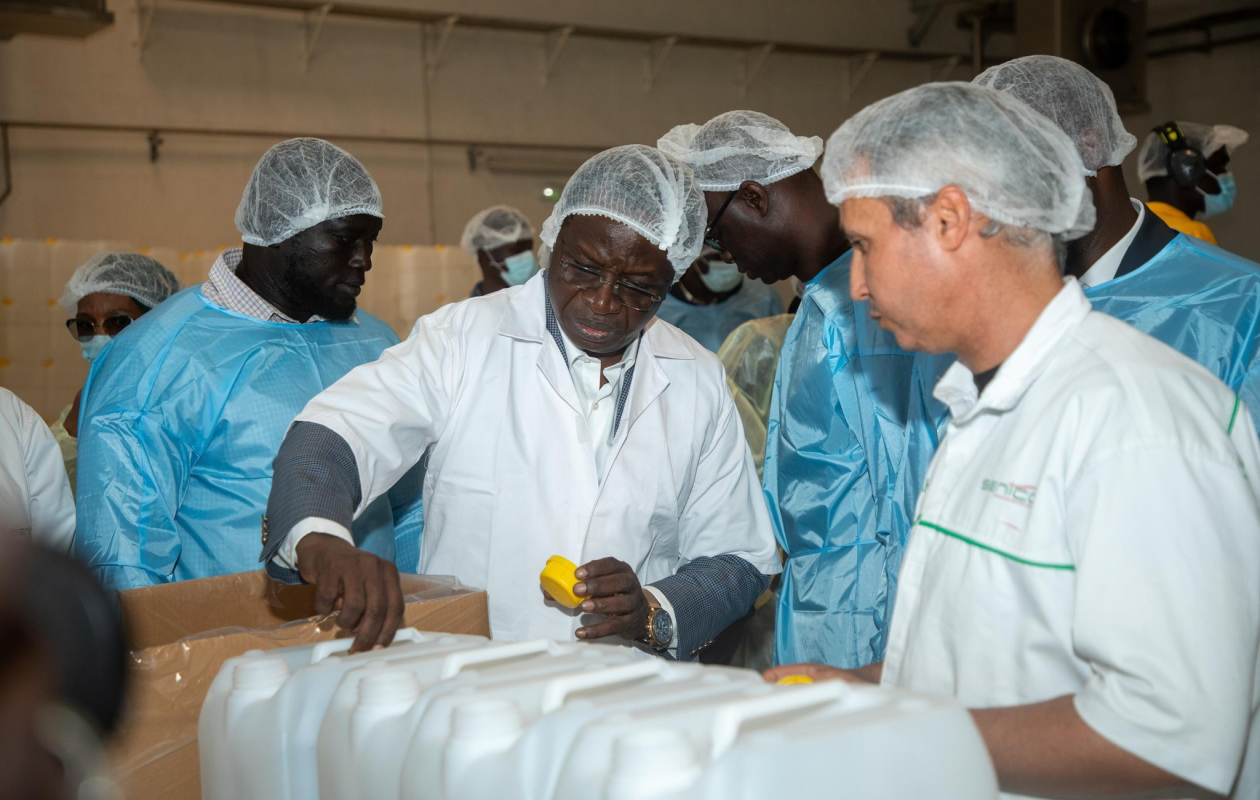
Senegal's Minister of Industry used the platform offered to him this morning at the Grand Theatre to address researchers in the pharmaceutical field. The occasion was the 38th Annual General Assembly and Scientific Conference of the West African College of Pharmacists (WAPCP), scheduled from April 20 to 24, 2026, in Dakar, initiated by the Faculty of Medicine at UCAD. Having come to preside over the opening ceremony of this event—held for the first time in French-speaking West Africa—alongside his colleague from the Ministry of Health, Serigne Guèye Diop called on academics to support the Senegalese state in its quest for pharmaceutical sovereignty.
"I wanted your conference to also begin reflecting on Africa's needs in terms of industrial investment ten years from now. How can we go from producing just 5% of our needs today to 80%, as Algeria has done, or even 90%? I believe that is also the challenge for academics. Isn't the role of researchers and academics to think, alongside policymakers, about technical, scientific, and financial solutions for research?" he asked.
Today, Senegal imports more than 80% of its pharmaceutical needs. However, as the Dean of the Faculty of Medicine, Professor Bara Ndiaye—who represented the Rector of UCAD—pointed out, this reliance on imports exposes the population "to supply shortages, high costs, and sometimes products of questionable quality." This, he argued, makes revitalizing local pharmaceutical production not an option but a strategic necessity.
During the COVID-19 pandemic, Serigne Guèye Diop said he was sent to the United States by the Senegalese government in search of vaccines. He was told that 100,000 doses were planned for Dakar, but given the evolving situation, it was no longer possible to grant even a single dose. Even today, he noted, with the African Continental Free Trade Area, Senegal could shift from dependence on the North to dependence on the South, with imports coming from Algeria, South Africa, Nigeria, or Kenya.
Drawing lessons from the past and to avoid merely relocating dependence, Senegal aims to produce 50% of its needs. Academics must play a major role in this. "I think what you need to do, as doctors, scientists, and also as pharmacists, is to advise governments on the best way to produce generics," he said.
To achieve this 50% target, the government has established three industrial zones: one in Diamniadio, another in Diass covering 700 hectares, and a third in Touba spanning 200 hectares. "We want not only to welcome chemists to produce medicines but also to attract those who manufacture measuring devices, analytical instruments, and laboratory equipment, in order to encourage research and development," he added.
He further stressed that the government intends to allocate significantly more funding to pharmaceutical research. Because, he admitted, it is inconceivable to set such ambitious goals while allocating only 0.5% of the budget to research. The aim is to strengthen and upgrade pharmacy training programs.






















Commentaires (2)
Participer à la Discussion
Règles de la communauté :
💡 Astuce : Utilisez des emojis depuis votre téléphone ou le module emoji ci-dessous. Cliquez sur GIF pour ajouter un GIF animé. Collez un lien X/Twitter, TikTok ou Instagram pour l'afficher automatiquement.