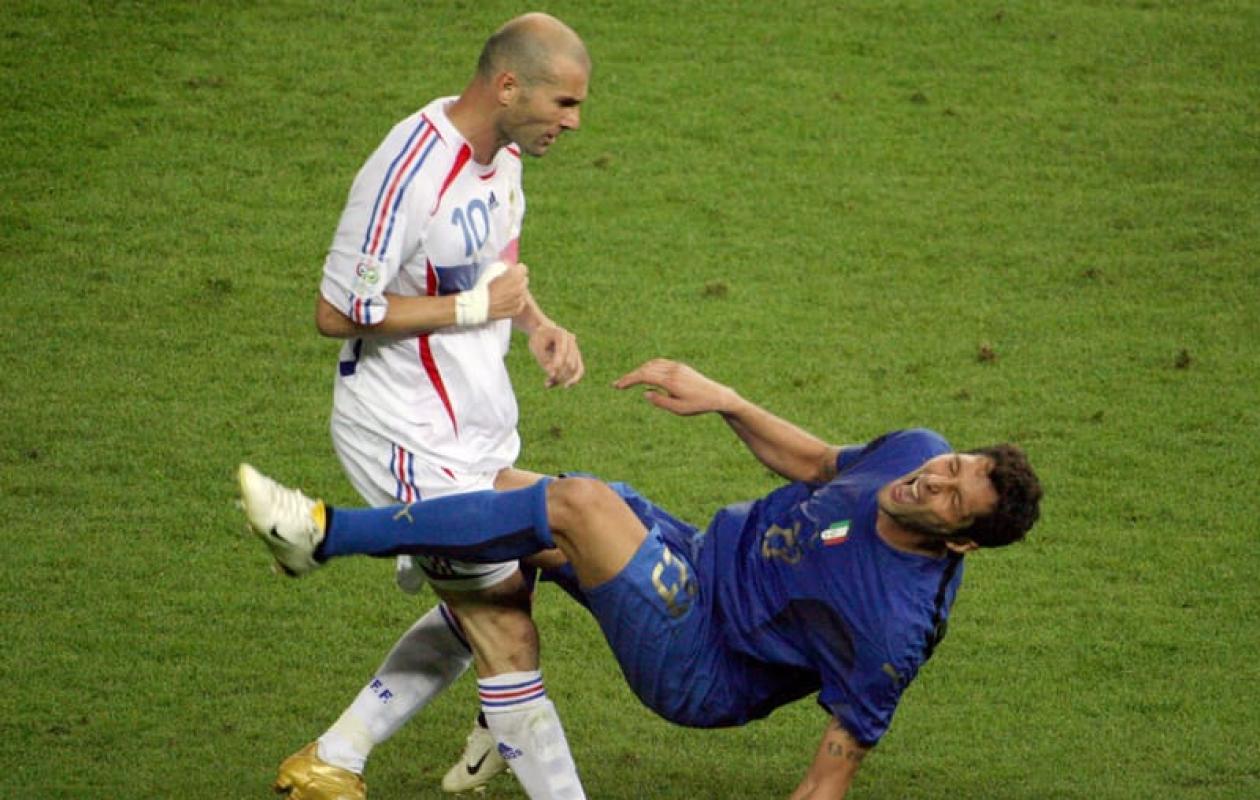
De Pelé à Zidane: ces scènes restées dans la légende de la Coupe du monde
Eight years after the national tragedy of the "Maracanazo" (defeat against Uruguay), Brazil's moment finally arrived in Sweden. In Stockholm's Rasunda Stadium, packed with supporters of the host nation, who were trailing 2-1, a 17-year-old boy revealed himself to the world, controlling the ball with his chest, followed by a sombrero flick in the box and an unstoppable shot. This legendary goal was the work of Pelé, whose real name was Edson Arantes do Nascimento. It was the culmination of two weeks spent setting records for precocity, first becoming the youngest goalscorer in the competition's history in the quarter-final against Wales (1-0), then the youngest to score a hat-trick in a semi-final against France (5-2), and finally, the youngest to score in a final, which the Seleção won convincingly (5-2), with a brace to his name.
No play has ever sparked so much debate. And for good reason: 60 years later, the mystery remains unsolved. England and West Germany were tied 2-2 in extra time of the final at Wembley when Geoffrey Hurst unleashed a powerful shot that struck the underside of the crossbar. Where did the ball bounce? Which side of the line? Did it bounce completely? Listening to his linesman, the referee awarded the goal to England, provoking the ire of the Germans. Goal-line technology obviously didn't exist in 1966, and the television replays of the time were never able to solve the mystery. Much later, biomechanical engineers from Oxford University, using computer simulations, concluded that the referee had made a mistake. Doubt resolved? Not according to Sky Sports, for whom the ball clearly crossed the line completely, in a virtual reality reconstruction carried out by EA Sports, developer of the Fifa game.
The World Cup in Mexico, Pelé's third title, stands as the masterpiece of the greatest player of the 20th century. More than his four goals during the tournament, including the first in the 4-1 final victory against Italy, it was other audacious but ultimately unsuccessful attempts that testified to his genius. Notably, in the semi-final against Uruguay, when he nutmegged the goalkeeper without even touching the ball. At the end of his run, however, Pelé's shot towards the empty net was just wide. He also narrowly missed the target in the first match against Czechoslovakia (4-1) with a 50-meter lob. And when he did manage to get his shots on target, it was his glancing header that evoked the genius of the England goalkeeper, who made the save of the century in the group stage (1-0). "I scored a goal, but Gordon Banks saved it," the Brazilian would later say.
So many intense, rollercoaster emotions swept through the players, spectators, and television viewers during this legendary semi-final, won by Germany against France on penalties after a crazy extra time in which Les Bleus led 3-1. But before the bitter French disappointment, there was a time of fear and anger when, around the hour mark, Patrick Battiston was violently struck by goalkeeper Harald Schumacher, who rushed out to meet him. For a moment, there was fear for the defender's life as he lay on the ground, his left hand seemingly frozen. Forty-four years later, the image is still chilling. Carried off on a stretcher, Battiston left three teeth on the cursed pitch of the Sanchez-Pizjuan stadium, without the referee penalizing Schumacher.
These were the craziest four minutes ever witnessed in a World Cup match. It all began in the 51st minute of the quarter-final between Argentina and England at the Azteca Stadium: Diego Maradona deflected a high ball destined for goalkeeper Peter Shilton with his left hand, sending it into the net without the referee noticing the cheating. "I put it in a little with Maradona's head and a little with the hand of God," he would later declare mischievously. The work of "God," then, but with a touch of the devil. And that devilish Diego almost made everyone forget the trickery in the 55th minute with a fantastic run, starting in his own half: he dribbled past five English players, including Shilton, before finally putting the ball into the back of the net. A masterpiece made by an extraterrestrial, "a cosmic kite" even screams a journalist from an Argentinian radio station, Víctor Hugo Morales, in a trance, in a comment that has gone down in history.
"Not that, Zinédine, not that, Zinédine! Oh no, not that! Not today, not now, not after everything you've done!" What words, other than those uttered by the late commentator Thierry Gilardi, could have better summed up the mixed feelings—stupefaction, incomprehension, dejection, anger—of the French fans when they saw, in slow motion, Zidane headbutt Marco Materazzi in the chest? At that precise moment in the suffocating extra time of the 2006 final against Italy, it was as if everything had collapsed for Les Bleus. First and foremost, the hope of winning a second star without the man who had, in fact, sparked it with his audacious Panenka penalty in the first half. The penalty shootout was the final blow, with Italy lifting the trophy before which "ZZ" had walked, head bowed, after his dismissal. The ultimate, and still famous, image of an idol who came so close to becoming a legend, but missed his exit.
AFP





















Commentaires (2)
Participer à la Discussion
Règles de la communauté :
💡 Astuce : Utilisez des emojis depuis votre téléphone ou le module emoji ci-dessous. Cliquez sur GIF pour ajouter un GIF animé. Collez un lien X/Twitter, TikTok ou Instagram pour l'afficher automatiquement.