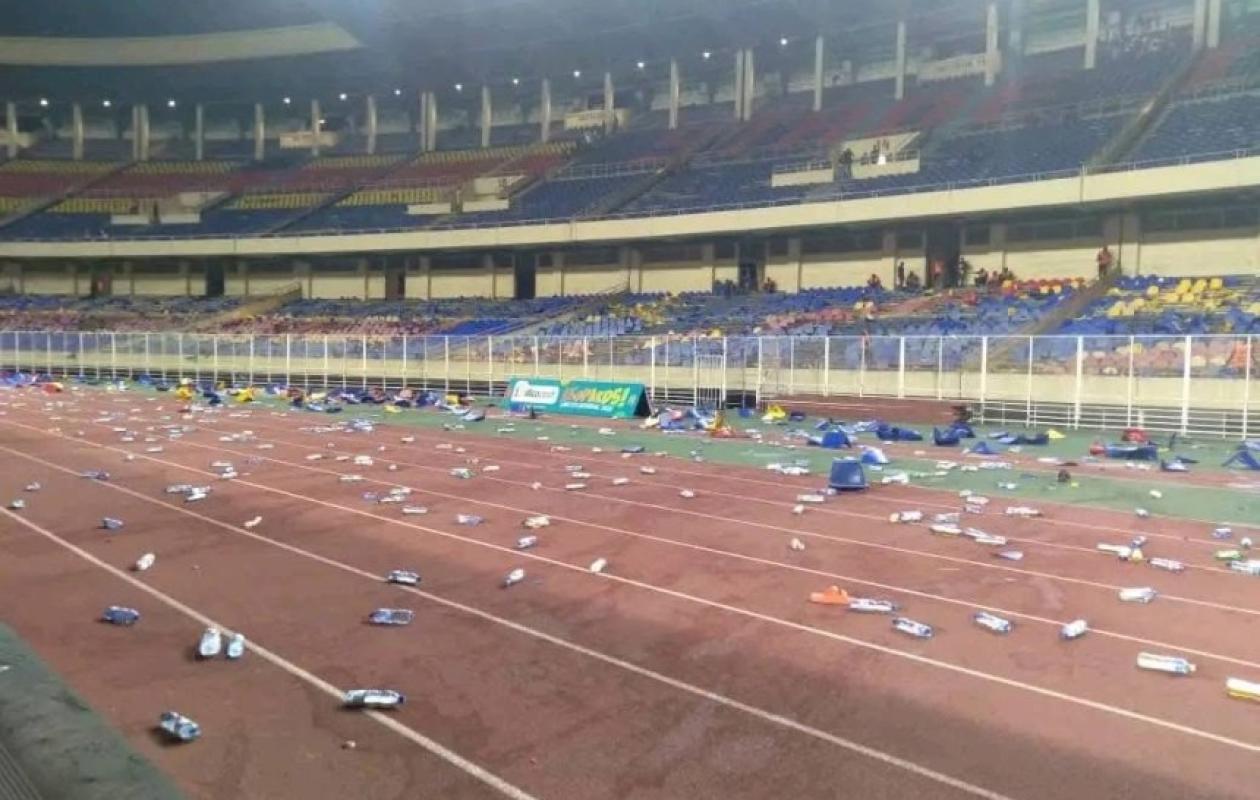
RDC-Sénégal (2-3) : une «bombe pipi» sur Pathé Ciss, témoignages flippants sur le chaos du stade des Martyrs
The Lions dominated the Leopards in Kinshasa in a surreal atmosphere where Senegalese players, journalists, and supporters were the target of rampaging Congolese. Witnesses recount in L'Observateur. Excerpts.
Fatima Sylla, journalist (2STV): “Honestly, I panicked”
“On the day of the match, the president of the Senegalese community in Kinshasa called me to warn me that if I was still at the hotel at 1 p.m., I wouldn't be able to access the stadium, as the fervor outside was so intense and uncontrollable. Indeed, upon my arrival, a crazy crowd awaited me, in the truest sense of the word. I'm used to giving viewers the pre-match excitement once I'm there, but this time, the Congolese fans gave me no room to maneuver. They shouted at me, insulted me, and interrupted me several times. The prevailing insecurity is inexplicable. I then joined the Senegalese fans, who returned to the stadium under military escort.
"The Congolese seem to be particularly targeting Paco, the Lions' 'mascot,' who is the most exposed because of his Senegalese uniform. It was because of him that we were initially denied access to the stadium. This prompted the supporters' president to intervene, explaining that I was a journalist and that Paco simply represented the Senegalese national teams. They finally let us through. But once inside the stadium, the situation escalated. Insults rained down from all sides.
Faced with this frenzied crowd, I felt the urgency to warn via my networks that the Senegalese present at the Martyrs Stadium were in danger. The stadium simply could not contain this mass of spectators. It was both incredible and terrifying. I didn't even have the opportunity to get the reactions of the Senegalese supporters regarding their predictions for the match.
"Bags of water were thrown at me, along with orders to leave the stand. At that point, the president of the Senegalese supporters advised me to change my clothes, to adopt neutral attire that in no way evoked Senegalese identity. I then left the supporters' stand to join the journalists' stand. But there again, all the seats were occupied by Congolese supporters. When they realized we were Senegalese, the insults intensified. Fortunately, the Congolese press present on site kept us safe until the end of the match.
"Honestly, I panicked. It was the first time in my life that I felt such fear. I saw men ready to confront the soldiers without the slightest hint of fear. They were beaten without fleeing. I was scared, really scared. Fortunately, Senegalese journalists like Mbaye Sène and Cheikh Tidiane Gomis were at my side, reassuring me. My panic stemmed from the unprecedented nature of the situation, from this spectacle that seemed to be from another world. We remember the victory, certainly, but even the players were tested by this excitement. This experience, although significant, was above all dangerous."
Sidy Talla, photographer (Eyelitstudio): “We had to take a seat on the Lions’ bus”
“Throughout the match, we lived in a poisonous atmosphere. There were several moments of panic, particularly during the ransacking of the stadium, in addition to the throwing of projectiles and the lingering smell of tear gas. There were also what they call 'pee bombs'. Bags of urine thrown at us. I saw Pathé Cissé hit by one of these projectiles as he tried to protect Pape Matar Sarr after his goal.
"Following the Lions' victory, the situation escalated: the demonstrations of anger from the Congolese were indescribable. I had never experienced such a tense atmosphere. At that moment, my safety became my priority. I put away my equipment, knowing that it was truly a matter of every man for himself. We tried to blend in with the group of Senegalese players, who were being escorted to the locker room. Three hours after the match, we had to take our places on the Lions' bus to be able to leave the stadium. But, fortunately, all's well that ends well."
Sheikh Tidiane Gomis, journalist (Wal fadjri): "I had an altercation with a police officer who was attacking a colleague"
“On match day, I arrived at the stadium at 11 a.m., and it was already full. The density of the crowd around the stadium was striking, almost frightening. Panic followed us into the stands. The section reserved for Senegalese supporters was suddenly attacked by individuals who forced their way through the barriers. Their language was abusive and their gestures threatening; their objective seemed clear: to intimidate us. They were dangerous, throwing bags of water and even urine. Thus, we experienced the tension of the match with this oppressive presence all around us.
“When the DRC led 2-0, the Congolese people burst into joy with chants, jumps, and dances. But as soon as Senegal scored its first goal, the atmosphere changed: the Congolese became angry, insulting and intimidating. Among Senegalese journalists, we decided not to draw attention to ourselves, forbidding ourselves from celebrating the goals for fear of reprisals. So, when Nicolas Jackson scored the equalizer to make it 2-2, I tried as best I could to contain my joy. But at the moment of Senegal's third goal, I could not completely repress my emotion. Quickly, however, I realized that the situation was about to degenerate. The Congolese began to overturn the stadium, and the panic grew.
“As a journalist, having attended numerous matches around the world, I had never experienced such an atmosphere of chaos. My main concern was the safety of the Senegalese players in the stadium. After the final whistle, the run-in began. As we entered the security cordon protecting the Senegalese players, I was involved in an altercation with a police officer who was attacking a colleague. I intervened to protect my colleague. Afterwards, we were lucky enough to reach the locker room; where we waited for long hours before being able to leave the stadium safely.”
Aliou Ngom "Paco", Lions supporter: "I narrowly escaped being lynched"
"We entered the Martyrs Stadium at 11 a.m. [on match day], under police escort. The problems began the moment we entered the enclosure. We settled into the area reserved for Senegalese supporters. But there were barely two hundred of us, where a thousand seats had been allocated to us. To fill this void, which made us vulnerable, we decided to hang a huge Senegalese flag, covering the deserted rows, then to stand above it, wearing T-shirts in the national colors. This gesture, symbolic and unifying for us, immediately provoked the anger of the Congolese. Very quickly, several of them climbed the gates and a fight broke out between these supporters and the stewards responsible for ensuring security. Chaos ensued. Tear gas was dispersed, but despite this, the Congolese fans gained the upper hand. They tore down the Senegalese flag, took it away and sat down on the seats that were meant for us.
"Faced with this humiliation, we decided to leave the stadium, determined to block the Senegalese players' path upon their arrival, so that everyone could appreciate the extent of the abuses we were subjected to. This strategy paid off. It forced the organizers to react and escort us back to our stands under military escort. The match began in deceptive calm. But everything changed with the first Congolese goal. While their supporters were cheering, a hail of projectiles fell on us: stones, bottles filled with urine, everything was thrown furiously in our direction. The atmosphere became suffocating, and after the second goal, the torture intensified. This time, it was bags filled with excrement and other filth that were aimed at us, giving off unbearable odors.
"The first Senegalese goal, then the equalizer, calm the fury for a moment. But with Senegal's third goal, everything explodes again. The enraged Congolese fans tear out the seats and throw them at us like weapons. It's a real war scene. Our lives are clearly threatened. Some, driven by panic, try to jump the barriers and hurt themselves in the fall. The soldiers intervene and set up a ladder to evacuate us through the tunnels that border the pitch. We stay there for more than three hours, confined, under military protection, before finally leaving the Martyrs stadium escorted like rescued prisoners. But the ordeal continues.
“When we went to collect our luggage to go to the airport, a hostile crowd camped outside our hotel. It was at that moment that I narrowly escaped being lynched, slipping into a car at the last minute. On the way, I called Bacary Cissé to find a solution. With 'Fall Drapeau,' we agreed to return with the players. Thanks to him, we were put in touch with the president of the Senegalese Football Federation, Abdoulaye Fall, who put us in touch with the representative of the Ministry of Sports. He took our passports and we boarded with the national team. Thus ended a painful adventure, marked by fear and humiliation, but saved by the happy outcome: Senegal's victory. This trip, I know, I will never forget it.”










Commentaires (9)
la vengeance est un plat qui se mange froid...💥
N’oublions pas que le Congo est un pays qui vit la guerre et que, dans pareil contexte, la perception de la violence change. Le jet de bouteilles et autres objets devient, pour les supporters, anodin. Même le spectacle sportif qui doit être une soupape, un bol d’air pur, ils sont capables de l’oublier. Leur rendre la monnaie de leur pièce ne serait pas la bonne option. Au contraire, accueillons-les avec respect et humanisme pour qu’ils se réveillent et s’amendent. Vous avez dit « Terranga » ?
Chez nous ont dit aussi « Lou waay di wouyo dakoy nouro » !
Mais en réalité, leur équipe est composée de joueurs qui n'ont pas réellement de temps de jeu dans leurs clubs. Les trois attaquants étaient cramés avant l'heure de jeu. Ça me rappelle le combat Balla Gaye 2 - Siteu Ha ha ha.
Bon! Ne tirez pas sur les tous congolais, c'est un groupe de supporters excités et déçus par la tournure des choses mais les congolais sont des gens bien en général. Ils sont bien.
Participer à la Discussion
Règles de la communauté :
💡 Astuce : Utilisez des emojis depuis votre téléphone ou le module emoji ci-dessous. Cliquez sur GIF pour ajouter un GIF animé. Collez un lien X/Twitter ou TikTok pour l'afficher automatiquement.