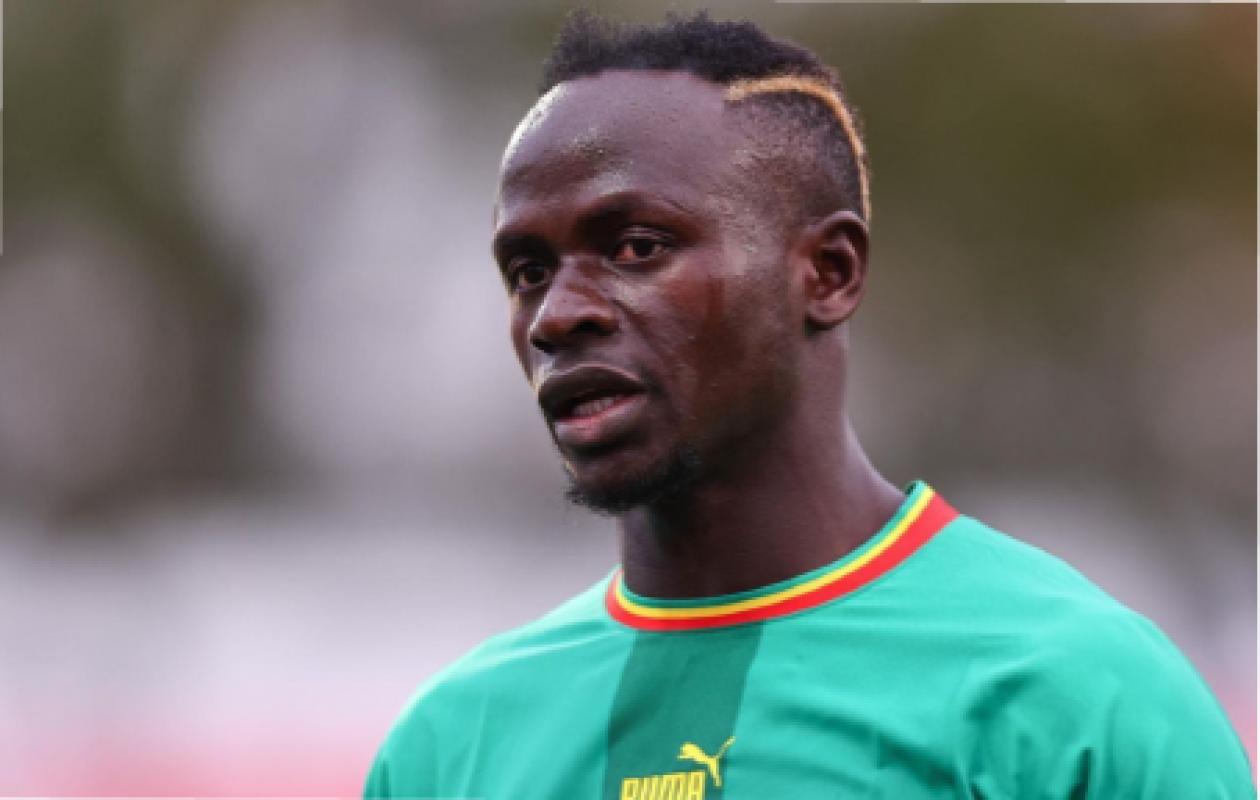
Sadio Mané est-il le plus grand joueur de l’histoire du Sénégal ?
What if the Senegalese football legend already had a face, a name, a destiny? For more than twenty years, the Lions of Teranga have offered the world unforgettable figures, football artists who have left their mark on hearts as much as on statistics. But one name always comes back, stronger, more obvious: Sadio Mané .
The striker, trained in the streets of Bambali, who became a global star at Liverpool and then the architect of Senegal's first continental title in 2022, today embodies the success and footballing identity of an entire country. However, the history of the Lions does not begin with him. Before Mané, there was El Hadji Diouf , double African Ballon d'Or winner and hero of the 2002 World Cup, or Henri Camara , the national team's top scorer and author of the legendary double against Sweden.
Behind this question – is Mané the greatest player in Senegalese history? – lies a universal debate that the media specializing in football and sports betting, MightyTips, is trying to answer: how to compare generations, how to evaluate a player's legacy? Cameroon has long wondered if Samuel Eto'o had dethroned the eternal icon Roger Milla , just as France pitted Michel Platini against Zinédine Zidane .
In Senegal, the debate has begun. More than just a ranking, it's a mirror held up to collective memory, a reflection on what a player represents in the construction of a national identity.
Mané, the heir who became king
Sadio Mané is, first and foremost, a romantic journey. He left Bambali , a small village in Casamance, to reach Europe with a sports bag and a boundless dream. He built himself up step by step, until he established himself as one of the best strikers in the world. From Salzburg to Southampton, from Liverpool to Bayern Munich, to Saudi Arabia, his journey tells as much about personal ambition as it does the evolution of African football on the world stage.
At Liverpool, he reached the peak of his powers. A Champions League winner in 2019 and English champion in 2020 , Mané was not only a brilliant player; he was one of the symbols of a team that defined its era. His speed, his goal-scoring ability, and his selflessness made him a feared striker, but also respected for his humility and commitment.
With Senegal, his legacy is even greater. For a long time, the Lions suffered from regrets, always failing to reach the final. It was he who broke the curse, giving the country its first African Cup of Nations in 2022 against Egypt. His winning penalty in the final instantly became legendary, as did his decisive role in qualifying for the 2022 World Cup.
More than just a player, Mané has become the face of a golden generation , that of Kalidou Koulibaly, Édouard Mendy and Idrissa Gueye. But he is its icon, the one who turned Senegal from flamboyant outsider to respected winner.
El Hadji Diouf, the icon of 2002
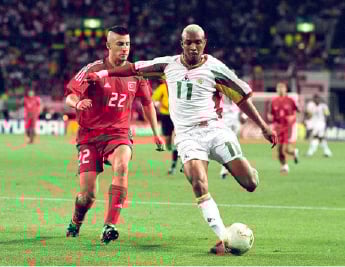
Before Sadio Mané became Senegal's flag bearer, another name made fans' hearts beat faster: El Hadji Diouf . Insolent, provocative, sometimes divisive, but always incandescent, Diouf was the face of a generation that gave Senegal its first great global thrill.
It all began in 2002. At 21, Diouf led the Lions to a historic World Cup in South Korea and Japan . His breakthrough? That legendary opening match against reigning world champions France, where he ridiculed the French defense with his dribbling and passion. Senegal won (1-0) and entered the legend. Diouf, for his part, became the symbol of this team that would go on to reach the quarter-finals, an unprecedented feat for the country and rare for the continent.
His flamboyant style is as seductive as it is divisive. A two-time African Ballon d'Or winner (2001 and 2002) , Diouf embodies the explosion of Senegalese football in the eyes of the world. However, his club career never lived up to its promise. Having played for Liverpool, Bolton, and Leeds, he never reached the level his talent seemed capable of taking him.
But Diouf was not just a player: he was a character, a standard . His personality, sometimes exuberant, left a lasting mark on the collective imagination. For a whole generation of African football fans , he will remain the man who paved the way, who proved that Senegal could compete with the greatest.
Although he did not bring a major title to the Lions, Diouf remains the icon of 2002, the mirror of insolence and rediscovered pride.
Henri Camara, the forgotten goalscorer?
In the great debates, there are always names that history forgets a little too quickly. In Senegal, this player is called Henri Camara . Less media-friendly than Mané, less exuberant than Diouf, the striker with the feline gait nevertheless remains the best scorer in the history of the Lions of Teranga , with 31 goals in 99 selections.
Yet his legend was written in one evening: June 8, 2002, in Oita , Japan. On that day, in the round of 16 of the World Cup against Sweden, Camara scored a memorable double, including the golden goal that sent Senegal to the quarter-finals. Instantly, he became a national hero and etched his name in the history of African football.
His club career took him from Strasbourg to Wolverhampton, via Greece and Switzerland, without ever reaching the European summits. But what was expected of him, he delivered: decisive goals, a fox's instinct and a rare loyalty to the national jersey .
While the spotlight has often been on Diouf and Mané, Henri Camara deserves to be mentioned in this debate. Because being a national team's top scorer is much more than a statistic: it's the invisible imprint of efficiency, the kind that transforms dreams into victories.
Beyond Statistics: The Notion of Inheritance
Comparing Sadio Mané to El Hadji Diouf or Henri Camara cannot be reduced to numbers. Because football, in Senegal as elsewhere, is also a matter of symbols, memory and collective transmission .
Mané embodies contemporary success: a player at the summit of European football, a model of humility, the architect of the first continental title.
Diouf remains the figure of creative insolence: he did not lift a trophy with the Lions, but he provided one of the greatest thrills in the country's sporting history.
Camara , for his part, symbolises quiet efficiency: less charismatic, but indispensable, he transformed matches in his own way, with decisive goals.
A player's legacy isn't measured solely in medals or goals: it's captured in the imagination of a nation . Mané changed destiny, Diouf led the way, Camara scored. Three faces, three ways of writing history.
International comparisons: Eto'o/Milla and Platini/Zidane
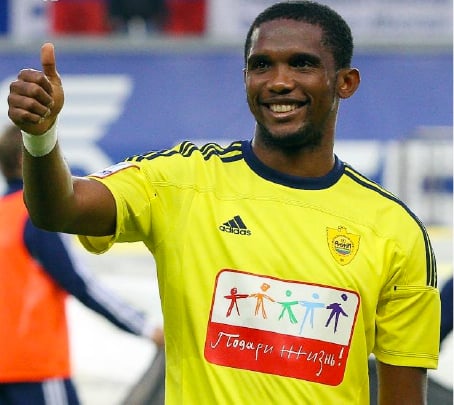
This debate is not unique to Senegal. Everywhere, major footballing nations are torn apart by the same question: who is the greatest?
In Cameroon , two icons are pitted against each other. Roger Milla , the eternal idol of 1990, a corner dancer and ambassador of uninhibited African football, against Samuel Eto'o , a four-time African Ballon d'Or winner, a star of Barça and Inter, whose club record is out of reach. One is the emotional legend, the other the statistical legend.
In France , the debate is no less heated. Michel Platini , maestro of the 1980s, triple Ballon d'Or winner, 1984 European champion, against Zinédine Zidane , man of the 1998 World Cup and Euro 2000, global icon who went beyond sport to become the symbol of a generation.
These comparisons say it all: it is not just about knowing who won the most or scored the most, but about determining who best embodied the soul of an era .
And that's exactly the question being asked in Senegal today. Mané may be the greatest in terms of achievements, but Diouf retains the aura of a pioneer. Like Zidane against Platini, like Eto'o against Milla, the answer is never definitive: it belongs as much to facts as to emotions.
However, the history of the Lions of Teranga cannot be reduced to Sadio Mané, El Hadji Diouf or Henri Camara. Khalilou Fadiga , elegant conductor of the midfield, Tony Sylva , last bulwark of the 2002 World Cup, Aliou Cissé , captain turned African champion coach, or Salif Diao , Papa Bouba Diop – legendary goalscorer against France in 2002 –, all have left an indelible mark. Not to mention the current generation, led by Kalidou Koulibaly , Édouard Mendy or Idrissa Gueye , who raised Senegal to the rank of continental power. The list is even longer, a sign that Senegalese football is rich in a lineage of players who each, in their own way, wrote a chapter of this epic.
10 players who made history in Senegal
Ultimately, the debate over the "greatest player" should not obscure one obvious fact: football remains, above all, a team sport . The exploits of Mané, Diouf, or Camara would never have had the same resonance without their teammates, without a united team behind them. Today, the era of social media further amplifies the spotlight on stars, sometimes blurring the distinction between individual performance and collective success.
African players make headlines during the football transfer window and even during the season. But comparing eras remains a perilous exercise: the 2000s are not the same as 2022, and the contexts, opponents, and resources differ. The greatness of a player is measured as much by his era as by the emotion he arouses. And it is perhaps there, more than in numbers or achievements, that the true legend of Senegalese football lies.







Commentaires (21)
Un grand Merci et bravo à tout le peuple sénégalais, hommes, femmes et enfants pour cette belle victoire du Sénégal contre la RDC. Nous savons démontrer que nous sommes un vrai peuple de lions et lionnes. Mais restons concentrés jusqu'au bout car le Sénégal n’est pas encore officiellement qualifié car il reste encore 2 matches à jouer et tout peut arriver d’autant plus que les lions vont recevoir la Mauritanie à domicile, ce qui sera un derby alors même que les Sénégalais n’aiment plus aller au stade. À chaque fois qu’on joue à domicile, le stade reste à moitié vide et la fédération semble trop incompetente pour régler le problème des billets et la mafia qui s’y est installée. Signé Karim-USA, probablement futur Ministre, DG et Président ! Bravo aussi au Président DIOMAYE Diakhar FAYE pour son soutien indéfectible aux lions lors de cette rencontre ! Let's gooooooo !
depuis le maroc a chaque fois que je déclare que je suis sénégalais on me dit automatiquement sadio mané ni diouf ni autre personnalité juste pour exprimer ma fierté envers lui
Et cerise sur le gâteau il nous a ramené la CAN, que les autres voulaient gagné. Sans parler de l'homme qui est de l'homme le sportif africain voir au monde qui a le plus impacté au sein de sa communauté d'origine.
God bless him forever
Mais ? footbalisquement parlant , Sadio Mané est lloin d’être le meilleur footballeur sénégalais de tous temps.
Je peux te citer plus de 10 footballeurs sénégalais qui manipulaient techniquement le ballon mieux que Sadio Mané.
Omar Gueye Séne_Elh Ousseynou Diouf_Baba Tourè_Matar Niang , pour ne citer que cela.
Même le ilimane Ndiaye d’aujourd’hui est 2 fois plus technique que Sadio Fall.
Mais avec respect Sadio Manè reste le meilleur de tous les temps, parce que tout simplement , c’est le plus professionnel de tous les temps et son parcours dans le haut niveau est inégalable
Signé triple xxx
Il faut aussi relativiser les titres gagnes parceque les joueurs de nos jours ont une carriere beaucoup plus longue. Nous n'avions meme pas d'ecole de foot. Tous les joueurs avant 2002 ont eu leur premier contrat professionel a l'age ou beaucoup de joueurs europeens etaient presk a la retraite. Ils devaient faire un jugement de -10 ans dans certains cas pour avoir un contrat. Rakh si doli l'equipe nationale etait tres mal encadree et sans argent. En 1986 l'equipe devait faire une quete dans chaque ecole pour financer sa campagne. Des joueurs depensaient leur propre argent pour jouer en ekip nationale.
C'est un peu comme mon pettit fils qui me disait un jour que Abdoulaye Diaw est le meilleut journalist sportif de l'histoire du senegal. Xale fekewoul !
Il faut arrêter de chercher du buzz pour Elhadji DIOUF.
Sadio n’est pas son égal sur tous les plans !
Participer à la Discussion
Règles de la communauté :
💡 Astuce : Utilisez des emojis depuis votre téléphone ou le module emoji ci-dessous. Cliquez sur GIF pour ajouter un GIF animé. Collez un lien X/Twitter, TikTok ou Instagram pour l'afficher automatiquement.