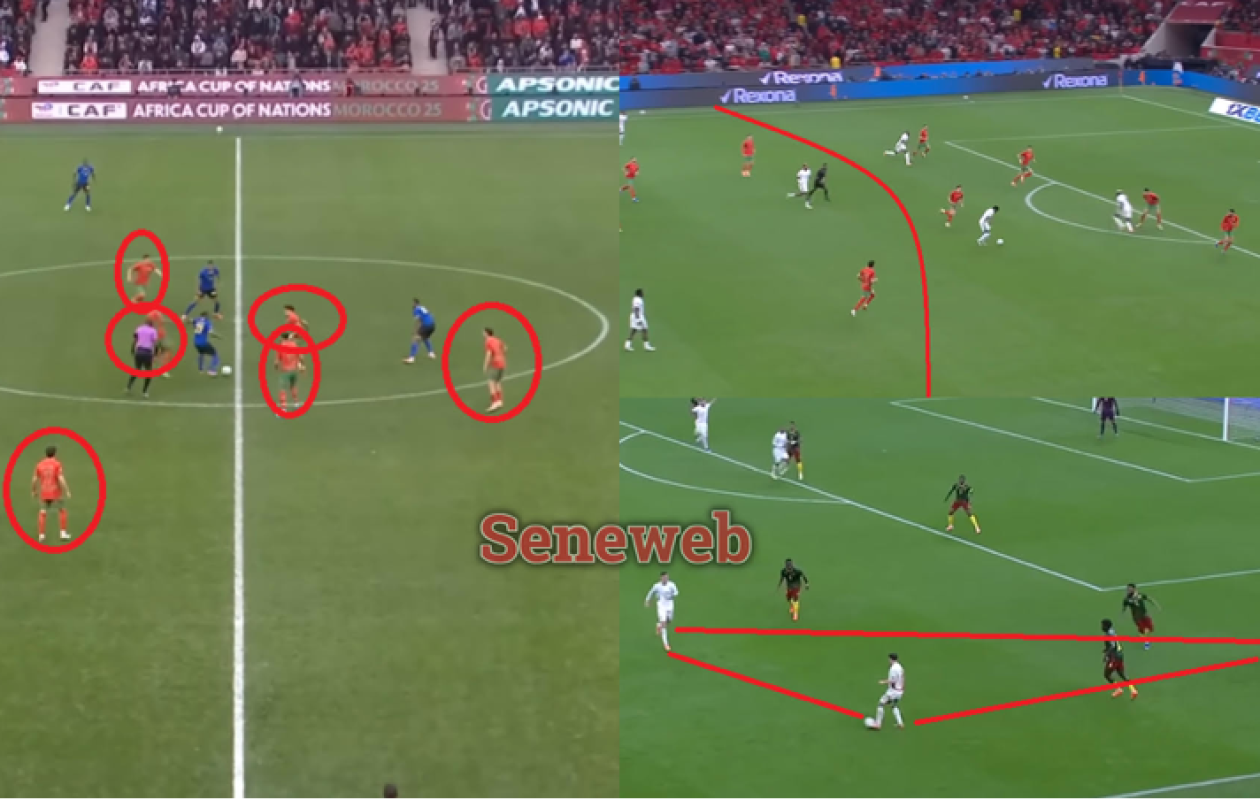
[Analyse tactique] Forces et faiblesses, diagnostic du jeu du Maroc (photos)
Morocco and Senegal face off this Sunday in the final of the 2025 Africa Cup of Nations. The host nation, pressured by its passionate fans, has overcome adversity to reach the final. The Atlas Lions haven't been spectacular throughout the tournament, often encountering reinforced defenses. To break them down, Walid Regragui has found some tactical solutions.
The analysis will not be exhaustive, but will highlight the main offensive weapon of the Moroccan team throughout this tournament, especially since the return of the team's star player Achraf Hakimi.
He's known for his attacking style, alongside his partner Brahim Diaz. To allow them to perform at their best and break down defenses, Walid Regragui has implemented a system based on overlapping runs out wide. Whenever the ball reaches the right flank, a triangle is formed by Brahim Diaz, Achraf Hakimi, and Bilal El Khannous. El Khannous then draws one of the midfielders out of position, creating space for Hakimi and Brahim Diaz.
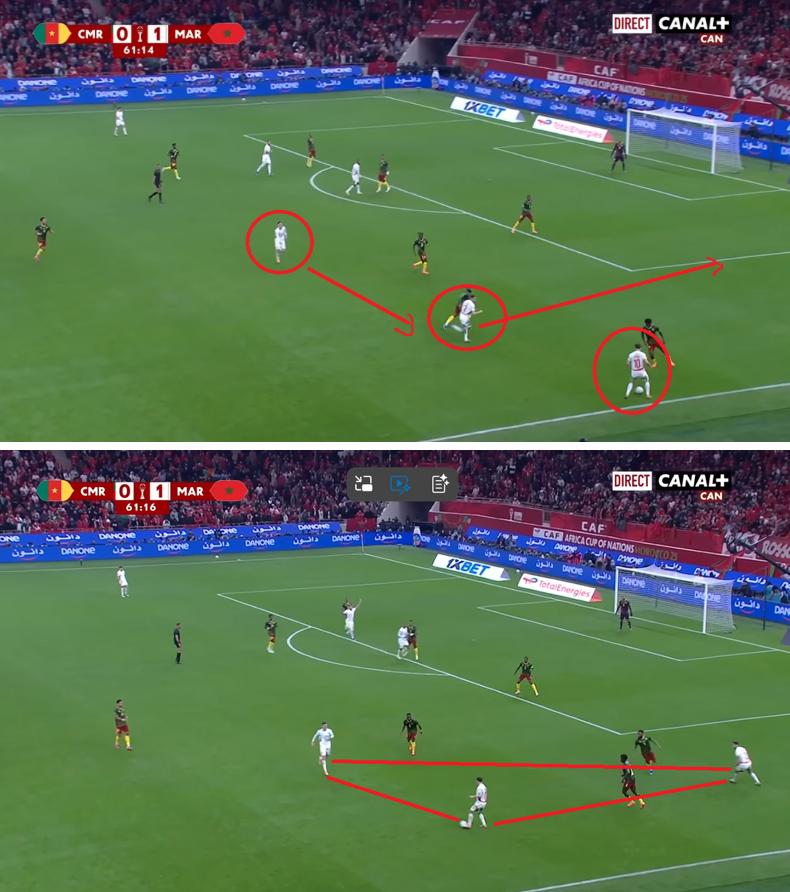
If El Khannous isn't available, Diaz and Hakimi can rely on their speed and the passer's good timing to be found without being offside. Once he gets going, Hakimi consistently tries to find El Kaabi, who is very good in the air. Brahim Diaz, for his part, has the freedom to cross or cut inside to shoot (see images). On this shot, Diaz's ball goes just millimeters wide of Nwabali's post. This tactical variety makes Morocco's play less predictable, relying on the inspiration and technical quality of its attacking players.
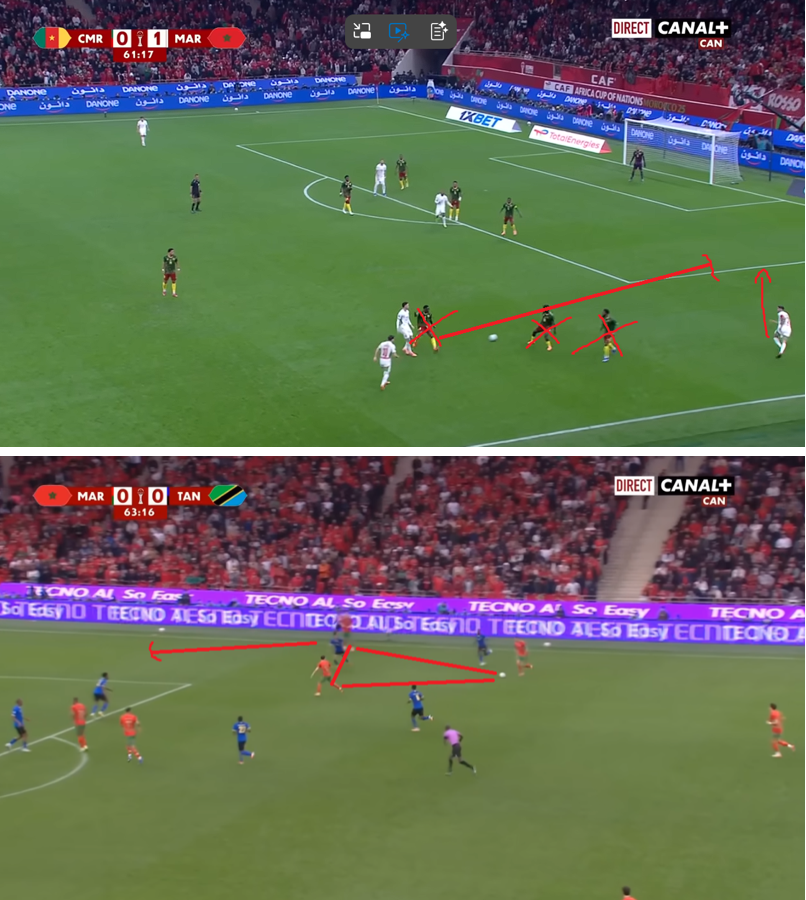
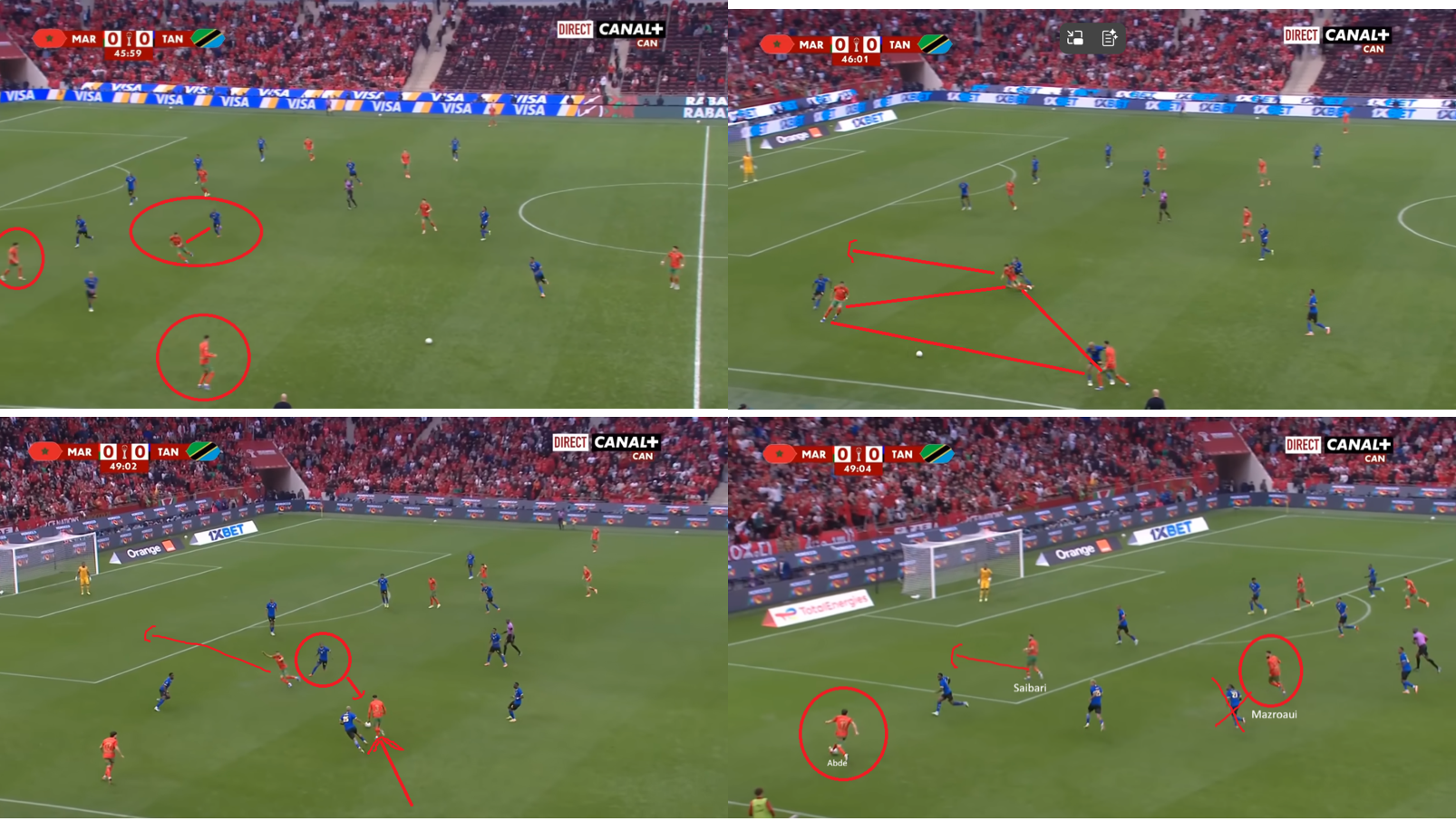
On the left, the Moroccan players always operate with overlapping positions, but here, Regragui has made a slight modification. It's not the winger and the full-back (Mazraoui) who combine, but the winger (Abde) and the left attacking midfielder (Saibari). In other words, on the left flank, Morocco plays with two wingers. With each Moroccan attack down the left, Mazraoui, on his weaker foot, cuts inside to open up the flank to Abde and Saibari. The latter played as a winger in all three group matches before moving into the center of the pitch. This strategy makes marking very difficult. In normal formations, the wingers track the full-back when he pushes forward. But here, if Mazraoui cuts inside, his direct marker is likely to follow him, allowing the attacking midfielder Saibari to break through the defense unmarked.
Up until now, teams that have played Morocco have struggled to defend against Saibari, who has gone from an average player during the group stage to a crucial one in the Moroccan game since Regragui's tactical change. In the following plays, Saibari is marked by the Tanzanian defensive midfielder. But his overlapping run down the left flank isn't followed by his direct opponent, who remains central. As a result, Saibari finds himself alone to combine with Abde, while Mazroaui brings the opposing winger inside.
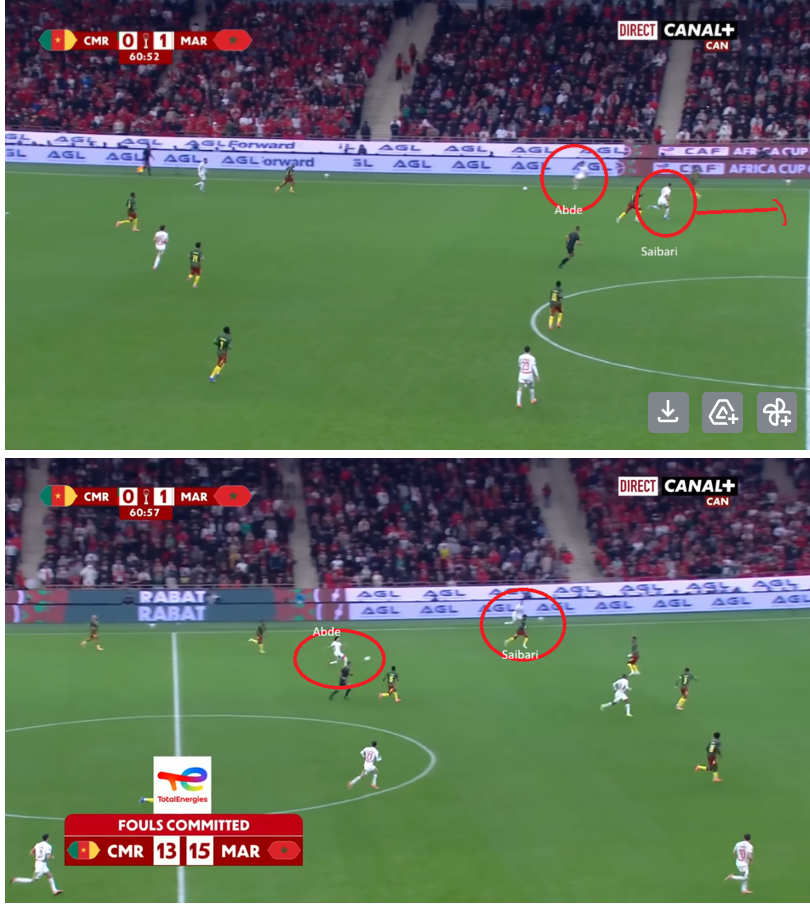
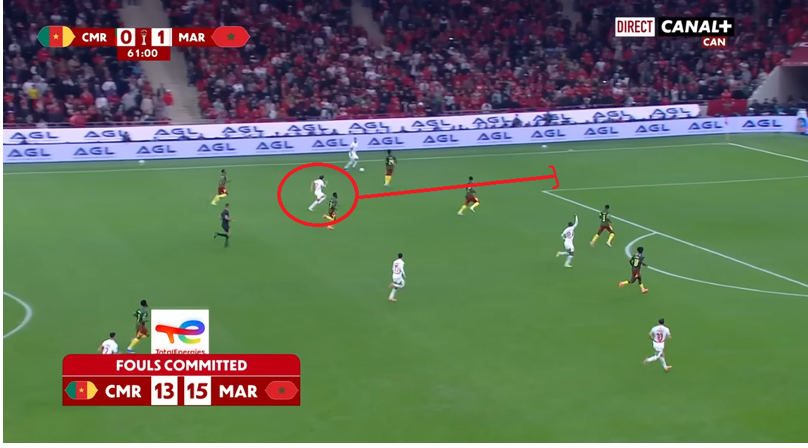
In this latest attack against Cameroon, Saibari accelerates down the left flank as soon as the ball reaches Abde. The two players then combine again on the wing. Abde, who passed the ball to Saibari, also accelerates to do the same as his teammate, overlapping to catch the defense off guard. In just two bursts of speed, Cameroon is outpaced, the Indomitable Lions' five-man defense breached.
Against Morocco, the Senegalese wingers will therefore play a crucial role in defensive support. Morocco's play is almost entirely focused on the flanks. For this final, the midfield battle will be secondary. Whoever wins the battle on the wings will win the match!
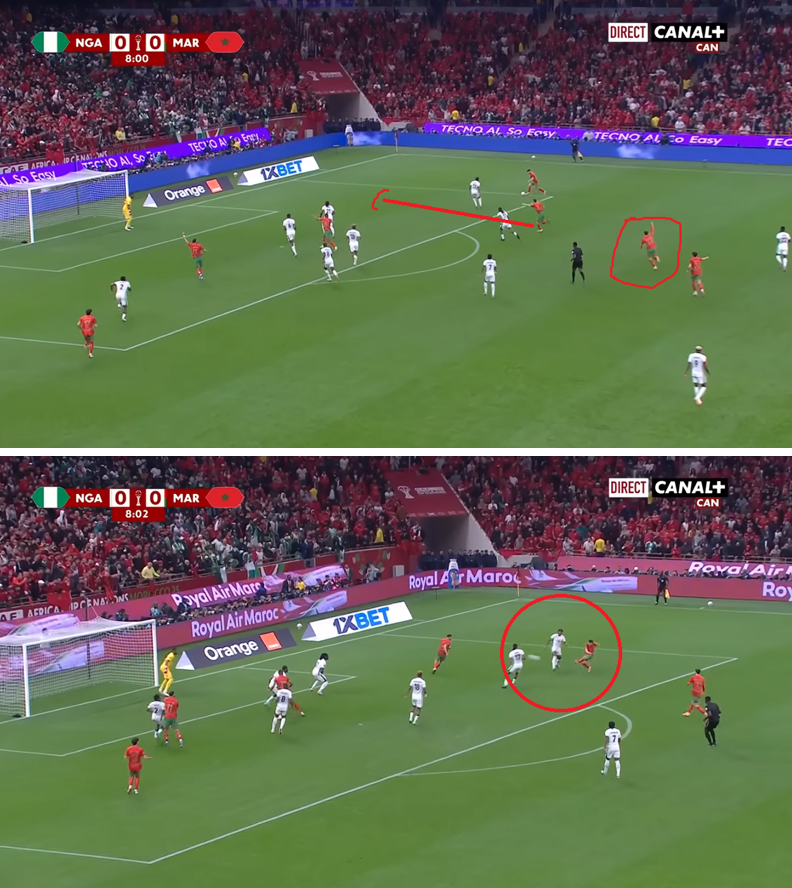
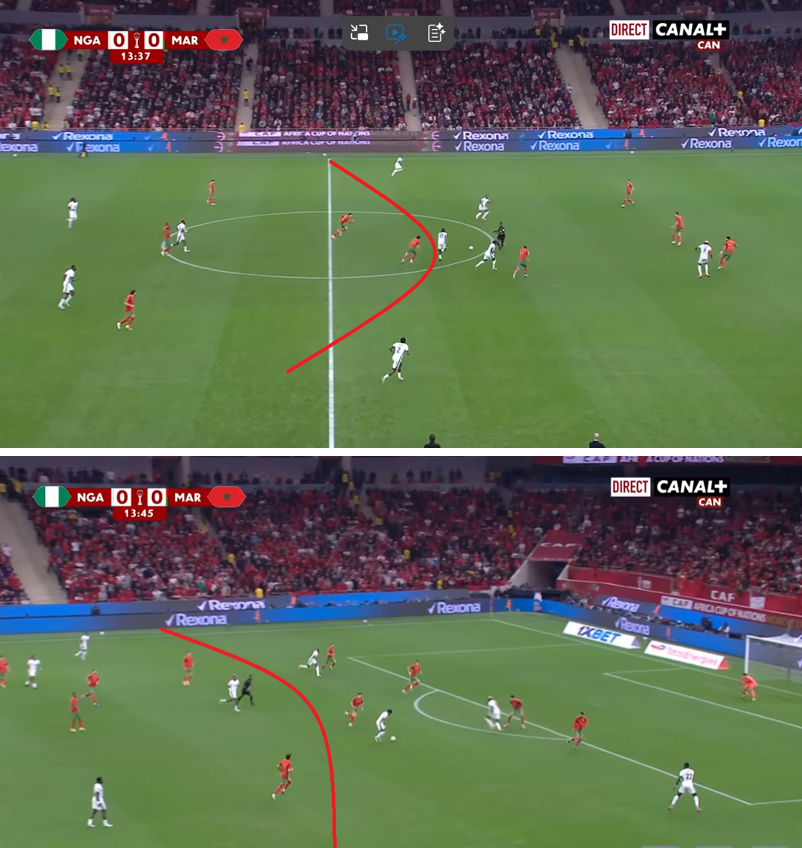
In this tactical battle, Senegal also has a chance. Morocco is very vulnerable as soon as the first line of their press is breached. Saibari and El Khannouss often play very high up the pitch and lack precision in defense. If Senegal manages to win the ball back high up the pitch, Morocco will find itself cut in two. In the semi-final, Nigeria's only clear-cut chance came from a high press which they quickly exploited. As you can see in the image, Morocco is split in two, with Saibari and El Khannous caught very late. Lookman decides to shoot. He even had the option of passing to the right.
The best example is Tanzania's big missed opportunity in the round of 16. Morocco pressed high up the pitch, but a direct pass put the entire Moroccan team in difficulty. Once again, Regragui's team was split in two, found themselves in a 5-on-5 situation against the Tanzanians, and almost conceded.
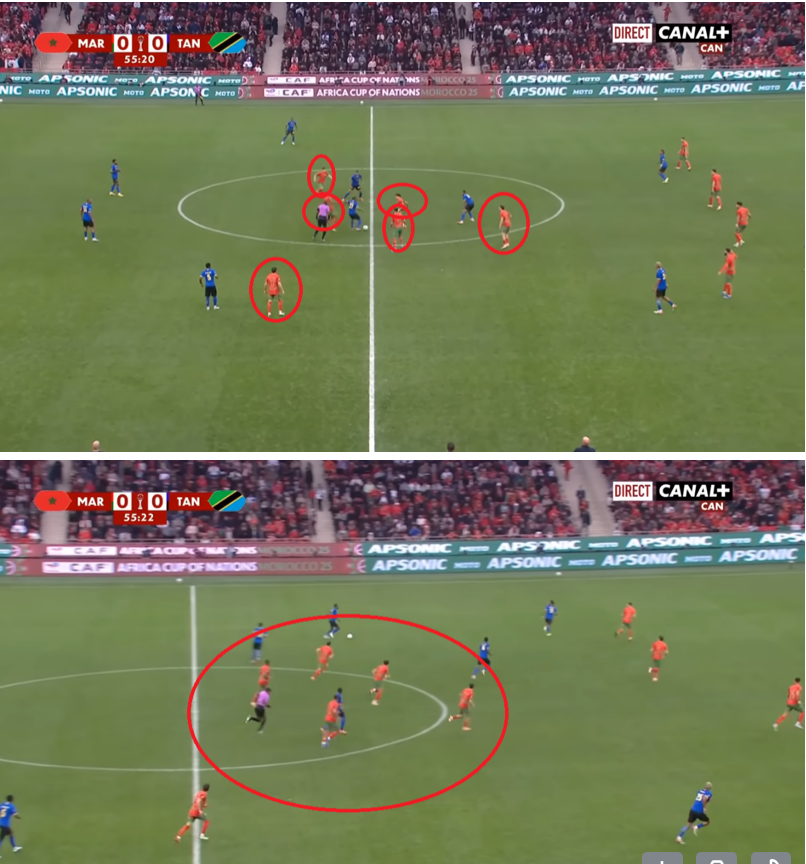
To win this match, it will therefore be necessary to pay attention to the offensive movements of the Moroccan players, impeccable on all defensive actions, but also to quickly exploit the recoveries.
The other important aspect of this match will be managing Morocco's pressing game. The Atlas Lions, spurred on by their home crowd, will try to put maximum pressure on Senegal from the outset. Senegal will need to minimize mistakes early on to find their rhythm and then implement their game plan.
If the Lions manage to impose their rhythm, Morocco will begin to ease their pressing, to avoid exposing themselves to an opponent capable of striking at any moment. Mamadou Sarr, Moussa Niakhaté, and Idrissa Gana Guèye, Senegal's primary playmakers, will have a crucial role in this final. It will be up to them to dictate Senegal's tempo and find gaps in the Moroccan press to launch attacks.










Commentaires (2)
This is what I do......................................... CASH54.COM
Participer à la Discussion
Règles de la communauté :
💡 Astuce : Utilisez des emojis depuis votre téléphone ou le module emoji ci-dessous. Cliquez sur GIF pour ajouter un GIF animé. Collez un lien X/Twitter, TikTok ou Instagram pour l'afficher automatiquement.