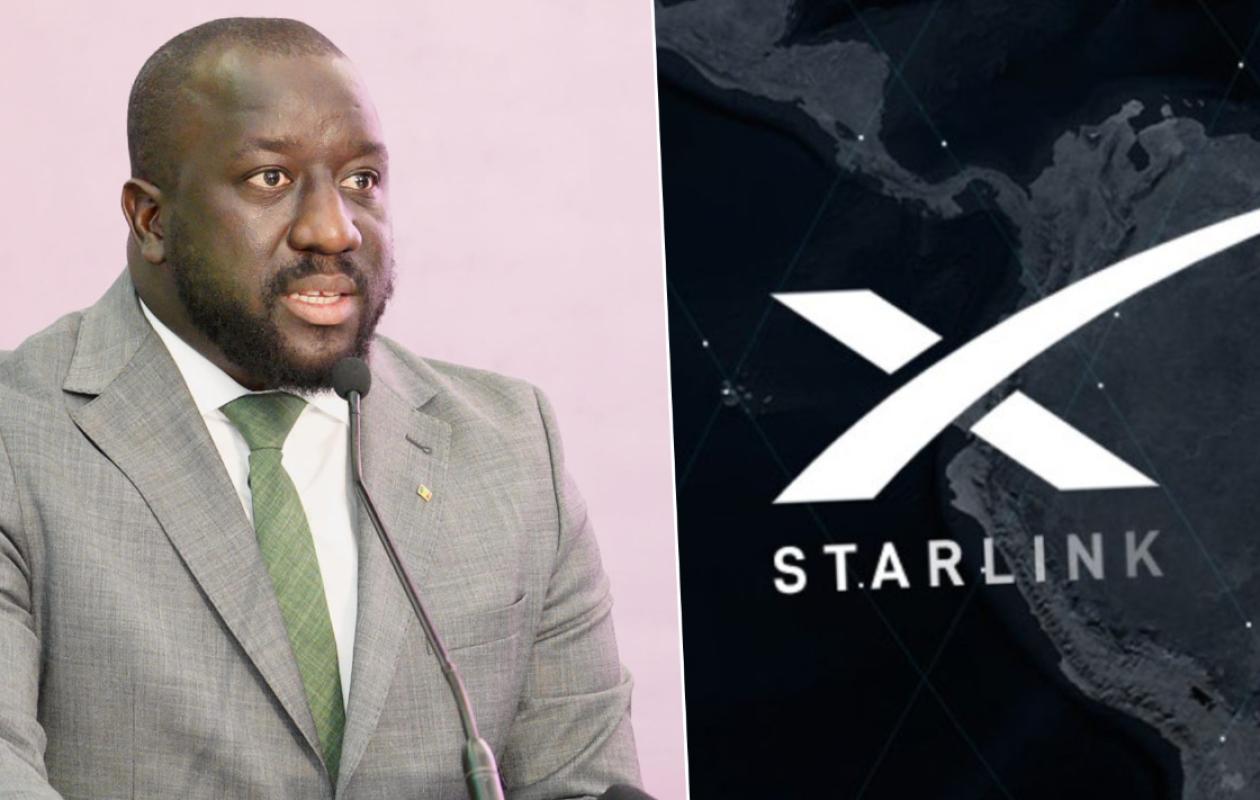
StarLink, le processus d’attribution, les données : Les explications du Ministre des télécoms
Alongside the euphoria that accompanied the announcement of Starlink's arrival in Senegal, questions and concerns have also arisen. Indeed, many want to know the conditions surrounding Elon Musk's company's entry into Senegal. Some Senegalese also seem worried about how their personal data will be handled.
“Starlink, like any company that operates in the field of telecoms or otherwise, is still governed by the telecommunications code and the ministry is only one stakeholder among many others,” said Aliou Sall, Minister of Communication, Telecommunications and Digital Affairs.
“Whether it’s Starlink or others, today the rules have been followed with the various stakeholders, such as the regulator and the ministry,” he added. He therefore assures that the regulations are being properly respected, particularly those concerning the allocation of licenses. And this is in accordance with the Senegalese telecommunications code.
His remarks are supported by his chief of staff. Mamadou Seck declares that StarLink is a “game changer” that could provide significant assistance: “It must be understood that this is a game changer, and the State of Senegal, as a responsible state, must be able to welcome its technology while regulating it. That is the challenge,” he says.
And speaking of the regulatory framework that Elon Musk's company should be subject to, he emphasizes that "this work is being carried out with the regulator as well as the Data Protection Commission (CDP), regarding the protection of personal data." Mr. Seck assures that Starlink Suarl Senegal has obtained "a favorable opinion from the CDP concerning the protection of personal data."
He and the minister were speaking at the “Ettu koom koom” conference, an event initiated by KPMG and focused on the theme “Digital Infrastructure and Universal Connectivity: Challenges, Models, and Perspectives.” During the discussions, Minister Aliou Sall painted a rather bleak picture of network coverage in the country.
He revealed that there are 540 "white zones" in Senegal, where coverage is nonexistent, and 700 localities with 2G technology that need upgrading. "And all of this has considerable impacts on the Senegalese economy," he said, emphasizing that at least 7 million Senegalese are affected by this situation.
“So today, with the arrival of satellite technology, there have been discussions with all stakeholders, including operators, so that we can see this technology as a complement. Today, we have a tech-savvy public that understands the issues. It would be a mistake for the State of Senegal to put all our eggs in one basket,” the minister stated.
For him, there is a need to be met, problems to which concrete solutions must be provided. “By 2034, if we aspire to make Senegal a digitized country and a country with high added value through digital technology, we are obliged to accelerate the pace with today's introduction of this technology which, for me, complements what already exists,” he says.


















Commentaires (17)
Participer à la Discussion
Règles de la communauté :
💡 Astuce : Utilisez des emojis depuis votre téléphone ou le module emoji ci-dessous. Cliquez sur GIF pour ajouter un GIF animé. Collez un lien X/Twitter, TikTok ou Instagram pour l'afficher automatiquement.