Entre jihadistes et rebelles au Mali, des agendas divergents mais un ennemi commun
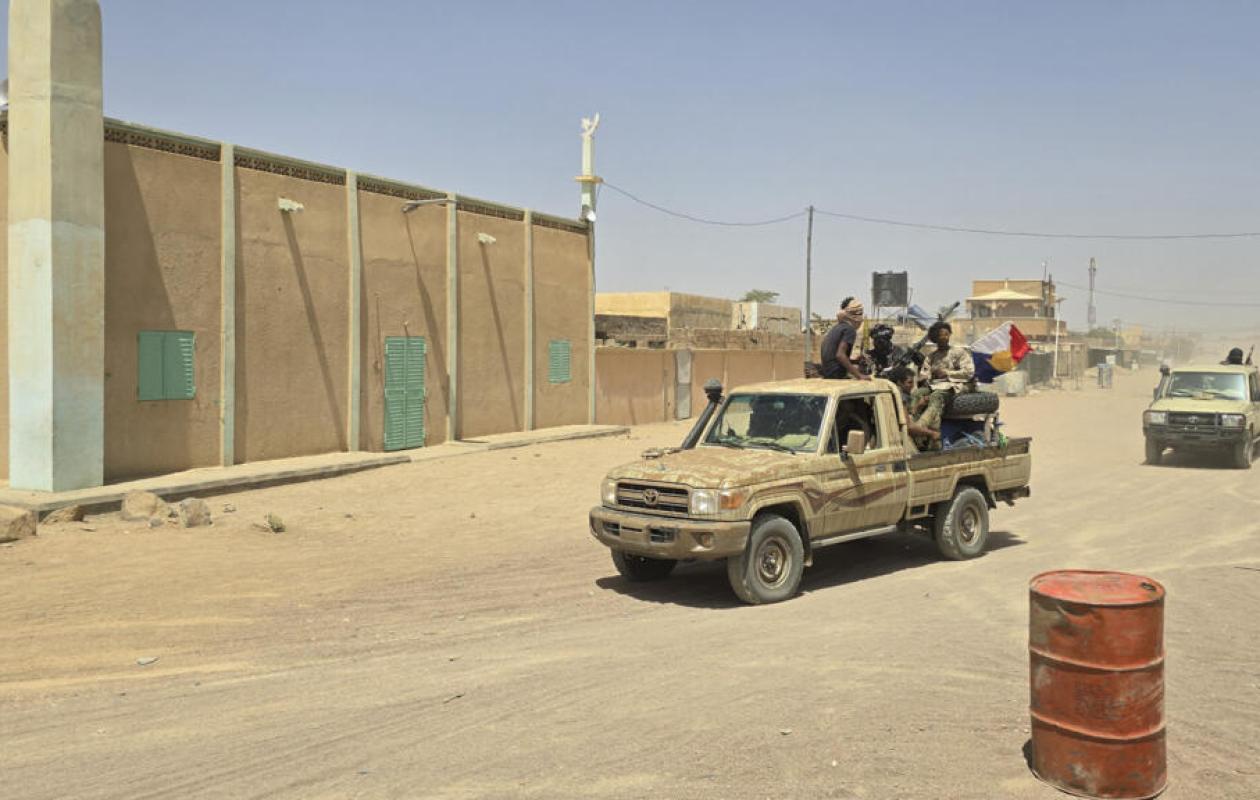
The unprecedented attacks carried out in Mali by Tuareg rebels and Al-Qaeda's Sahelian branch dramatically demonstrate their alliance sealed a year ago, based on divergent interests but a common enemy: the junta in power since 2020 and the Russian paramilitaries that support it.
The jihadists of the Group for the Support of Islam and Muslims (JNIM, allied with Al-Qaeda) claimed responsibility on Saturday for a series of coordinated and large-scale attacks with the Tuareg rebellion of the Azawad Liberation Front (FLA) against strategic positions of the junta, on the outskirts of Bamako and in several important cities.
On the evening of these attacks, JNIM proclaimed "victory", the result of "hard work", coordination with its "partners" and "the active participation of our brothers from the Azawad Liberation Front", a predominantly Tuareg independence group created in November 2024 which claims the territory of Azawad, in northern Mali.
Rebels and jihadists launched a joint assault on Saturday against the key city of Kidal (north), which they now control again, after losing it in November 2023 following an offensive by the Malian army supported by Russian paramilitaries.
According to security sources, the two groups also fought together on Saturday in Gao (north), where they were repelled by the Malian army but are still deployed in the area.
These joint assaults are reminiscent of those of 2012, when Tuareg rebels allied themselves with jihadists to seize major cities in the north. However, the two sides ultimately clashed violently, with the jihadists driving out the Tuareg separatists. The north of the country was subsequently liberated from jihadist occupation in January 2013 following the intervention of the French army, which would remain in Mali for almost 10 years.
Since then, relations between separatists and jihadists have been conflictual. Direct fighting was still observed in April 2024 on the Mauritanian border, recalls Wassim Nasr, a specialist in jihadist movements and a researcher at the Soufan Center think tank.
But a year ago, an agreement was reached between the FLA and JNIM, explains Mr. Nasr, who revealed it at the time.
Historically a nomadic people spread across several states – Mali, Niger, Algeria, Libya and Burkina Faso – the Tuareg have been waging armed struggles against their marginalization for decades, particularly around Kidal.
This new alliance between the FLA and JNIM notably provides for the acceptance by the Tuareg rebels of the application of Sharia law, the establishment of judges recognized by both movements, an exchange of military skills as well as a principle according to which, in the event of the capture of territories, urban management will be entrusted in priority to the FLA and rural management to the jihadists, the researcher explains.
This cooperation materialized over the past year through transfers of military know-how, particularly in the area of improvised explosive devices (IEDs) or the use of mortars, capabilities which were previously little mastered by the FLA but held by JNIM, Wassim Nasr points out.
But Saturday's coordinated attacks mark "the first time we have really seen the terms of the agreement being applied," the researcher continued.
The specific feature of this new alliance is that it unites two organizations with different agendas, notes Jean-Hervé Jezequel, director of the Sahel project at the NGO International Crisis Group.
"JNIM carries a politico-religious project, centered on the establishment of Sharia law and the rejection of foreign forces, while the FLA defends a territorial and autonomist agenda, centered on Azawad," he summarizes.
"This convergence is based above all on the existence of common adversaries, namely the Malian authorities and their Russian partners" in the paramilitary group Africa Corps, controlled by Moscow, he adds.
For Wassim Nasr, the strategic goal sought by the alliance of jihadists and rebels is not the seizure of power in Bamako, but the reconquest of the northern regions.
"They fixed the army in the center, hurt the government in Bamako, which paralyzed the military response, and they got what they wanted in the North," Kidal, he adds.
"In a second stage, they may try to push their advantage into the center of the country, a sort of second phase that would accelerate the fall of the current junta and/or a regime change in Bamako," Nasr continued.
Sadio Camara, 47, the defense minister and a key figure in the junta, was killed in a JNIM attack on his residence near Bamako on Saturday. The head of intelligence, Modibo Koné, was wounded by gunfire.
From the start of the attacks on Saturday morning until Tuesday evening, Assimi Goïta, the head of the junta, remained invisible and silent, fueling speculation about his fate. He finally appeared on national television Tuesday evening, stating that the security situation was "under control".
The strategy of the jihadists and rebels "is to weaken and delegitimize the Malian authorities, by increasing security pressure in the hope of a political collapse of the regime rather than a direct takeover, which appears more complicated in the short term," says Mr. Jezequel.
In fact, the FLA separatists announced on Wednesday their intention to conquer the major cities of the North and predicted the fall of the junta, "sooner or later".
Unlike the alliances of the early 2010s, which quickly broke down, the researcher believes that the current cooperation could last longer, even if he considers its future uncertain in the medium term.
For Wassim Nasr, the real test will be managing cities like Kidal, a phase that has not yet really begun.

![[EXCLUSIF] Le lutteur Ama Baldé arrêté par la BR de Keur Massar](https://image.seneweb.com/content/news/2026-22-27//thumb_1260x800_6a174f4ee60cb_SOgkg3Pd2C.png)










Commentaires (4)
Participer à la Discussion
Règles de la communauté :
💡 Astuce : Utilisez des emojis depuis votre téléphone ou le module emoji ci-dessous. Cliquez sur GIF pour ajouter un GIF animé. Collez un lien X/Twitter, TikTok ou Instagram pour l'afficher automatiquement.