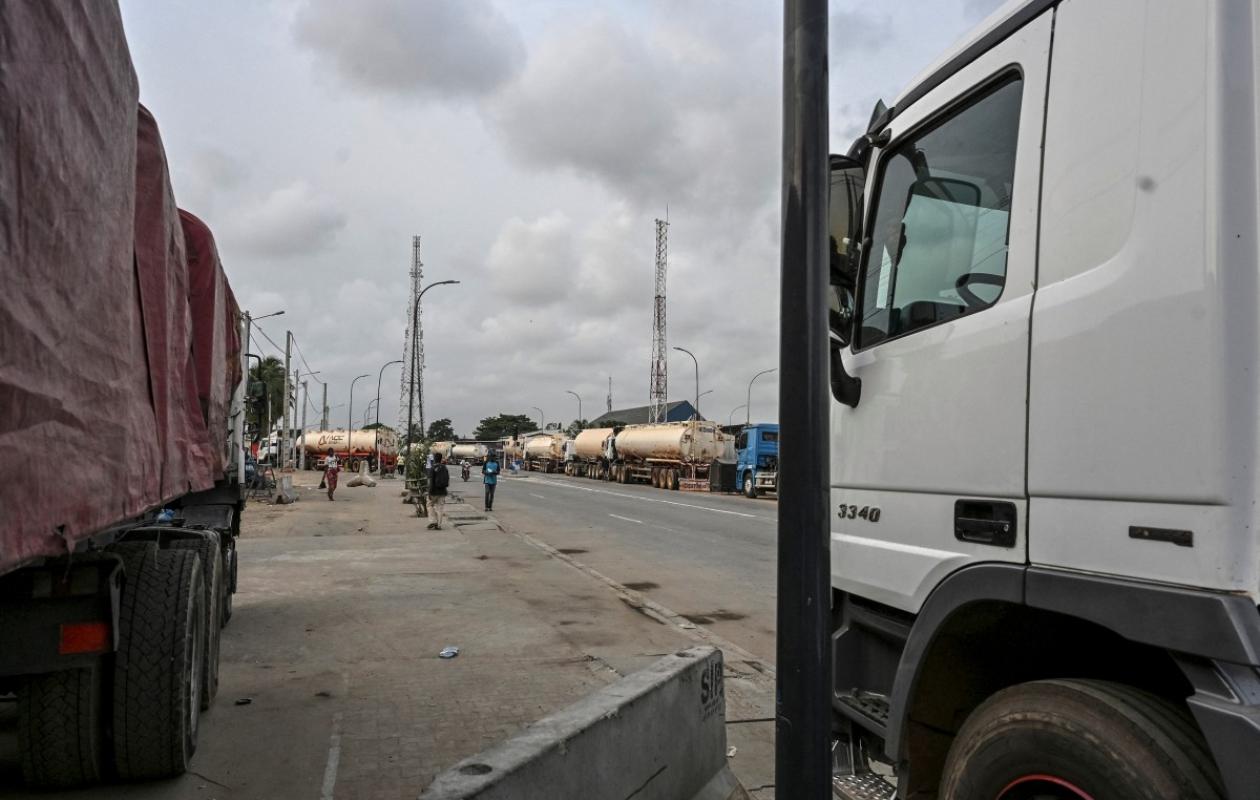
Quand les routiers sénégalais parcourent le Mali la peur au ventre
On his way to the Malian city of Kayes, Amath Mboup, a young Senegalese truck driver, recounts witnessing the horror firsthand: charred or decomposing bodies lying along the roadside connecting Dakar to Bamako. The deceased were all truck drivers like himself, victims of the jihadists wreaking havoc in Mali.
These attacks, which sow death and fear on this important road, have been part of the strategy for several months by the Group for the Support of Islam and Muslims (JNIM), affiliated with Al-Qaeda, aimed at economically suffocating Mali but also at undermining the junta in power in the country.
Among the methods put in place by the jihadists are the prohibition of any tanker truck loaded with fuel entering Mali from a neighbouring country, but also the erection of ad hoc roadblocks on certain strategic routes leading to Bamako.
Since then, hundreds of trucks coming from Abidjan or Dakar have been set on fire. Dozens of drivers have been killed or kidnapped, particularly on the Kayes-Bamako road in the west of the country, a border area with Senegal.
After two days of waiting due to the usual checks in the Senegalese town of Kidira, one of the main crossing points between Senegal and Mali, Amath is preparing to resume his journey to Bamako, his truck loaded with goods.
Alone in the cab of his truck, where charms against bad luck are hanging, the young driver in his thirties is dreading the journey, as he is every time he passes through there.
- "A mind never at peace" -
"Everyone is afraid to take this route because it's too risky: you know you're leaving but you don't know if you'll come back alive," he said, his face dusty and pale with fatigue.
"Your mind is never at peace when you cross this road. You tell yourself that you could be attacked at any moment," adds Malick Bodian, another Senegalese driver, saying he puts his life "in God's hands."
But like many of their colleagues interviewed by AFP, there's no question of abandoning their jobs despite the risks. "We have no choice: it's the only job I know how to do to be able to feed my family," says Amath, who is married and has two children.
Behind him, dozens of trucks, engines purring, are lined up for kilometers. All are waiting their turn to leave Senegalese territory, before tackling the bumpy Malian road leading to Bamako and its potential dangers.
Others are parked along the roadside, taking a break to eat or carry out repairs.
No tanker trucks were in sight in this line, however. Last November, JNIM claimed in a propaganda video that all tanker truck drivers would henceforth be considered "military targets".
Among the drivers present that day were Senegalese, Malians, Ivorians, and Burkinabe. Many said they had already crossed paths with jihadists.
"They often come out of nowhere in the forest on motorcycles and are usually turbaned and heavily armed," says Moussa Traoré, a Malian driver.
"When you see them, you're the one who slows down. Sometimes they stop you to ask for your coins, other times they don't," he continues.
- Alert networks -
Lacking access to the sea, Mali transports most of the goods it needs (fuels, fish, fruits and vegetables, etc.) by road from Senegal, Mauritania, or Ivory Coast. More than 70% of its imports transit through the port of Dakar.
According to a report by the Timbuktu Institute published in 2025, JNIM is conducting a form of "economic jihad" in western Mali, aiming to destabilize the region by "targeting vital logistical routes".
Since then, traveling normally on certain roads like the one to Kayes has become an obstacle course for transporters.
"The flow of trucks that used to pass through Kidira is no longer the same. The rotations have decreased," says Modou Kayeré, an official of the Union of Road Drivers of West Africa, which includes more than 15 countries.
At the end of November 2025, Senegalese authorities indicated that nearly 2,500 containers loaded with goods destined for Mali were blocked at the port of Dakar due to the security situation in the neighboring country.
According to most of the drivers interviewed by AFP, vehicles carrying goods are rarely attacked by jihadists, unlike tanker trucks carrying fuel.
But the risk is real, and drivers are trying their best to adapt. In particular, they have decided to stop driving at night. Some have also set up alert networks via WhatsApp groups to warn their colleagues of potential hazards on the road.


















Commentaires (6)
Participer à la Discussion
Règles de la communauté :
💡 Astuce : Utilisez des emojis depuis votre téléphone ou le module emoji ci-dessous. Cliquez sur GIF pour ajouter un GIF animé. Collez un lien X/Twitter, TikTok ou Instagram pour l'afficher automatiquement.