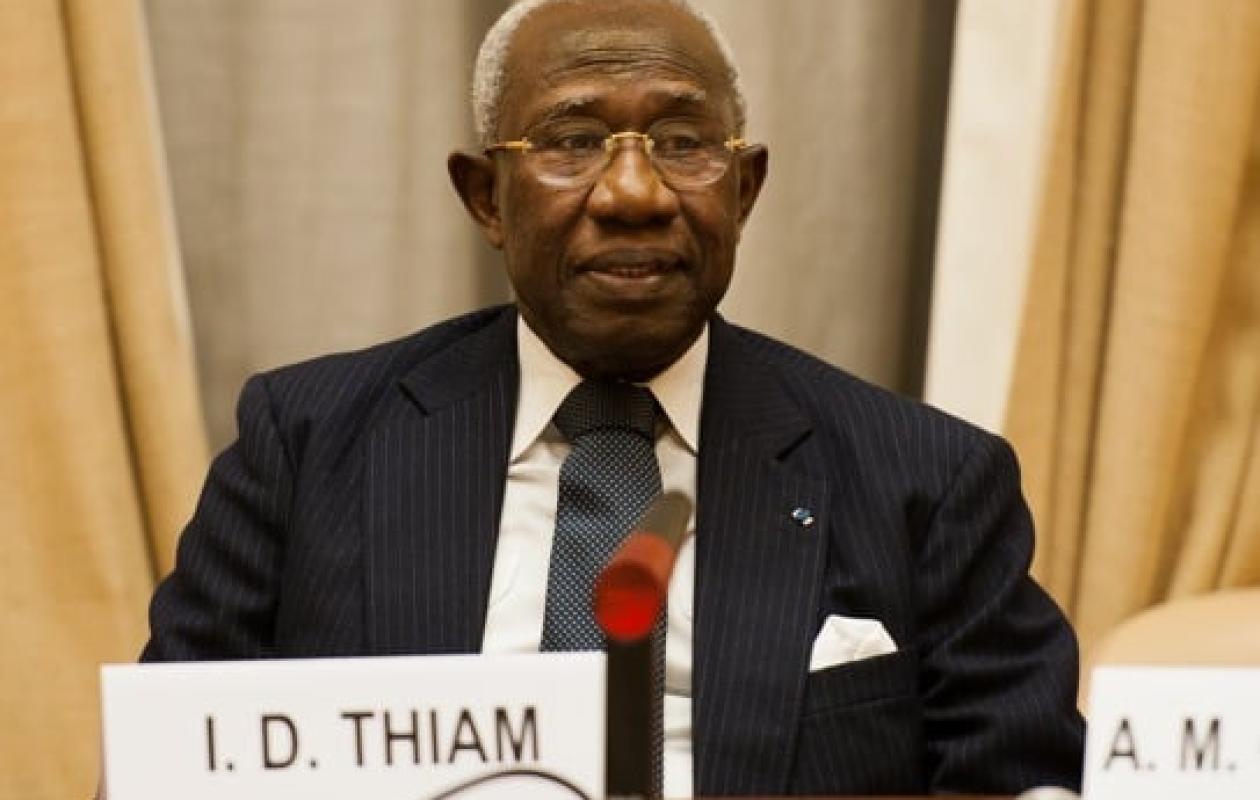
Iba Der Thiam, Une vie de combats [Pr Omar GUEYE]
"Professor," the title he cherished, or "Super Der," as newspaper cartoonists liked to call him in the 1980s, Iba Der Thiam (1937-2020) left no one indifferent, whether through his academic career or his struggles for a better Senegal. He embodied a kind of encyclopedic knowledge, a gift for gab, and a sincere commitment, which earned him as much praise as it did obstacles in a turbulent life typical of men of action and character who rarely compromise their convictions. Iba Der Thiam walked without pretense, with integrity. Until his last breath, he dedicated himself to his passions, his fights for African history, national education, trade unionism, politics, and religion, to name just a few of the areas in which he was known to the public. This text is a testimony on behalf of an entire generation of Senegalese schoolchildren, high school students, and university students from the 1970s to 2020 who knew him as the author of their History and Civics textbooks, Minister of National Education, Minister of Higher Education, and professor at Cheikh Anta Diop University, though he is better known to the general public as a figure in the labor movement and politics. It therefore offers a glimpse into the truth about this highly complex scientist and public figure, well-versed in the debates and controversies of his time.
Myth in the making
The name Iba Der Thiam was familiar to young schoolchildren alongside those of the historical figures in the History and Civics textbooks he authored or co-authored with Nadiour Ndiaye. Most of the teachers who came from the student movements of the 1960s, and who recounted to us the union and political struggles of their youth, spoke of him as one of the "hardliners" who had often dared to challenge the so-called neo-colonial regime of President Senghor. Thus, the fiery Iba Der had successively spent time in prison with his fellow inmates, directed the former École Normale Supérieure (ENS, now the Faculty of Science and Technology of Education and Training - FASTEF) from 1975 to 1983, and then been co-opted into the Senegalese government as a technocrat, serving as Minister of National Education and all-powerful plenipotentiary in charge of Higher Education (1983-1988). For students of the 1970s and 1980s, his name was already familiar among the major players in the labor movement and a witness to the youthful turmoil of the young Republic of Senegal, particularly during its most significant crises in 1968 and 1988.
Indeed, he was involved in the May-June 1968 crisis, a pivotal moment in his union activism. During this period, he was arrested along with leaders of the National Union of Senegalese Workers (UNTS) at the Labor Exchange following the urban riots of May 31st. Most of the leaders were deported to Dodji and released on June 9, 1968, while some of their comrades remained in detention: Iba Der Thiam, deported to Ololdou, near Bakel; Séga Seck Fall to Dabo; Dr. Amath Bâ to Sindian; and Abdoul Maham Bâ to Tanaf. At the end of the workers' strike, he played a key role in resolving the student strike, acting as a facilitator within the delegation of union members and parents who participated in the negotiations that led to the strike-ending agreements on September 14, 1968 (see photo).
As during the 1968 crisis, he was at the forefront of the general strike of February 1988 at the University of Dakar, which had become Cheikh Anta Diop University in 1987. Students from high schools and colleges throughout Senegal participated in the strike. This strike, which resulted in a lost academic year for the majority of university students and most public schools, was one of the most turbulent periods in Senegalese political and labor history. Ironically, he found himself in the government's ranks, facing the strikers, this time on the side of the "oppressors" of whom he had been a victim, unlike during the May 1968 strike.
Thus unfolded a multifaceted career illustrating the complexity of a man who found himself active in several fields simultaneously, making his actions multifaceted and cross-cutting, adding depth to his often overlooked or misunderstood journey, which was only partially or incompletely appreciated. He could swing from one extreme to the other, always standing by his convictions: he was a man of principle. One could be with him or against him, but he was always recognized for his commitment to the causes he believed in and to the people he defended. Such was the man who dreamed of History, who spoke of History, and who will remain in History through his literary works, his political actions, and also…his controversies.
Promoter of the New School
The French Ministry of Education owes to him the celebration of Godfather's Day (March 26), which involved honoring the godfather or godmother of each school. This patriotic initiative consisted of naming or renaming schools and institutions after African and Senegalese figures, chosen according to their location and historical, political, and religious significance. Among others, the Van Vollenhoven High School (named after a former Governor of Senegal) in Dakar became the Lamine Gueye High School (named after a former President of the National Assembly of Senegal), the Faidherbe High School (named after a former Governor of Senegal) in Saint-Louis was renamed after Cheikh Omar Foutiyou Tall (named after a former marabout and resistance fighter from Senegal), while the Gaston Berger High School in Kaolack was named after Valdiodio Ndiaye (named after a former Minister of the Interior of Senegal). This practice was observed almost everywhere in the country. The University of Dakar became Cheikh Anta Diop University upon the latter's death in 1986. For a country, or even a world, in search of landmarks, he had set an example with this sponsorship, a dedicated day of which had been integrated into the school calendar.
However, the reality of Senegalese schools under Iba Der Thiam's ministry was less idyllic, marked as it was by the structural adjustment years of the 1980s. Senegal, like most African countries, was subject to policies inspired by the Bretton Woods institutions, the IMF and the World Bank, which imposed budget cuts and austerity measures. In the context of an economic crisis, these measures targeted so-called non-productive sectors, particularly health and education, which were considered budget drains. For Senegalese schools, these new policies translated into drastic measures such as the elimination of boarding schools, the introduction of double-shift classes, and a whole series of measures taken within the framework of the "New School" concept, also known as the "Dumpster School" by its detractors. At the same time, teachers had put on the table, for their implementation, the conclusions of the 1981 Estates General of Education.
Iba Der's tenure at the Ministry of National Education was a turbulent time with his fellow union members, particularly teachers, with whom he had shared the trials of political and professional struggles. The contradictions had become more acute because the union movement was infiltrated by political factions and, therefore, reflected all kinds of power struggles, ideological disputes, and personal rivalries. Since then, the education system, already subject to economic uncertainties and crippled by restrictive measures that were ruining its reputation as an elite training ground, was not immune to political upheaval. It had become a battleground for political factions within the unions vying for control. Despite this turmoil, "Super-Der" was at the heart of reforms aimed at democratizing the education system and which had granted teachers social benefits, many of which still exist today.
Political and trade union activist
Like their fellow union members, teachers led the resistance against the single-party state, the UPS-PS, of President Senghor, which dominated political life in the 1960s and 1970s but struggled to control the union movement. This antagonism lasted until President Abdou Diouf came to power in the early 1980s, coinciding with the opening to full multi-party democracy, which allowed for the emergence of diverse schools of thought as well as rivalries between factions and individuals. Thus, SUDES, created in 1976, heir to teachers' activism and leaning left, continued the tradition of "opposition unionism," as the various regimes termed it. This powerful unified union, bringing together teachers from kindergarten to university, experienced large-scale mobilizations before falling apart. Iba Der Thiam, who had been involved in the most representative teachers' union movements, was implicated in this dynamic. A former Secretary General of the Unified Union of Secular Education (SUEL) and the Teachers' Union of Senegal (SES), a member of the Bureau of the National Union of Workers of Senegal (UNTS), and a former activist with the PAI and the PRA/Senegal, he stood up to the UPS-PS regime and Senghor alongside the "stubborn" like his comrades Abdoulaye Thiaw, Babacar Sané, Mbaba Guissé, Séga Seck Fall, Bakhao Seck, Demba Sall Niang, and Ousmane Diallo; they were subjected to repeated disciplinary measures ranging from distant postings to prison sentences. Beyond being a technocrat, he remained a committed activist, serving as a unionist-minister or minister-unionist. The adversity and infighting inherent in the activist life of his era were thus an integral part of his life and personality.
Iba Der Thiam simultaneously pursued union activism and political activism, sometimes merging into a single front. He was a member of the PAI (African Independence Party) until 1965, alongside activists such as Salif Diop from Kaolack, Thioumbé Samb, the head of the women's wing of the African Independence Party-PAI in Fann-Gueule Tapée, and Angélique Gaye. His political trajectory also included the African Rally Party-PRA/Senegal, which merged with the Senegalese Progressive Union-UPS in 1966. He later promoted the Appeal of the 1500 in 1981 and GRESEN (Study and Reflection Group on a New Senegal), which was close to the Socialist Party-PS government. He extended his commitment by creating a political party, the Convention of Democrats and Patriots (CDP/GARAP GUI), and participated in the presidential and legislative elections from 1993 to 2000, before merging with the ruling Senegalese Democratic Party (PDS). He collaborated with various regimes and held national responsibilities, first as a minister and then as a "people's deputy," as he liked to call himself. With the "Rufisque Group"—Falaye Diop, Souleymane Loum, and Mamadou Mbodj—comrades from the SUEL and SES unions, as well as the 1968 deportees Amath Bâ and Sega Seck Fall, he formed a core of militant unionism. However, he did not achieve the expected success with his political party, the CDP/GARAP GUI, which ultimately merged with the ruling party as part of a coalition.
A fundamental academic
The professor led a brilliant academic career alongside his turbulent union and political life. Undoubtedly, this is the area where he is universally admired. A university professor and Doctor of History, he cherished the title of Professor, which he deserved. From teaching assistant to university professor, he climbed every rung of the ladder in the French national education system, a path marked by hardships, including exams taken in prison (History degree in 1971). In addition to teaching several generations, he supervised numerous history theses and dissertations at Cheikh Anta Diop University in Dakar. He was also an eminent "academic diplomat" as a member of the Executive Board of UNESCO, for which he conducted numerous studies and missions. Alongside these roles, he held honorary positions and received numerous scientific distinctions. His bibliography is as extensive as his rich biography. University life was both a time for former students to meet the author of their old history textbook, an opportunity for socialization and connection. But despite his renown, he was always very approachable and extremely courteous to his former students, who, out of respect, always addressed him by the same name: Professor.
Iba Der Thiam's greatest strength was perhaps also his greatest weakness: his courage and his excessive commitment. He defended his ideas and those he supported, in every way. To the very end, he remained true to his temperament, which he dedicated to his final major project, begun at the twilight of his life: writing the General History of Senegal. Even if he had devoted his entire life and energy to it, it would not have been enough. He thus paved the way and showed the path, having fulfilled his part of the mission, for the honor of his country, to which he was devoted until his last breath: Senegal. It is only fitting that a university institution bears his name, he who had previously renamed Senegalese schools after figures representative of the nation in all its historical, political, and religious facets. The Iba Der Thiam University (UIDT), inaugurated in 2023, is thus a final, symbolic tribute in the city of Thiès, an African crossroads and witness to so many historical events, to which he dedicated numerous works and publications. Like his eventful life, his work, now immortalized, reflects the meaning of his lifelong passion for humanity, dedicated to numerous causes, to history, to Africa, and to Africans. This eminent African deserves respect!










Commentaires (4)
Participer à la Discussion
Règles de la communauté :
💡 Astuce : Utilisez des emojis depuis votre téléphone ou le module emoji ci-dessous. Cliquez sur GIF pour ajouter un GIF animé. Collez un lien X/Twitter, TikTok ou Instagram pour l'afficher automatiquement.