Saint-Louis : l’exposition "Samba Sadio 1875" ravive le débat sur la restitution du patrimoine culturel
The museum of the Centre for Research and Documentation of Senegal (CRDS, formerly IFAN), in partnership with the Alternative Association, the Regional Museum of Thiès and the Dunkirk Museum, inaugurated the Samba Sadio 1875 exhibition on Tuesday, March 3, 2026. Hosted in the CRDS premises in Saint-Louis, this initiative brings back to the forefront the sensitive issue of the restitution of African cultural property.
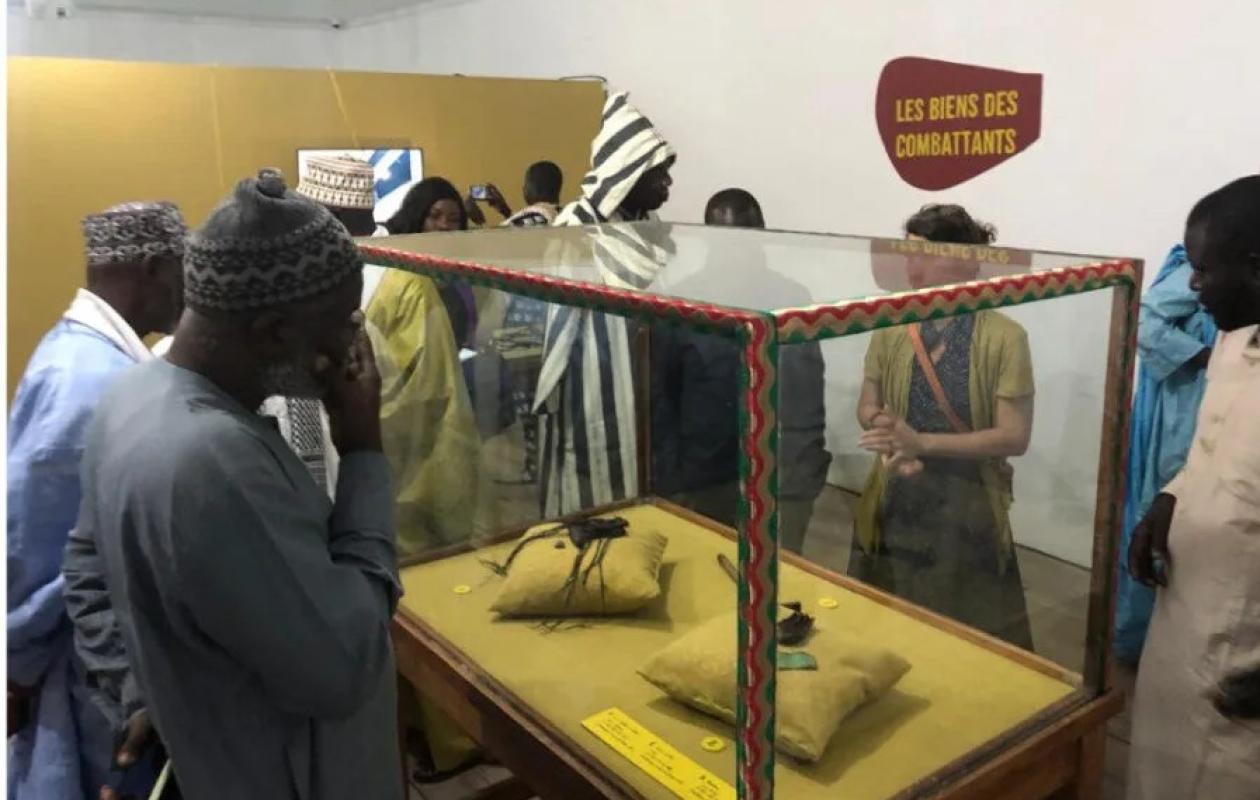
The exhibition, the result of in-depth research conducted by the Alternative Association, traces the circulation of objects seized during a colonial battle and kept in France for nearly 150 years. Several pieces have thus been exceptionally repatriated to be presented to the Senegalese public, accompanied by historical information on the context of their acquisition.
According to Emmanuelle Cadet, president of the Alternative Association, the collection was identified in Dunkirk as part of a socio-cultural project dedicated to the controversial legacy of General Louis Faidherbe. The research notably revealed the involvement of his nephew, Émile Faidherbe, then a lieutenant in the French army, in the Battle of Kokou or Samba Sadio, which took place on February 11, 1875.
This battle pitted French troops and those of Lat Dior, Damel of Cayor, against the forces of the Tijani religious leader Amadou Cheikhou Ba. Eight cultural artifacts taken from the battlefield are now on display, including a Sudanese saddle, a Koranic tablet used for learning to read, bullet bags, a hammer, a wallet containing verses from the Koran, a flint gunflint, a necklace of war amulets, and a bridle and bit.
For Emmanuelle Cadet, these objects, acquired under historically questionable circumstances, could be the subject of a formal restitution request from the Senegalese state. She emphasizes, however, that any material restitution must be based on thorough historical research, an essential prerequisite for any institutional process. In this regard, she encourages citizens to contact the authorities, as the request has not yet been formally submitted by the Senegalese state.
For his part, Professor Abdou Sow, director of the CRDS in Saint-Louis, praised the scientific and symbolic significance of the exhibition. For at least a month, visitors will be able to discover these objects and reconnect with a little-known part of their history.
According to him, this initiative contributes both to raising international awareness of Senegalese heritage and to enabling Senegalese people to reclaim their cultural legacy. He also emphasized that Senegal has already undertaken preparatory work in anticipation of potential restitution claims, through the development of cultural policies, the creation of specialized training centers, and the development of university programs dedicated to heritage professions.
"The challenge is to bring together all the necessary conditions: to have qualified experts and museums capable of ensuring the conservation of these collections," he explained, while acknowledging that the country is still in a phase of identifying these assets that have long remained in the shadows.
According to the director of the CRDS, the progress made in recent years now puts Senegal in a good position to officially initiate the restitution process. "The time has come to request the return of these artifacts, but this must be done in compliance with all scientific and institutional requirements," he concluded.



![[EXCLUSIF] Le lutteur Ama Baldé arrêté par la BR de Keur Massar](https://image.seneweb.com/content/news/2026-22-27//thumb_1260x800_6a174f4ee60cb_SOgkg3Pd2C.png)








Commentaires (2)
Participer à la Discussion
Règles de la communauté :
💡 Astuce : Utilisez des emojis depuis votre téléphone ou le module emoji ci-dessous. Cliquez sur GIF pour ajouter un GIF animé. Collez un lien X/Twitter, TikTok ou Instagram pour l'afficher automatiquement.