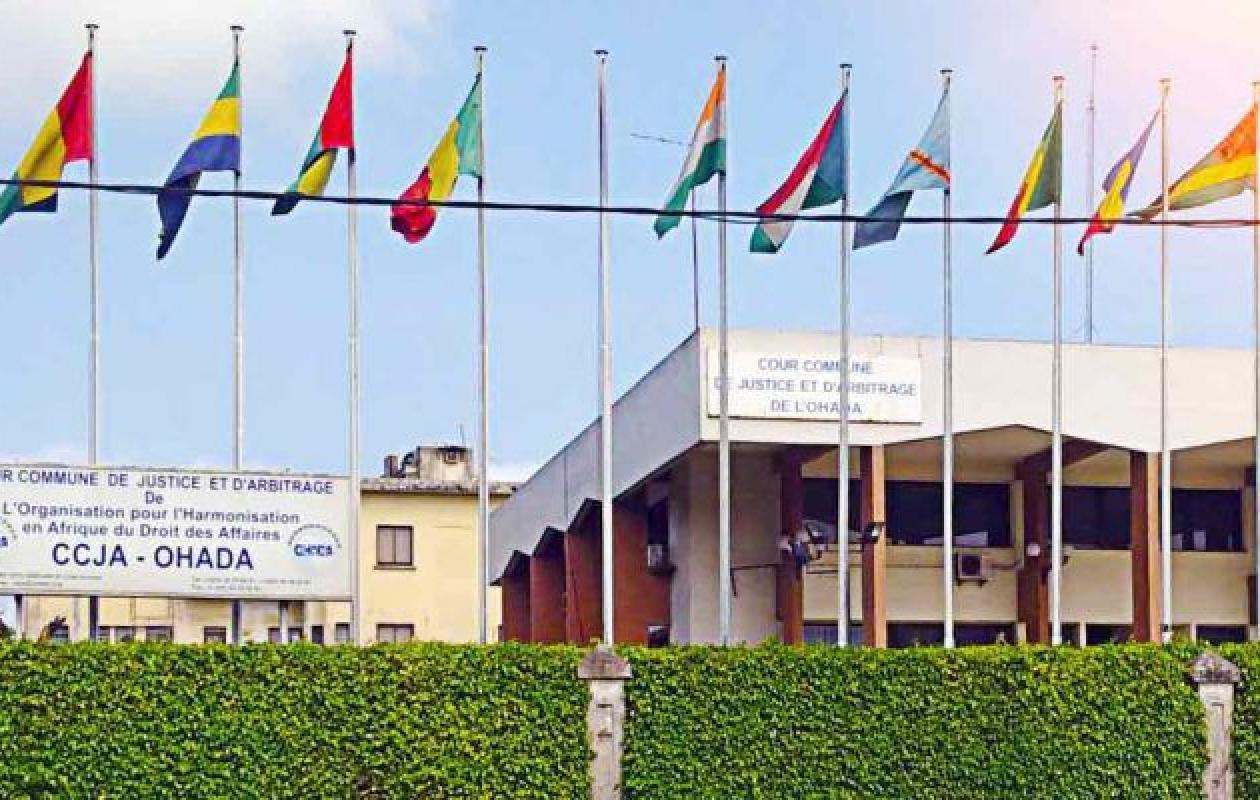
La juridiction qui accompagne l’intégration économique de l’espace OHADA
When a Senegalese company signs a contract with an Ivorian, Cameroonian, or Beninese partner, it must be able to rely on legal rules applied consistently across all countries. Without this security, regional economic integration would remain largely theoretical, and investors would be more hesitant to expand their operations beyond their national borders. It is to address this challenge that the Common Court of Justice and Arbitration (CCJA) was created, one of the most strategic institutions of the Organization for the Harmonization of Business Law in Africa (OHADA).
Based in Abidjan since its creation in 1997, the CCJA is the supreme court responsible for ensuring the uniform application of OHADA law in all member states. Its jurisdiction currently covers 17 African countries, to which the Democratic Republic of Congo has been added since its accession to the organization in 2012. The area concerned represents more than 250 million inhabitants and several hundred billion dollars in gross domestic product.
The existence of this jurisdiction addresses a very real concern. Adopting common rules is not enough to guarantee their uniform application. If national courts interpret the same laws differently from country to country, businesses quickly find themselves facing legal uncertainty, which undermines investor confidence and complicates economic transactions.
The CCJA intervenes precisely to avoid this situation. It is competent to examine appeals relating to the application of the OHADA Uniform Acts, that is to say the texts which govern in particular general commercial law, company law, securities, insolvency proceedings, arbitration or accounting.
In practical terms, when a commercial dispute is brought before the national courts of a member state and a question relating to OHADA law arises, the decisions may, under certain conditions, be submitted to the Court of Justice of the European Union in Abidjan for review. The Court then ensures that the community rules are interpreted uniformly throughout the OHADA region.
This function directly influences the business climate. A company investing several billion CFA francs in another country seeks to understand which rules will apply in the event of a commercial dispute. The possibility of relying on a supranational jurisdiction helps to strengthen the predictability of judicial decisions.
Financial institutions are also closely monitoring developments in this case law. When a bank grants credit, it wants to be certain that the security taken on the borrower's assets can be enforced according to clear rules. The efficient operation of credit relies in part on this legal certainty.
The CCJA's role extends beyond judicial appeals. It also performs arbitration, giving it a unique position in the African economic landscape. Arbitration is a method of dispute resolution often preferred by companies when they wish to avoid lengthy or complex legal proceedings.
This activity has grown with the increase in cross-border investments on the continent. Major infrastructure projects, industrial partnerships, energy operations, and international commercial contracts often involve sums of several billion CFA francs and require dispute resolution mechanisms recognized by all parties.
In this area, the court operates through its Arbitration Centre, which administers the procedures and ensures their proper conduct. Arbitration awards rendered under the auspices of the CCJA are recognized throughout the OHADA member states, thus facilitating their enforcement.
The economic importance of this legal framework becomes clear when considering the growing role of the private sector in African economies. According to the African Development Bank, the private sector accounts for more than 80% of production and employment in many countries across the continent. Regional and international investments therefore require a legal environment capable of securing business relationships.
International organizations often consider OHADA to be one of the most advanced legal harmonization experiences on the continent. The World Bank, the African Development Bank, and several specialized institutions regularly emphasize that legal certainty is among the criteria examined by investors when evaluating a market.
The case law of the CCJA also contributes to the evolution of African business law. The decisions rendered clarify the interpretation of certain texts, adapt their application to economic realities, and progressively strengthen the coherence of the entire community legal system.
This mission takes on even greater importance as regional economic exchanges develop. African businesses are increasingly operating beyond their national borders, while investors seek stable and predictable regulatory frameworks. In this context, the ability to ensure the uniform application of rules becomes a key factor in economic competitiveness.
The Common Court of Justice and Arbitration thus occupies a position that extends far beyond the judicial sphere. By securing contracts, harmonizing the interpretation of business law, and providing a regionally recognized framework for dispute resolution, it directly contributes to building a common economic space. Behind its decisions lies a significant portion of the trust necessary for the development of investment, trade, and economic integration across a large part of Francophone Africa.
























Commentaires (0)
Participer à la Discussion
Règles de la communauté :
💡 Astuce : Utilisez des emojis depuis votre téléphone ou le module emoji ci-dessous. Cliquez sur GIF pour ajouter un GIF animé. Collez un lien X/Twitter, TikTok ou Instagram pour l'afficher automatiquement.