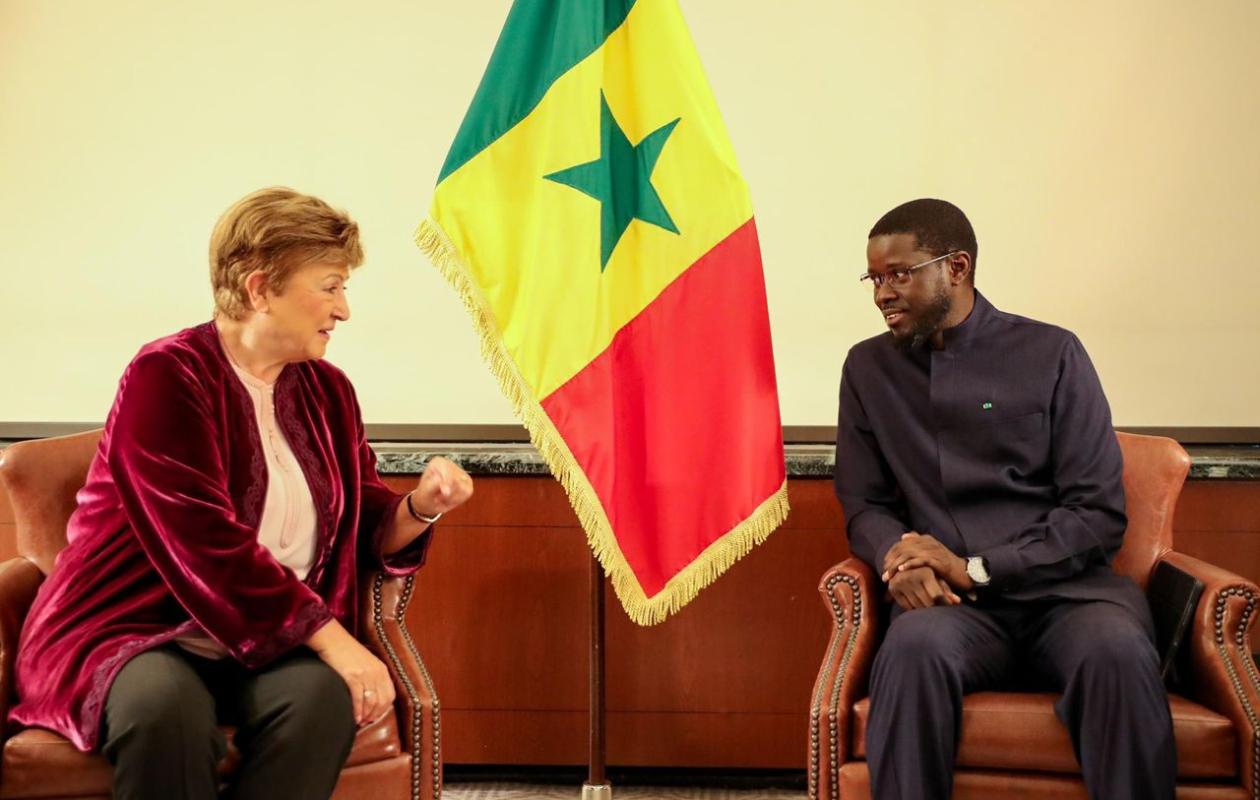
PR AMATH NDIAYE : "FMI ET DETTE DU SENEGAL : SORTIR DU DEBAT IDÉOLOGIQUE, RETROUVER LA DISCIPLINE ECONOMIQUE"
The debate surrounding the IMF has resurfaced in Senegal because public debt has become a central issue. Public opinion often presents two extreme positions: some believe the IMF is a “savior,” while others see it as a “tool for dominating poor countries.” In reality, we must move beyond these hasty judgments. The IMF is neither a friend nor an enemy: it is an international financial institution. And Senegal's debt is not primarily a matter of patriotism, but a simple question: does the state still have the means to finance its priorities without being crushed by debt interest payments?
The IMF: what exactly is it for?
The International Monetary Fund (IMF) was created in 1944 to help maintain the stability of the global economy. It includes almost all the countries of the world.
The IMF has three main roles:
Monitor the economic situation of countries, and raise the alarm when there are risks of crisis.
Lending money to a country in difficulty when it can no longer finance itself properly or lacks foreign currency.
To provide technical assistance to states to better manage their finances: taxation, budget, debt, banks, statistics.
It is also important to dispel a misconception: the IMF is not reserved for poor countries. Richer or more developed countries have turned to it when they were in crisis: Greece in the Eurozone, Argentina, but also in Asia, South Korea, Thailand, and Indonesia. Even India, now a major emerging power, signed IMF programs between 1991 and 1993. So, going to the IMF is not a sign of weakness: it often demonstrates the need for a robust framework to overcome a crisis.
Why is Senegal's debt becoming a real problem?
The heart of the problem is simple: Senegal has to pay interest on its debt every year, and this interest increases very quickly.
Between 2024 and 2025, the country made a significant effort to increase its revenues:
Tax revenues: from 3,620 billion to 4,099.6 billion FCFA (+13.3%)
But at the same time, the interest burden has exploded:
Debt interest payments: from 824.2 billion to 1,057 billion FCFA (+28%)
So one reality is immediately apparent: interest payments are increasing twice as fast as revenues. The most telling figure is this:
Interest and commissions = 25.8% of tax revenue in 2025. In 2025, they represent more than the combined budgets of higher education, agriculture and health.
This means that about one franc out of every four that the State collects in taxes is used to pay interest… before even funding schools, health, agriculture, security or roads.
This is precisely what makes the situation dangerous: the debt begins to eat away at the budget, and the state is forced to make difficult choices: reducing public investment, delaying certain payments, and accumulating arrears. As a result, future growth slows, and social tensions increase.
Why is the IMF back in the debate in Senegal?
When a country has a very high debt burden, it hits a wall: financial markets demand very high interest rates to lend. The lower confidence falls, the higher interest rates rise. And the higher interest rates rise, the heavier the debt becomes. It's a vicious cycle.
The country is then said to be in a situation of “financial stress”:
He borrows at a high price to repay an already high debt, and he is gradually suffocating.
It is in this context that the IMF often returns to the center of attention. Not because it wants to control the country, but because it brings three things:
a framework of stability (budgetary discipline, transparency, credible strategy),
a signal of confidence for investors,
and above all easier access to cheaper financing (World Bank, AfDB, bilateral partners).
The IMF's conditions: is it necessarily "austerity"?
Many believe that the IMF is only there to impose austerity. In reality, the IMF operates with a simple logic: it cannot lend sustainably to a country that continues to increase its deficits without correcting the imbalances.
In Senegal, the budget deficit is estimated at 7.82% of GDP in 2025, while the objective is to return to around 3% by 2027. But at the same time, social demands are strong: jobs, wages, scholarships, education, health. This is normal.
The real point is that if the state spends more than it earns over the long term, an adjustment will eventually come, sooner or later. And if it comes late, it may be more drastic.
Finally, let's be clear: the IMF is not responsible for poor economic governance or corruption. And above all, no country is obligated to sign a program with the IMF: it's a sovereign choice. But if a country refuses, it must have a credible and funded alternative.
Today, two strategies are back in the debate.
Active management or restructuring: which strategy is the most realistic?
Option 1: Active management (reprofiling)
Reprofiling means postponing certain deadlines, exchanging securities, extending durations.
This can work when:
Interest rates are falling.
and that the country retains the confidence of the markets.
But if rates remain high, reprofiled may cost more, and therefore worsen the problem.
Option 2: Restructuring
Restructuring means renegotiating the debt to breathe easier:
pay less interest,
to be reimbursed later.
to have a grace period,
and sometimes reduce part of the amount (discount).
There's no shame in it: it's an economic tool when debt becomes overwhelming. But to succeed, it must be orderly, transparent, and accompanied by an IMF program and coordination with the BCEAO (Central Bank of West African States) to protect banks and prevent a regional financial crisis.
True sovereignty is discipline
Senegal will not emerge from its debt crisis with slogans. True sovereignty lies in the ability to manage its finances responsibly: reducing government spending, better controlling expenditures, improving the governance of public enterprises, and preserving productive investment.
The IMF is not responsible for the crisis, but it can help restore credibility and stabilize the economy. The question, therefore, is not “IMF or no IMF.” The question is: how to protect the budget, revive the economy, and create jobs while preventing debt from suffocating the country.
Professor Amath Ndiaye – FASEG/UCAD





![Mamadou Lamine Camara : Le « Lion » privé de haie d’honneur au Maroc, mais porté en triomphe par tout un peuple ! [PAR Sokhna Faty Isseu SAMB]](https://image.seneweb.com/content/news/2026-04-25//thumb_1260x800_6975e5b59cea9_OUHjgCUzGx.jpg)







Commentaires (9)
Fin septembre 2025, l’État sénégalais a enregistré des dépenses ordinaires de 3 220,8 milliards de francs CFA, représentant 72,7 % des crédits de la Loi de finances rectificative.
Bien que le déficit budgétaire atteigne 4,88 % du PIB, ce chiffre reste sous l'objectif annuel de 7,82 % mais dépasse le critère UEMOA de 3 %. L'État œuvre à une consolidation budgétaire lente, dans l'absence d'accord récent avec le FMI et avec une notation souveraine diminuée par S&P et Moody’s.
Les dépenses se caractérisent par des rigidités majeures : la masse salariale, qui s'élève à 1 082,8 milliards de francs CFA, occupe 33,6 % des dépenses ordinaires, augmentant de 3,7 %. Les charges de la dette atteignent 705,7 milliards, concentrées à 78 % sur la dette extérieure. De plus, les subventions énergétiques en hausse de 51,4 % atteignent 411,6 milliards, creusant les transferts à 36,3 %.
Les investissements, s'élevant à 1 092,2 milliards, sont principalement financés à l'extérieur et devraient voir un rattrapage en fin d'année. Côté recettes, l'État a mobilisé 3 254 milliards, soit 69,7 % des objectifs annuels, grâce à une hausse des recettes fiscales de 7,6 %.
Essayez de de plus de place aux débats qui en valent la peine.
Mais des fois ça ramène pas des milliards ou la ...coupe
Ils faut que les autres respectent !
Bravo Professeur NDIAYE!
Le peuple paye durement toutes ces frasques .
Participer à la Discussion
Règles de la communauté :
💡 Astuce : Utilisez des emojis depuis votre téléphone ou le module emoji ci-dessous. Cliquez sur GIF pour ajouter un GIF animé. Collez un lien X/Twitter ou TikTok pour l'afficher automatiquement.