[Reportage] Minneapolis: Profilage, intimidation et crépuscule de la « Terre de la Liberté »
Minneapolis, MN (USA) – Immigrant profiling, violations of fundamental freedoms, and the erosion of constitutional rights: this is the America of today, the America that was once the
"Land of liberty" according to the national anthem, and which is now nothing more than a landscape of surveillance and fear.
My business trip to Minneapolis left me in a state of shock and disillusionment, but also profound admiration. The shock stems from the stark realization of what the United States has become, particularly in recent months. In his quest to seize control of global economic resources and dismantle his predecessor's policies, President Donald Trump is betting everything on stifling immigration; the result is an excessive and militarized crackdown on all immigrants, primarily Black and Latino populations, under the pretext of eliminating criminals. More importantly, what is being strangled is every fundamental freedom of both foreigners and Americans: freedom of speech, thought, and the press—rights once taken for granted in modern democracies but now no longer guaranteed.
Under Trump's second term, immigration enforcement has evolved into "something that openly resembles militarization," says Suleiman Adan, deputy executive director of CAIR (Council on American-Islamic Relations) - Minnesota. "Armed federal agents are operating in neighborhoods, and more and more citizens and legal residents are being arrested and detained. When people see weapons and tactics designed for war on their streets, the message they receive is not public safety, it's intimidation." The danger extends even to American citizens born and raised in this country. While previous administrations were already strict, we are reaching a new level of aggression that the current administration openly boasts about, even when American citizens like Renee Good and Alex Pretti are killed in this confrontation. We came to this city despite the freezing cold to cover the protests of tens of thousands of people against the actions of ICE (Immigration and Customs Enforcement) and DHS (Department of Homeland Security). Minnesota was chosen for this massive federal presence in part because of allegations of fraud within the Somali community, but as Adan notes, “turning a sensitive issue of accountability into a story targeting an entire community isn’t justice, it’s profiling.”
The human cost is staggering. Renee Good was shot dead for not stopping her car. Admittedly, another American, paramedic Alex Pretti, was no angel: he went to the protests armed (legally) and, a few days before he was killed, he had kicked out the taillight of an ICE vehicle; he had already been tackled to the ground. But is repression the right path in a free and democratic country?
Everyone lives in fear in the United States. I found myself carrying my green card at all times, knowing I could be detained for nothing more than an accent if I were in the wrong place at the wrong time. I experienced this tension firsthand in front of ICE headquarters: while I was documenting the protest, a sheriff—caught between federal orders and the public—pulled out his tear gas canister and ordered me to leave the street. He was ready to spray my cameraman and me simply for being there, doing our job, even though there were no signs indicating we weren't allowed to be in public.
We retreated to our car to change the camera batteries and record an audio segment for Italian radio, and that brief moment saved us. When we returned, we learned that six people had just been tackled to the ground and arrested in the exact same spot, at the entrance to a tennis club across from ICE headquarters. Witnesses showed us the video of the arrests but were too terrified to share the files, fearing the police would check their phones and seize them as well.
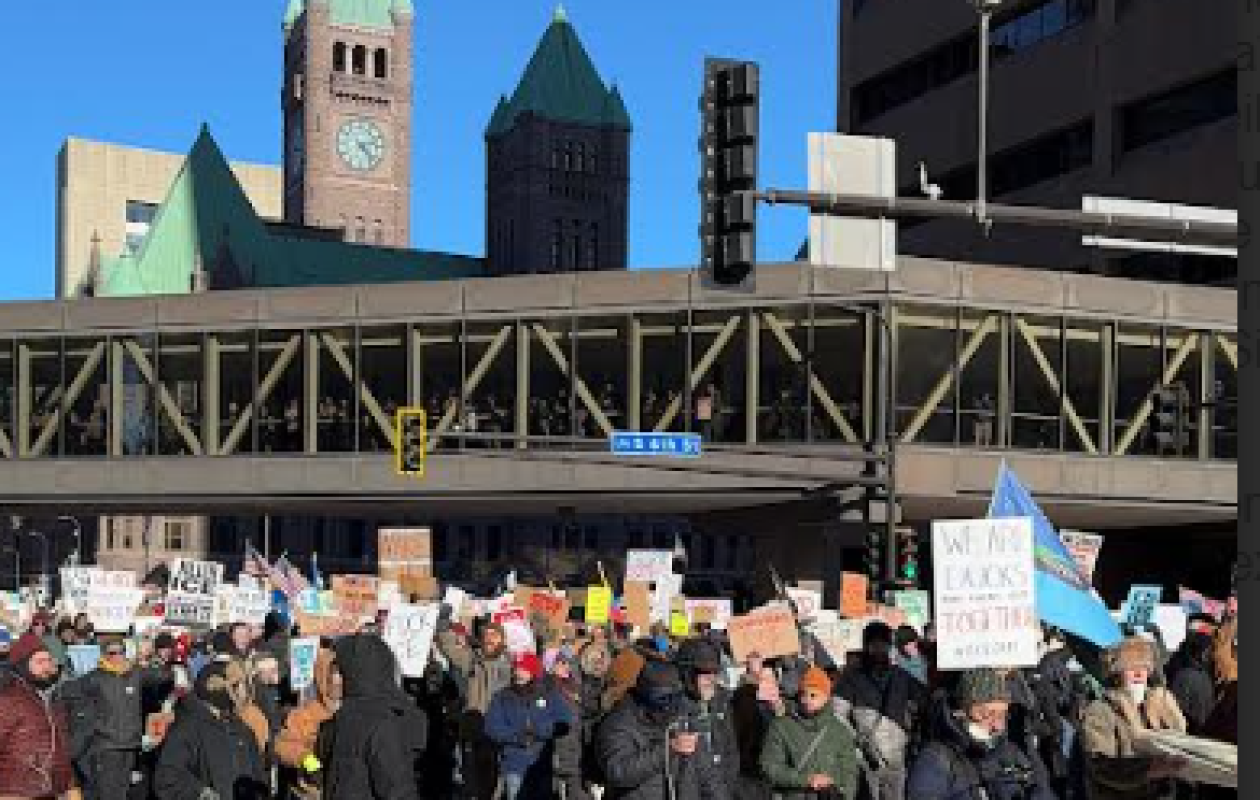
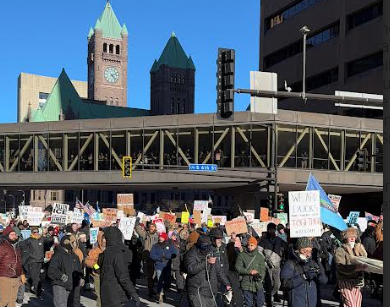
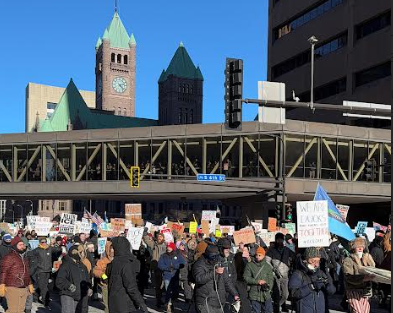
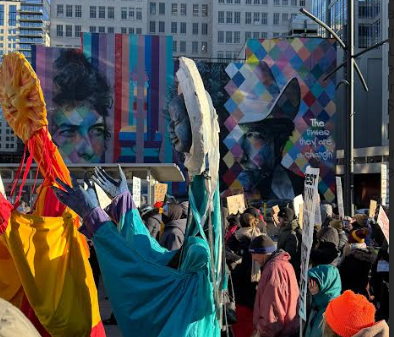
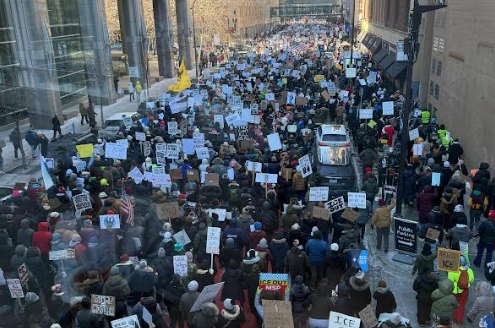
In this “powerful democracy,” showing the truth has become a risk. The mere thought that the police could search my phone and punish me for the content of my messages—if they say anything against the regime—is unbearable. Exasperation is indeed one of the major problems here, coupled with fear; people can no longer tolerate this lack of freedom and the precariousness of their existence. The rally I attended to cover the events of January 30th was impressive, with tens of thousands of people protesting and marching peacefully in the streets despite the freezing temperatures.
Yet, amidst the despair, there is that admiration I mentioned. The community's response—its courage, tenacity, and solidarity—is incredible. They organized genuine resistance groups, using public testimony and mutual aid to protect one another.
“After the 2024 election, many of my neighbors on the block were angry and scared,” Christine Sikorski, a poet and Minneapolis resident, told us. “Our response was to build community: We met regularly, attended protests together, and learned ways to resist the regime.” Police and federal agents don’t like it when people start filming and documenting what’s happening because showing the reality goes against them and their abuses. Censorship is the preferred form of rewriting the narrative. ICE agents drove their SUVs with their faces covered. People are starting to hate them because they follow orders without even seeming to consider how they treat other human beings.
“Minneapolis is experiencing a moment of both tension and deep organizing at the same time. Our community is responding to a heavy federal presence with mutual aid, legal support, documentation, and public testimony,” Adan explained. “People are checking in on families, accompanying seniors to appointments, and showing up on the streets because they feel their basic safety and dignity are being tested.” Minneapolis has historically served as a laboratory for intrusive surveillance, evolving from post-9/11 federal counterterrorism programs targeting Muslim communities to multi-agency surveillance of activists and journalists after the 2020 George Floyd protests. “Many people have learned that in this city, organizing is often met with surveillance before it is met with dialogue,” Adan added. Residents have begun learning strategies to resist the tactics of federal agents. When thousands of ICE agents were deployed, residents who “had already spent months learning to trust each other and work together rallied to employ these strategies to protect our dear neighbors,” explained Ms. Sikorski. That was the most beautiful thing I saw during this shocking trip: the solidarity of people who decide to risk their lives to protect others.
The use of whistles is just one example. When federal agents are in the area, residents start whistling to achieve two different results: telling people of color and immigrants to hide, and telling white Americans to start filming and documenting. It's a prime example of how Americans remain strong and fight together against what they deem unacceptable.

![[EXCLUSIF] Expulsion de la famille Srour : L'accusée Khady Diagne se prononce, documents à l'appui](https://image.seneweb.com/content/news/2026-20-14//thumb_1260x800_6a05cc2715573_a9nMMiStMC.jpg)








Commentaires (1)
Participer à la Discussion
Règles de la communauté :
💡 Astuce : Utilisez des emojis depuis votre téléphone ou le module emoji ci-dessous. Cliquez sur GIF pour ajouter un GIF animé. Collez un lien X/Twitter, TikTok ou Instagram pour l'afficher automatiquement.